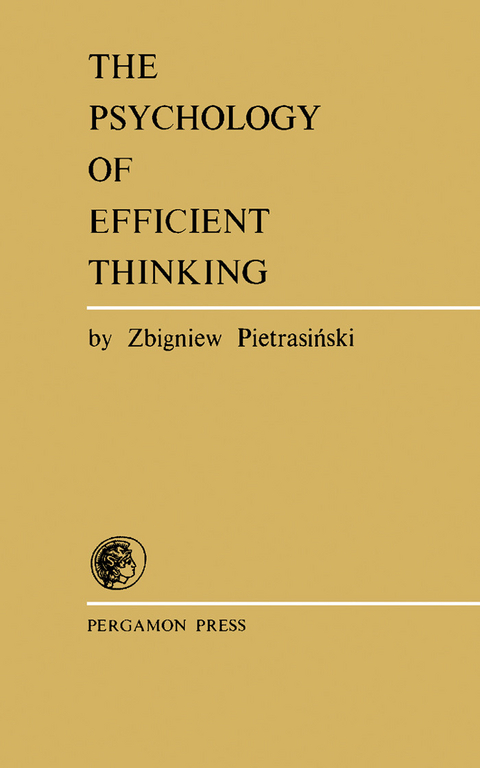
Psychology of Efficient Thinking (eBook)
214 Seiten
Elsevier Science (Verlag)
978-1-4831-5447-3 (ISBN)
The Psychology of Efficient Thinking provides information concerning intellectual abilities and psychological principles of thinking that might be helpful in the solution of more complex problems encountered in the vocational field or in daily living. This book explores the ways and means of increasing the efficiency of thought. Organized into three parts encompassing six chapters, this book begins with an overview of the nature of intellect with special reference to intelligence and mental abilities. This text then examines the general field of mental development. Other chapters consider the application of intellect in such spheres as technical invention, problem solving, and general creativity. This book discusses as well the training of intellect, both by individual effort and at school. The final chapter deals with the continuous engagement in activities requiring thought, which is an essential condition for the improvement of intellectual skill. Psychologists, scientists, and teachers will find this book useful.
Front Cover 1
The Psychology of Efficient Thinking 4
Copyright Page 5
Table of Contents 6
INTRODUCTION 10
PART ONE — THE NATURE OF INTELLECT 12
CHAPTER I. THE INTELLECTUAL ABILITIES 14
THE CONCEPT OF ABILITY 14
THE MEANING OF INTELLIGENCE 17
THE PRIMARY MENTAL ABILITIES 21
MEMORY FACTORS 26
THE INTERNAL STRUCTURE OF MENTAL ABILITIES 29
LEVELS OF INTELLIGENCE 34
THE DETERMINING FACTORS OF MENTAL DEVELOPMENT 50
THE DUAL ORIGIN OF ABILITIES 58
CHAPTER II. THE METHODS OF DEVELOPING MENTAL SKILLS 67
THE CONCEPT OF MENTAL SKILL 67
THE SIGNIFICANCE OF MENTAL ABILITIES 69
THE BASIC FEATURES OF MENTAL SKILL 70
THE OBSTACLES TO AN IMPROVEMENT OF MENTAL CULTURE 75
FINAL COMMENTS 82
PART TWO — THE INTELLECT IN ACTION 84
CHAPTER III. THE PROCESS OF PROBLEM SOLVING 86
THE PRINCIPAL DOMAIN OF THINKING 86
THE SIMPLEST APPROACH TO PROBLEM SOLVING 87
PHASES OF PROBLEM SOLVING 88
THE ART OF IDENTIFYING PROBLEMS 89
MAKING FULL USE OF ALL THE DATA 91
THOUGHT PROCESSES IN PROBLEM SOLVING 92
THE DUAL NATURE OF MODELS 95
CHOOSING THE RIGHT DIRECTION 97
THE POSITIVE AND THE NEGATIVE EFFECTS OF "HABIT" 98
FUNCTIONAL FIXATION 102
FACTORS FACILITATING THE USE OF EXPERIENCE 103
FACTORS IMPAIRING THE USE OF EXPERIENCE 105
EMOTIONAL FACTORS IN PROBLEM SOLVING 108
SCIENTIFIC TECHNIQUES OF PROBLEM SOLVING 108
A PSYCHOLOGICAL STRATEGY OF PROBLEM SOLVING 112
CHAPTER IV. THE PSYCHOLOGY OF CREATIVITY 125
WHAT IS CREATIVITY? 125
IMAGINATION AND THINKING IN CREATIVITY 127
IS CREATIVITY GOVERNED BY ANY RULES? 128
THE PRINCIPAL TYPES OF CREATIVITY 132
THE PSYCHOLOGY OF TECHNICAL INVENTION 133
SOME REMARKS ON THE PROCESS OF SCIENTIFIC CREATION 147
SUBJECTIVE ASPECTS OF CREATIVITY 148
AGE AND CREATIVE ACHIEVEMENT 149
PART THREE —THE TRAINING OF THE INTELLECT 152
CHAPTER V. ON SCHOOL EDUCATION 154
PRESENT SCHOOL PRACTICE 155
SUGGESTIONS FOR THE EFFECTIVE TRAINING OF MENTAL SKILLS 162
FULL-SCALE TRAINING PROGRAMMES FOR THE IMPROVEMENT OF TECHNICAL THINKING 174
OUTDATED SCHOOL PROCEDURES AND SOME PROPOSITIONS 178
CHAPTER VI. WAYS AND MEANS OF INTELLECTUAL IMPROVEMENT 183
THE VALUE OF INTELLIGENCE 184
THE RELATIVE MERITS OF THOUGHT TRANSFER 186
SOME ESSENTIAL OBJECTIVES 189
THE DEVELOPMENT OF EFFICIENCY IN PERCEIVING THE WORLD AROUND US 191
BIBLIOGRAPHY 206
| Erscheint lt. Verlag | 26.1.2016 |
|---|---|
| Sprache | englisch |
| Themenwelt | Geisteswissenschaften ► Psychologie ► Allgemeine Psychologie |
| Geisteswissenschaften ► Psychologie ► Verhaltenstherapie | |
| Naturwissenschaften ► Chemie | |
| ISBN-10 | 1-4831-5447-5 / 1483154475 |
| ISBN-13 | 978-1-4831-5447-3 / 9781483154473 |
| Informationen gemäß Produktsicherheitsverordnung (GPSR) | |
| Haben Sie eine Frage zum Produkt? |
 PDF (Adobe DRM)
Kopierschutz: Adobe-DRM
Adobe-DRM ist ein Kopierschutz, der das eBook vor Mißbrauch schützen soll. Dabei wird das eBook bereits beim Download auf Ihre persönliche Adobe-ID autorisiert. Lesen können Sie das eBook dann nur auf den Geräten, welche ebenfalls auf Ihre Adobe-ID registriert sind.
Details zum Adobe-DRM
Dateiformat: PDF (Portable Document Format)
Mit einem festen Seitenlayout eignet sich die PDF besonders für Fachbücher mit Spalten, Tabellen und Abbildungen. Eine PDF kann auf fast allen Geräten angezeigt werden, ist aber für kleine Displays (Smartphone, eReader) nur eingeschränkt geeignet.
Systemvoraussetzungen:
PC/Mac: Mit einem PC oder Mac können Sie dieses eBook lesen. Sie benötigen eine
eReader: Dieses eBook kann mit (fast) allen eBook-Readern gelesen werden. Mit dem amazon-Kindle ist es aber nicht kompatibel.
Smartphone/Tablet: Egal ob Apple oder Android, dieses eBook können Sie lesen. Sie benötigen eine
Geräteliste und zusätzliche Hinweise
Buying eBooks from abroad
For tax law reasons we can sell eBooks just within Germany and Switzerland. Regrettably we cannot fulfill eBook-orders from other countries.
aus dem Bereich