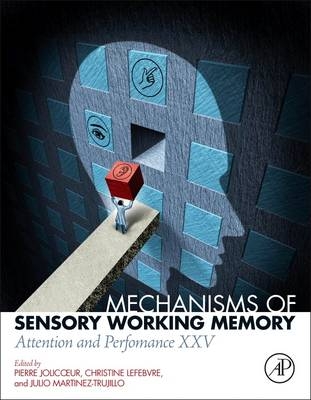
Mechanisms of Sensory Working Memory
Academic Press Inc (Verlag)
978-0-12-801371-7 (ISBN)
- Titel erscheint in neuer Auflage
- Artikel merken

This contemporary focus on sensory memory is just beginning, and this collection of original contributions provides a foundational reference for the study mechanisms of sensory memory.
Students, scholars, and researchers studying memory mechanisms and processes in cognitive neuroscience, cognitive science, neuroscience, and psychology will find this text of great value to their work.
Dr. Pierre Jolicoeur studies complex cognitive systems using EEG, MEG, NIRS, and fMRI. His primary focus is on fundamental mechanisms of attention and working memory in the visual, auditory, and tactile domains and how they mediate performance in single and dual-task situations. By leveraging the exceptional skills and knowledge of extraordinary collaborators, he examines these mechanisms in normal younger and older individuals, and in a number of special populations, including mild cognitive impairment and mild traumatic brain injury. Dr. Jolicoeur is a member of the Royal Society of Canada, and he is a full professor in the department of psychology at Université de Montréal where he holds the Canada Research Chair in experimental cognitive science. Dr. Martinez-Trujillo is an associate professor at the departments of Physiology and Pharmacology and Psychiatry and a scientist at the Robarts Research Institute, Western University, London, Ontario, Canada. He studied Medicine at the University of Havana, Cuba and continued pursuing his medical training in Neurology and Clinical Neurophysiology at the Cuban Neuroscience Center. He continued his scientific training and obtained an MSc and PhD in Neurobiology at the Neurology Department of the University of Tübingen, Germany. He came to Canada in 2000 to pursue postdoctoral training at the Centre for Vision Research, York University, Toronto. In 2004 he became a Canada Research Chair and assistant professor at McGill University Department of Physiology in Montreal, Canada. In 2014 he joined Western University as associate professor and Western Research Chair in Autism. Dr. Martinez-Trujillo’s scientific work is dedicated to investigate the brain mechanisms underlying cognition, more specifically underlying the allocation of attention, and how these mechanisms fail during neurological and mental disease. His work has been published and acknowledged in prestigious scientific journal such as Nature, Nature Neuroscience, Neuron, Current Biology, amongst others.
1. Introduction
2. Sensational Memorability: Working Memory For Things We See, Hear, Feel, Or Somehow Sense
3. The Brain Mechanisms of Working Memory: An evolving story
4. The Contribution of Human Superior Intra-Parietal Sulcus to Visual Short-Term Memory and Perception
5. Neural Bases of the Short-Term Retention of Visual Information
6. Precision,Capacity,Attention and Awareness: The Role of Sensory and Parietal Activity in VSTM
7. Hemispheric organization of visual memory: Analyzing visual working memory with brain measures
8. Visual working memory and attentional object selection
9. Analyzing visual working memory with brain measures
10. Statistical regularities allow multiple feature values to be stored as discrete units
11. Working memory and aging: A review
12. Defining a role for dorsolateral prefrontal cortex in memory-guided decisions about visual motion
13. Working memory representations of visual motion along the primate dorsal visual pathway
14. Neurophysiological Mechanisms of Working Memory: Cortical Specialization & Plasticity
15. Neural and Behavioral Correlates of Auditory Short-term and Recognition Memory
16. Brain activity related to the retention of tones in auditory short-term memory
17. The Interplay between Auditory Attention and Working Memory
18. Neuroimaging of the mind’s ear using representational similarity analysis
19. Remembering touch: Using interference tasks to study tactile and haptic memory
20. Cortical representation of tactile short-term memory in the human brain for stimulation patterns on the hand: Evidence from magnetoencephalography
21. The role of spatial attention in tactile short-term memory
| Verlagsort | San Diego |
|---|---|
| Sprache | englisch |
| Maße | 216 x 276 mm |
| Gewicht | 1090 g |
| Themenwelt | Geisteswissenschaften ► Psychologie ► Allgemeine Psychologie |
| Geisteswissenschaften ► Psychologie ► Biopsychologie / Neurowissenschaften | |
| Geisteswissenschaften ► Psychologie ► Verhaltenstherapie | |
| Medizin / Pharmazie ► Medizinische Fachgebiete ► Neurologie | |
| Naturwissenschaften ► Biologie ► Zoologie | |
| ISBN-10 | 0-12-801371-0 / 0128013710 |
| ISBN-13 | 978-0-12-801371-7 / 9780128013717 |
| Zustand | Neuware |
| Informationen gemäß Produktsicherheitsverordnung (GPSR) | |
| Haben Sie eine Frage zum Produkt? |
aus dem Bereich