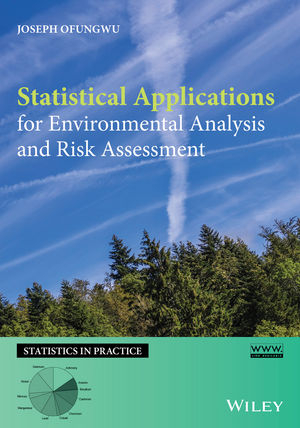
Statistical Applications for Environmental Analysis and Risk Assessment (eBook)
John Wiley & Sons (Verlag)
978-1-118-63451-6 (ISBN)
Statistical Applications for Environmental Analysis and Risk Assessment guides readers through real-world situations and the best statistical methods used to determine the nature and extent of the problem, evaluate the potential human health and ecological risks, and design and implement remedial systems as necessary. Featuring numerous worked examples using actual data and “ready-made” software scripts, Statistical Applications for Environmental Analysis and Risk Assessment also includes:
• Descriptions of basic statistical concepts and principles in an informal style that does not presume prior familiarity with the subject
• Detailed illustrations of statistical applications in the environmental and related water resources fields using real-world data in the contexts that would typically be encountered by practitioners
• Software scripts using the high-powered statistical software system, R, and supplemented by USEPA’s ProUCL and USDOE’s VSP software packages, which are all freely available
• Coverage of frequent data sample issues such as non-detects, outliers, skewness, sustained and cyclical trend that habitually plague environmental data samples
• Clear demonstrations of the crucial, but often overlooked, role of statistics in environmental sampling design and subsequent exposure risk assessment.
Joseph Ofungwu, PhD, is an environmental professional with over eighteen years of hands-on experience in environmental practice, including contaminant impact analysis, human health and ecological risk assessment, pollutant fate and transport modeling in ambient air, soil, ground and surface water. Dr. Ofungwu is also Visiting Assistant Professor with the Urban Environmental Systems Management Program at Pratt Institute and teaches statistics courses for professional engineer license maintenance requirements.
Joseph Ofungwu, PhD, is an environmental professional with over eighteen years of hands-on experience in environmental practice, including contaminant impact analysis, human health and ecological risk assessment, pollutant fate and transport modeling in ambient air, soil, ground and surface water. Dr. Ofungwu is also Visiting Assistant Professor with the Urban Environmental Systems Management Program at Pratt Institute and teaches statistics courses for professional engineer license maintenance requirements.
Chapter 1
Introduction
1.1 Introduction and Overview
Statistics is viewed by many as a branch of mathematics and since math is widely regarded as a difficult subject, people often assume automatically that statistics must be just as difficult. In truth, there is much not to “fear” in statistics, which in some cases involves nothing more complex than elementary arithmetic operations. As proof that statistics is not as “unappetizing” as it might seem, it is one of the few disciplines that find useful applications across a wide variety of professions, including the medical and biomedical, social sciences and psychology, economics, environmental and engineering professions, and so on. The environmental profession is almost completely driven by data, but surprisingly does not seem to have embraced statistics as much as some of the other professions just mentioned. Environmental engineers, geologists, scientists, or other professionals engaged in miscellaneous practice, research, or related activities have to work routinely with data from soil and sediment, surface and groundwater, ambient air, and other environmental media, for a variety of reasons or purposes. Data are collected to investigate or monitor an environmental concern, analyzed, and interpreted to gain insights into the situation, and the findings used to support decisions on response actions or predict future outcomes.
There appears to be a number of possible reasons why the use of statistics is not as widespread among environmental professionals as could have been expected. One reason is that it is largely a regulated profession, and the (government) regulators often “usurp” statistical responsibility for the data analysis. That is, environmental statutes and regulations regarding pollutants typically incorporate numerical standards and requirements that the regulated community is expected to abide by, and those numerical standards and criteria typically incorporate some form of statistical analysis and estimation procedures. Therefore, technically, the environmental professional only has to follow the regulators' guidelines, and not be unduly burdened with performing miscellaneous statistical analyses on his or her data. The problem with this minimalistic approach obviously is that the regulatory standards are necessarily generic (i.e., “one size fits all”), since the regulators cannot possibly have foreknowledge of every conceivable site or circumstance. Usually, the regulations allow for alternate site-specific standards that more realistically reflect the particular site conditions and characteristics if supported by the appropriate statistical analysis, but in practice, many practitioners decline to develop such alternate standards when feasible (see the next paragraph for possible reasons), opting instead to use the generic standards reflexively. As a result, decisions on response actions are often reached that are overly conservative for some sites (e.g., waste of resources for unnecessary cleanup actions), or insufficiently protective for other sites (e.g., chemical exposure risk falsely determined to be within acceptable limits).
A second likely impediment to widespread use of statistics among environmental professionals is that the college curricula for the associated disciplines (environmental engineering, geology, environmental science, etc.) sometimes do not include or emphasize environmental statistics, while standard statistical books are often not sufficiently readable and sufficiently relatable for readers without a mathematics background to fully appreciate. A third related reason is the high cost of high-quality statistical software. Although software cannot substitute for functional familiarity with the basic statistical concepts, access to software does provide a powerful incentive to get more involved and cultivate the habit of subjecting the data to greater analysis. Nothing kills the appetite like trying to perform multiple nonlinear regression by hand! The more affordable software packages are often selective in what tasks they can or cannot perform, which can become quite frustrating. The high-quality commercial software systems that do it all can be prohibitively expensive and difficult to justify, especially by someone who is not even at the level yet to understand what to do with or expect from these high-cost software packages. Fortunately, the advent of the freely available R software system, with its extensive and ever growing range of capabilities, has taken the constraint of software access off the table.
1.2 The Aim of the Book: Get Involved!
Given the above background, the main purpose of this book is to present fundamental statistical principles and procedures, in the context that they are commonly encountered in environmental practice, in simple and unambiguous language. The powerful free software package, R, plays an important supporting role in this regard. As indicated above, manual computation of many statistical tests is impractical due to the level of effort required, and fully functional software is not always affordable. With the easy availability of R, all that is really needed is a good grasp of the basic statistical concepts, as described in this book, and R can help take care of the rest. No excuse to wait any longer! However, although almost unlimited in its functionalities and with an ever growing list of user-contributed packages and procedures, R is not completely without issues. For one, it does not have the point-and-click ease of use that is usually the norm with commercial software, but the good thing is that there are “portable” scripts as provided throughout this book that will readily compute the desired analyses or procedures. The reader only needs to substitute his or her own data for the data used in the worked examples in the book, and document the scripts for future reuse as necessary. Trying to become a certified R expert can indeed be daunting, but taking it in small bite-sized scripts and macros can be surprisingly easy, always keeping in mind that for each function or command that performs a particular task, there are other alternative functions that can perform the same task and even better, with more functions becoming available as R continues to expand. Another potential hurdle is that there is no dedicated technical support service for R, although there are mailing lists and kind souls who usually respond to user requests for assistance out of the goodness of their hearts.
There are obviously other software packages besides R, including freely available as well as commercial packages, and since no software system is necessarily infallible, whenever in doubt, it is prudent to compute the same analysis using more than one software system, if available. For these reasons, alternative software packages besides R that are used for computing the numerous worked examples in this book include the freely available ProUCL, Visual Sample Plan (VSP), and DATAPLOT software packages, as well as the popular and affordable commercial Minitab® (version 16). ProUCL Version 4 has received criticism in the literature for deficiencies in some areas (see Chapter 2), but is still a very useful software package especially for the analysis of data containing nondetects (NDs). Note that Version 5 was recently released and may have addressed many of Version 4's shortcomings. Minitab is a modestly priced, conveniently user-friendly software product that would be suitable for the reader who does not wish to experiment with or depend solely on free software. The objective is not only to provide sufficient software options that the reader is unlikely to be hindered by lack of access to software, but also to heed the conventional wisdom of not putting all our (statistical) eggs in any one basket.
As indicated above, environmental practice is typically subject to regulatory oversight, and regulatory departments usually have access to professional statisticians. Therefore, it is crucial for the environmental professional who wishes to engage in statistical communication with regulatory officials to have full confidence in his or her grasp of at least the basic concepts. It is the intent in this book to provide the necessary level of detail and illustration to foster that confidence.
A related objective of the book is to draw attention to the critical but often overlooked role of statistics in human health and ecological risk assessment. The book is divided into four parts and the last part (Part IV) links the various statistical techniques and procedures of the preceding parts to the ultimate objective of assessing contaminant exposure risk. It is often the case that the analyst is performing a great many statistical tests and procedures, but not always keeping in focus the end purpose of all the analyses. Why are we comparing populations, the background and the site, or interested in the true mean concentration of a contaminant, or exploring contaminant trends and patterns? The exposure point concentration (EPC), which is the concentration of the contaminant or chemical that is assumed to contact the human or ecological receptor, is probably the most important exposure factor driving the risk assessment, and determination of the EPC is mainly a statistical task.
The bulk of environmental practice revolves around contaminant data collection and analysis, for the purpose of determining whether the contaminants pose unacceptable public health or ecological risks warranting corrective action, or if the exposure risks are minimal. Unfortunately, in many cases, risk assessors are toxicologists by profession and...
| Erscheint lt. Verlag | 6.5.2014 |
|---|---|
| Reihe/Serie | Statistics in Practice |
| Statistics in Practice | Statistics in Practice |
| Sprache | englisch |
| Themenwelt | Mathematik / Informatik ► Mathematik ► Statistik |
| Mathematik / Informatik ► Mathematik ► Wahrscheinlichkeit / Kombinatorik | |
| Naturwissenschaften ► Biologie ► Ökologie / Naturschutz | |
| Sozialwissenschaften ► Soziologie ► Empirische Sozialforschung | |
| Technik | |
| Schlagworte | Angewandte Wahrscheinlichkeitsrechnung u. Statistik • Applied Probability & Statistics • earth sciences • Environmental Geoscience • Environmental Statistics & Environmetrics • Geowissenschaften • <p>bounded influence regression, boxplots for nondetects, categorical data regression, central tendency exposure, confidence band around trend line, contaminant of concern, data quality objectives, Dataplot, environmental sample size determination, environmental statistics, exposure point concentration, generalized linear model, geostatistics in sampling design, human health risk assessment, Kaplan-Meier estimation, Monte Carlo risk simulation, nondetects and reporting limits, nonlinear regression, point ri • Statistics • Statistik • Umweltgeowissenschaften • Umweltstatistik u. Environmetrics |
| ISBN-10 | 1-118-63451-9 / 1118634519 |
| ISBN-13 | 978-1-118-63451-6 / 9781118634516 |
| Informationen gemäß Produktsicherheitsverordnung (GPSR) | |
| Haben Sie eine Frage zum Produkt? |
 PDF (Adobe DRM)
Größe: 16,4 MB
Kopierschutz: Adobe-DRM
Adobe-DRM ist ein Kopierschutz, der das eBook vor Mißbrauch schützen soll. Dabei wird das eBook bereits beim Download auf Ihre persönliche Adobe-ID autorisiert. Lesen können Sie das eBook dann nur auf den Geräten, welche ebenfalls auf Ihre Adobe-ID registriert sind.
Details zum Adobe-DRM
Dateiformat: PDF (Portable Document Format)
Mit einem festen Seitenlayout eignet sich die PDF besonders für Fachbücher mit Spalten, Tabellen und Abbildungen. Eine PDF kann auf fast allen Geräten angezeigt werden, ist aber für kleine Displays (Smartphone, eReader) nur eingeschränkt geeignet.
Systemvoraussetzungen:
PC/Mac: Mit einem PC oder Mac können Sie dieses eBook lesen. Sie benötigen eine
eReader: Dieses eBook kann mit (fast) allen eBook-Readern gelesen werden. Mit dem amazon-Kindle ist es aber nicht kompatibel.
Smartphone/Tablet: Egal ob Apple oder Android, dieses eBook können Sie lesen. Sie benötigen eine
Geräteliste und zusätzliche Hinweise
Zusätzliches Feature: Online Lesen
Dieses eBook können Sie zusätzlich zum Download auch online im Webbrowser lesen.
Buying eBooks from abroad
For tax law reasons we can sell eBooks just within Germany and Switzerland. Regrettably we cannot fulfill eBook-orders from other countries.
 EPUB (Adobe DRM)
Kopierschutz: Adobe-DRM
Adobe-DRM ist ein Kopierschutz, der das eBook vor Mißbrauch schützen soll. Dabei wird das eBook bereits beim Download auf Ihre persönliche Adobe-ID autorisiert. Lesen können Sie das eBook dann nur auf den Geräten, welche ebenfalls auf Ihre Adobe-ID registriert sind.
Details zum Adobe-DRM
Dateiformat: EPUB (Electronic Publication)
EPUB ist ein offener Standard für eBooks und eignet sich besonders zur Darstellung von Belletristik und Sachbüchern. Der Fließtext wird dynamisch an die Display- und Schriftgröße angepasst. Auch für mobile Lesegeräte ist EPUB daher gut geeignet.
Systemvoraussetzungen:
PC/Mac: Mit einem PC oder Mac können Sie dieses eBook lesen. Sie benötigen eine
eReader: Dieses eBook kann mit (fast) allen eBook-Readern gelesen werden. Mit dem amazon-Kindle ist es aber nicht kompatibel.
Smartphone/Tablet: Egal ob Apple oder Android, dieses eBook können Sie lesen. Sie benötigen eine
Geräteliste und zusätzliche Hinweise
Buying eBooks from abroad
For tax law reasons we can sell eBooks just within Germany and Switzerland. Regrettably we cannot fulfill eBook-orders from other countries.
aus dem Bereich