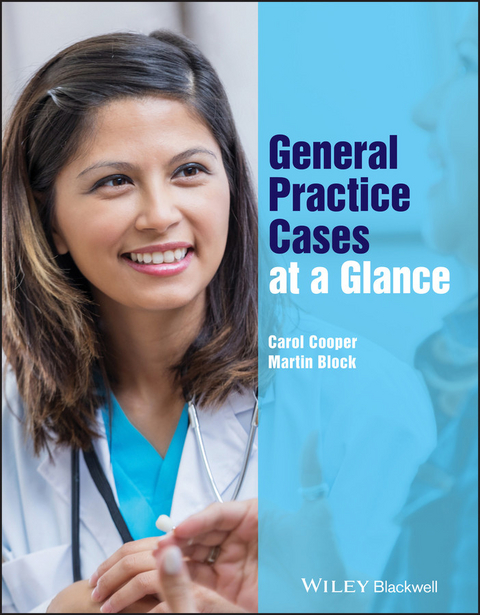
General Practice Cases at a Glance (eBook)
John Wiley & Sons (Verlag)
978-1-119-04382-9 (ISBN)
General Practice Cases at a Glance is a workbook of clinical scenarios, ideal for those working in general practice, on their GP rotations, or looking to improve their history-taking, diagnostic and management planning skills. Written by practising teaching GPs, it provides an accessible overview of the richness and complexity of general practice.
With 50 engaging consultations, covering all age ranges and a broad spread of clinical areas, each symptom-based chapter begins with the clinical presentation of a patient, before going on to uncover the full history and examination. As you work through each true-to-life case, there are red flag symptoms, useful charts and tables, and further resources to deepen your knowledge.
General Practice Cases at a Glance:
- Is suitable for clinical students, Foundation doctors, and those preparing for the MRCGP's CSA
- Includes 50 case scenarios from across the medical spectrum, from mental health and paediatrics to musculoskeletal and ENT medicine
- Is comprehensively illustrated
- Features current clinical guidelines, and charts and tables to accompany each case
- Is the companion volume to General Practice at a Glance, ISBN 978-0-470-65551-1, (Awarded First Prize in the Primary health care category at the 2013 BMA Medical Book Awards) but is also a stand-alone resource
Carol Cooper is an Honorary Teaching Fellow within the Department of Primary Care and Public Health, Imperial College London, UK. She is also a General Practitioner.
Martin Block is Programme Director, Imperial GP Specialty Training and GP Partner at Clapham Park Group Practice, London, UK.
Carol Cooper is an Honorary Teaching Fellow within the Department of Primary Care and Public Health, Imperial College London, UK. She is also a General Practitioner. Martin Block is Programme Director, Imperial GP Specialty Training and GP Partner at Clapham Park Group Practice, London, UK.
Preface vii
Part 1 Introduction 1
1 The consultation 2
2 Clinical reasoning to reach a diagnosis 4
Part 2 Cases 7
1 My baby is burning up 8
2 I need something for hay fever 10
3 I can't seem to shift this cough 12
4 My knee is very bad 14
5 I have migraine 16
6 I've come for my flu jab 18
7 He's a little terror 20
8 I've got a problem with my shoulder 22
9 I can't believe how much weight I've put on 24
10 It's my back passage 26
11 I am pregnant again 28
12 My baby has an upset tummy 30
13 My ear really hurts 32
14 I'm worried about my drinking 33
15 She cries all the time 34
16 I need something to help me sleep 36
17 My eye hurts 38
18 I think I should get this prostate test, doctor 40
19 I can't live with this pain much longer 41
20 I've got a red eye 44
21 I'm fed up with my spots 46
22 I've come for the results of my blood tests 48
23 I'd like to talk to you about HRT 50
24 I've got a bit of a discharge 52
25 I'm feeling tired and woozy 54
26 I think I need to get my blood pressure checked 56
27 Well, I'm pregnant 58
28 I've been feeling short of breath 60
29 She's coughing non-stop 62
30 I'm worried about my memory 64
31 I've got this pain in my chest, doctor 66
32 I've been having terrible stomach cramps 68
33 I'm concerned this mole has been growing 70
34 I seem to have lost weight 72
35 I'm worried about my erection 74
36 I think the cancer has got me 76
37 I'm all over the place these days 78
38 She's had tummy ache for two days 80
39 I don't want to have my period when I am on holiday 82
40 It's my leg 84
41 I'm having terrible diarrhoea 86
42 The nurse did my diabetes check last week. I'm here for the results 88
43 My skin is really itchy 90
44 Doctor, I'm just feeling really down 92
45 I've got a really bad burning in my stomach 93
46 I want to talk about my risk of breast cancer 94
47 I've got a terrible back ache 96
48 I'd like antibiotics please 98
49 I'm tired all the time 100
50 I'm worried about this lump, doctor 102
List of abbreviations 105
Index of cases by speciality 106
Index 107
"The more clinical cases one studies, the better the critical skills one develops in learning how to approach the numerous complaints one may encounter, along with developing the understanding that there can be many presentations of a common diagnosis. This books adds a number of cases to help this development." (Doody Enterprises 2016)
CASE 2
I need something for hay fever
Clare Davey, age 20 years
Student
PMH: constipation; anxiety; hay fever
Medication: lactulose
Clare Davey is a history student whose last two consultations were for constipation. Three months ago, one of your colleagues prescribed ispaghula husk. This did not help, so she returned to see another doctor. He noted she looked thin, and prescribed lactulose.
Today she wants something for hay fever that won’t make her drowsy during exams. She has tried loratadine and cetirizine over the counter, but they do not help much, and she finds chlorphenamine too sedating. Her main symptoms are sneezing and runny nose. You therefore hope that a prescription of a steroid nasal spray will send her on her way, leaving you to catch up on lost time.
You ask briefly about her constipation and she says, ‘I’ve got used to it.’ You’ve never seen her before but you can’t help noticing she looks thin, especially around the shoulders, even through a thick jumper. There is no record of her weight on the system.
What are your thoughts?
- She may be naturally slim.
- She may have an eating disorder, in which case it’s your duty to assess her and initiate treatment.
- She may have lost weight unintentionally, which is your duty to investigate.
What three or four initial questions could you ask to sort out these three possibilities?
- ‘How’s your general health?’
- ‘Has your weight changed over the last few months?’
- ‘What are your periods like?’ Amenorrhoea is common in anorexia nervosa, as well as bulimia even when the weight is normal.
- ‘Do you feel the cold?’ This isn’t specific to eating disorders but can help distinguish hyperthyroidism (prefers the cold) from anorexia (often feels cold).
Clare says her general health is absolutely fine, but admits she’s missed two periods. She can’t possibly be pregnant, she adds, because she broke up with her boyfriend nearly a year ago and there’s been nobody else. Her weight ‘hasn’t really changed’. She does feel the cold, but she just puts on extra layers. Today the sleeves of her jumper cover most of her hands.
You weigh her as this hasn’t been done for quite a while according to the notes. She is 47 kg. At 5’6” (about 1.68 m) tall, her BMI is 16.6, low enough for anorexia nervosa (use centile charts for patients under 18).
You consider a pregnancy test in case what she’s told you about timing is incorrect, but from Clare’s weight and her responses so far you put an eating disorder at the top of your list.
key point
According to NICE guidance on eating disorders, GPs should take the responsibility for the person’s initial assessment and coordination of care.
Main types of eating disorders
- It’s estimated that at least 6% of the population has an eating disorder.
- Eating disorders often start in the teens and are more common in women.
- But they can occur at almost any age, e.g. children as young as six years.
- Around a quarter are men.
- Anorexia nervosa (about 0.6% population): low body weight due to preoccupation with weight and diet.
- Bulimia nervosa (two to four times as common): episodes of binge eating and weight-loss behaviour (vomiting, fasting, excessive exercise). Weight is often normal.
- Binge-eating disorder (the most common of all): recurrent persistent episodes of binge eating, at least three times a week, without compensatory weight loss behaviour. Weight may be normal or high.
The diagnosis of ‘atypical eating disorder’ is sometimes still used when features don’t fit any of the three main categories.
Of these eating disorders, anorexia seems the most likely diagnosis here.
What could you now ask to confirm this?
Your challenge is to tease out a fuller history, without losing your patient’s trust, appearing judgmental, or antagonizing her. Remember she’s likely to have already been interrogated or judged by her family and friends.
The SCOFF questionnaire can help in the diagnosis of eating disorders:
- Have you ever felt so uncomfortably full that you have had to make yourself Sick?
- Do you worry that you have ever lost Control over what you eat?
- Have you gained or lost more than One stone over a three-month period?
- Do you believe yourself to be Fat when others think you’re thin?
- Would you say that Food dominates your life?
A positive answer to two or more questions suggests anorexia or bulimia.
However, direct questioning such as this can be difficult so you may do better with a gentler start:
- ‘Tell me how things are at the moment.’ She might reveal sources of stress at home or at college.
- ‘Tell me about your weight’ and ‘What would be your ideal weight?’
- ‘Have you dieted or tried anything else to lose weight?’ followed up by ‘I realize that some people turn to various tablets…’ Find out if she eats with others (those with eating disorders often eat alone). Also ask about exercise and whether she goes to the gym.
- Ask about possible complications of eating disorders, e.g. dry skin, body hair, tiredness from anaemia, fainting spells, dental problems if vomiting.
- ‘Tell me about your mood day-to-day.’ This may reveal depression, or sources of stress, especially if you allow plenty of time for the answer.
- ‘Have there been any illnesses in the family?’ Sometimes there’s a family history of mental illness, of anorexia or gross obesity.
Clare tells you that she has always felt fat and that her mother is very slim. She doesn’t know what her ideal weight might be. She has tried laxatives but not diuretics or illicit drugs. She does not exercise regularly. All her time is taken up by her studies, and she wants to do well. She says she makes ‘lots of healthy food’ and eats mostly alone. She admits she may now have lost a bit too much weight. Her mood is ‘fine’ but she is worried about impending exams.
You now examine Clare. Apart from her weight, which you already checked, what are you looking for? Write down at least four things.
- Pulse and BP. There may be bradycardia or postural hypotension.
- Temperature. There can be hypothermia.
- Circulation. Acrocyanosis is common. Sometimes there’s oedema, and in rare cases there can be gangrenous digits.
- Test muscle power. Doing a sit-up and getting up from a squatting position are both useful tests.
Her temperature, pulse and BP are normal. Her fingers are a bit cold. She can get up from a squatting position without using her arms, except to balance.
What do you do now?
The absence of physical findings does not mean you can ignore her eating disorder. First, you could discuss your concerns about her weight, then ask if she has considered this may be anorexia. This may enable you to get agreement that she’d benefit from help before things get out of hand.
Figure 2.1 Complications of anorexia nervosa.
Meanwhile, you want to do a few simple tests, if that’s OK with her.
Clare readily agrees, mainly because, as she admits, she has less energy than she did, and can’t study half the night as she used to.
What investigations do you consider?
- FBC, U&Es and creatinine. LFTs and albumin. Glucose.
- Consider an ECG, especially if BMI is under 15, or there is bradycardia.
All Clare’s results come back normal. This is the case in most people with eating disorders. It’s mildly reassuring, because it suggests her health is not currently at high risk.
CKS/NICE has a guide to determine who is most at risk. Low BMI, postural hypotension, bradycardia, poor muscle strength and abnormal blood tests are all significant. Some people need admission.
Tip
Remember anorexia nervosa is the most deadly of all mental health conditions.
Consider admission to hospital for any of the following
- Risk of suicide or severe self-harm (needs admission to acute psychiatry, not eating disorders unit).
- Home situation hinders recovery.
- Severe deterioration (may require admission to acute medical ward).
- Very low body weight (refer urgently if BMI <15).
- Medical complications (e.g. severe electrolyte disturbance, hypoglycaemia or severe intercurrent infection).
If considering compulsory admission (whatever your patient’s age), get specialist advice.
See Resources for details.
For everyone else, referral to the Community Mental Health Team...
| Erscheint lt. Verlag | 29.4.2016 |
|---|---|
| Reihe/Serie | At a Glance |
| At a Glance | At a Glance |
| Sprache | englisch |
| Themenwelt | Medizin / Pharmazie ► Allgemeines / Lexika |
| Medizin / Pharmazie ► Medizinische Fachgebiete | |
| Medizin / Pharmazie ► Studium | |
| Schlagworte | Allgemeine u. Innere Medizin • Allgemeinmedizin • Allgemeinpraxis, hausärztliche Praxis • Allgemeinpraxis, hausärztliche Praxis • Clinical • Clinical Skills • Consultation • General & Internal Medicine • General Practice/Family Practice • GP • Klinische Fertigkeiten • <p>General practice • Medical Science • medical student • medication</p> • Medizin • Rotation • scenario • Symptom |
| ISBN-10 | 1-119-04382-4 / 1119043824 |
| ISBN-13 | 978-1-119-04382-9 / 9781119043829 |
| Informationen gemäß Produktsicherheitsverordnung (GPSR) | |
| Haben Sie eine Frage zum Produkt? |
 EPUB (Adobe DRM)
Kopierschutz: Adobe-DRM
Adobe-DRM ist ein Kopierschutz, der das eBook vor Mißbrauch schützen soll. Dabei wird das eBook bereits beim Download auf Ihre persönliche Adobe-ID autorisiert. Lesen können Sie das eBook dann nur auf den Geräten, welche ebenfalls auf Ihre Adobe-ID registriert sind.
Details zum Adobe-DRM
Dateiformat: EPUB (Electronic Publication)
EPUB ist ein offener Standard für eBooks und eignet sich besonders zur Darstellung von Belletristik und Sachbüchern. Der Fließtext wird dynamisch an die Display- und Schriftgröße angepasst. Auch für mobile Lesegeräte ist EPUB daher gut geeignet.
Systemvoraussetzungen:
PC/Mac: Mit einem PC oder Mac können Sie dieses eBook lesen. Sie benötigen eine
eReader: Dieses eBook kann mit (fast) allen eBook-Readern gelesen werden. Mit dem amazon-Kindle ist es aber nicht kompatibel.
Smartphone/Tablet: Egal ob Apple oder Android, dieses eBook können Sie lesen. Sie benötigen eine
Geräteliste und zusätzliche Hinweise
Buying eBooks from abroad
For tax law reasons we can sell eBooks just within Germany and Switzerland. Regrettably we cannot fulfill eBook-orders from other countries.
aus dem Bereich