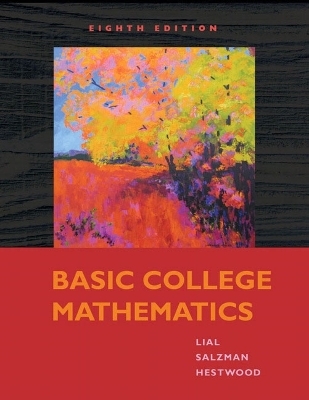
Basic College Mathematics
Pearson (Verlag)
978-0-321-55712-4 (ISBN)
- Titel erscheint in neuer Auflage
- Artikel merken

Marge Lial was always interested in math; it was her favorite subject in the first grade! Marge's intense desire to educate both her students and herself has inspired the writing of numerous best-selling textbooks. Marge, who received Bachelor's and Master's degrees from California State University at Sacramento, is affiliated with American River College. Marge is an avid reader and traveler. Her travel experiences often find their way into her books as applications, exercise sets, and feature sets. She is particularly interested in archeology. Trips to various digs and ruin sites have produced some fascinating problems for her textbooks involving such topics as the building of Mayan pyramids and the acoustics of ancient ball courts in the Yucatan. When John Hornsby enrolled as an undergraduate at Louisiana State University, he was uncertain whether he wanted to study mathematics education or journalism. His ultimate decision was to become a teacher, but after twenty-five years of teaching at the high school and university levels and fifteen years of writing mathematics textbooks, both of his goals have been realized. His love for both teaching and for mathematics is evident in his passion for working with students and fellow teachers as well. His specific professional interests are recreational mathematics, mathematics history, and incorporating graphing calculators into the curriculum. John's personal life is busy as he devotes time to his family (wife Gwen, and sons Chris, Jack, and Josh). He has been a rabid baseball fan all of his life. John's other hobbies include numismatics (the study of coins) and record collecting. He loves the music of the 1960s and has an extensive collection of the recorded works of Frankie Valli and the Four Seasons. A native Midwesterner,Terry McGinnis received her Bachelor’s of Science in Elementary Education with a concentration in Mathematics from Iowa State University. She has taught elementary and middle school mathematics, and developed and implemented the curriculum used with her students. Terry has been involved in college mathematics publishing for over 20 years, working with a variety of authors on textbooks in developmental mathematics and precalculus. After working behind the scenes on many of the Lial/Hornsby textbooks and supplements for over 10 years, Terry joined Margaret Lial and John Hornsby in 2002 as coauthor of their developmental mathematics series that includes Introductory Algebra, Intermediate Algebra, and Introductory and Intermediate Algebra. When not working, Terry enjoys spinning at a local health club, walking, and reading fiction. She is the devoted mother of two sons, Andrew and Tyler.
Each chapter ends with a Summary, Review Exercises, and a Chapter Test. Beginning with Chapter 2, each chapter also ends with a Cumulative Review.
1. Whole Numbers
1.1 Reading and Writing Whole Numbers
Study Skills: Your Brain Can Learn Mathematics
Study Skills: Using Your Textbook
1.2 Adding Whole Numbers
1.3 Subtracting Whole Numbers
1.4 Multiplying Whole Numbers
1.5 Dividing Whole Numbers
1.6 Long Division
Summary Exercises on Whole Numbers
1.7 Rounding Whole Numbers
1.8 Exponents, Roots, and Order of Operations
Study Skills: Taking Lecture Notes
1.9 Reading Pictographs, Bar Graphs, and Line Graphs
1.10 Solving Application Problems
2. Multiplying and Dividing Fractions
2.1 Basics of Fractions
Study Skills: Homework: How, Why, When
2.2 Mixed Numbers
2.3 Factors
2.4 Writing a Fraction in Lowest Terms
Study Skills: Using Study Cards: Part I
Summary Exercises on Fractions
2.5 Multiplying Fractions
2.6 Applications of Multiplication
2.7 Dividing Fractions
2.8 Multiplying and Dividing Mixed Numbers
Study Skills: Using Study Cards: Part II
Study Skills: Reviewing a Chapter
Study Skills: Preparing for Tests
3. Adding and Subtracting Fractions
3.1 Adding and Subtracting Like Fractions
Study Skills: Managing Your Time
3.2 Least Common Multiples
3.3 Adding and Subtracting Unlike Fractions
Study Skills: Making a Mind Map
3.4 Adding and Subtracting Mixed Numbers
3.5 Order Relations and the Order of Operations
Summary Exercises on Fractions
Study Skills: Taking Tests
4. Decimals
4.1 Reading and Writing Decimals
4.2 Rounding Decimals
4.3 Adding and Subtracting Decimals
4.4 Multiplying Decimals
Summary Exercises on Decimals
4.5 Dividing Decimals
4.6 Writing Fractions as Decimals
Study Skills: Analyzing Your Test Results
5. Ratio and Proportion
5.1 Ratios
5.2 Rates
5.3 Proportions
5.4 Solving Proportions
Summary Exercises on Ratios, Rates, and Proportions
5.5 Solving Application Problems with Proportions
6. Percent
6.1 Basics of Percent
6.2 Percents and Fractions
6.3 Using the Percent Proportion and Identifying the Components in a Percent Problem
6.4 Using Proportions to Solve Percent Problems
6.5 Using the Percent Equation
Summary Exercises on Percent
6.6 Solving Application Problems with Percent
6.7 Simple Interest
6.8 Compound Interest
Study Skills: Preparing for a Final Exam
7. Measurement
7.1 Problem Solving with U.S. Customary Measurement
7.2 The Metric System-Length
7.3 The Metric System-Capacity and Weight (Mass)
Summary Exercises on U.S. Customary and Metric Units
7.4 Problem Solving with Metric Measurement
7.5 Metric-U.S. Customary Conversions and Temperature
8. Geometry
8.1 Basic Geometric Terms
8.2 Angles and Their Relationships
8.3 Rectangles and Squares
8.4 Parallelograms and Trapezoids
8.5 Triangles
8.6 Circles
Summary Exercises on Perimeter, Circumference, and Area
8.7 Volume
8.8 Pythagorean Theorem
8.9 Similar Triangles
9. Basic Algebra
9.1 Signed Numbers
9.2 Adding and Subtracting Signed Numbers
9.3 Multiplying and Dividing Signed Numbers
9.4 Order of Operations
Summary Exercises on Operations with Signed Numbers
9.5 Evaluating Expressions and Formulas
9.6 Solving Equations
9.7 Solving Equations with Several Steps
9.8 Using Equations to Solve Application Problems
10. Statistics
10.1 Circle Graphs
10.2 Bar Graphs and Line Graphs
Summary Exercises on Graphs
10.3 Frequency Distributions and Histograms
10.4 Mean, Median, and Mode
Appendix: Inductive and Deductive Reasoning
Answers to Selected Exercises
Solutions to Selected Exercises
Index
| Erscheint lt. Verlag | 11.3.2009 |
|---|---|
| Sprache | englisch |
| Maße | 216 x 276 mm |
| Gewicht | 1578 g |
| Themenwelt | Mathematik / Informatik ► Mathematik |
| ISBN-10 | 0-321-55712-3 / 0321557123 |
| ISBN-13 | 978-0-321-55712-4 / 9780321557124 |
| Zustand | Neuware |
| Informationen gemäß Produktsicherheitsverordnung (GPSR) | |
| Haben Sie eine Frage zum Produkt? |
aus dem Bereich