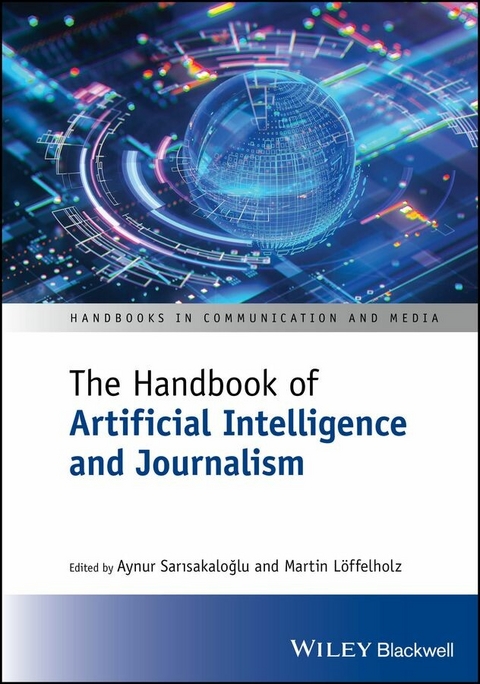
Handbook of Artificial Intelligence and Journalism (eBook)
968 Seiten
Wiley (Verlag)
978-1-394-25040-0 (ISBN)
Presents a comprehensive global overview of AI-driven journalism and its transformative impact on media practices
As artificial intelligence (AI) continues to reshape the media landscape, The Handbook of Artificial Intelligence and Journalism provides the first comprehensive academic exploration of the intersection between AI technologies and journalism. Edited by Aynur Sarisakaloglu and Martin Löffelholz, this foundational volume brings together 37 leading scholars from six continents to examine how AI is redefining the structures, practices, and epistemologies of journalism.
Organized around key thematic areas, the Handbook investigates the driving forces propelling the algorithmic transformation and unveils emerging trends in journalistic practice and journalism research, moving beyond Western-centric perspectives to incorporate diverse global experiences and knowledge production. Twenty-eight original chapters address systemic shifts such as evolving structures of media organizations, changing roles of actors, transformations in news production routines, and shifting patterns of news consumption. By integrating theoretical, empirical, and practical perspectives, the Handbook sets the stage for a new research agenda for understanding AI-driven journalism on a global scale.
Containing rigorous interdisciplinary scholarship and broad geographical coverage, The Handbook of Artificial Intelligence and Journalism:
- Integrates theoretical foundations, empirical studies, and practical applications in a cohesive structure
- Offers insights into journalism practices across a wide range of geographical contexts and engages with approaches that transcends Western-dominated paradigms, incorporating perspectives from the Global South
- Employs interdisciplinary frameworks to enhance the understanding of AI-driven journalism
- Examines the sociotechnical dynamics of AI, including its potential benefits and challenges for journalism
- Presents forward-looking reflections on the future of journalism research in the AI era
The Handbook of Artificial Intelligence and Journalism is ideal for undergraduate, graduate, and doctoral students in journalism, communication, and media studies programs. It also serves as a vital reference for researchers, educators, media professionals, and policy advisors engaged in digital journalism, journalism research, media innovation, and public communication.
Dr. habil. Aynur Sar?sakalo?lu is a researcher and lecturer at Technische Universität Ilmenau, Germany. Her research focuses on the transformation of journalism through Artificial Intelligence and automation systems, with a particular interest in sociotechnical developments and interdisciplinary frameworks in media and communication studies.
Dr. Martin Löffelholz is Professor of Media Studies at Technische Universität Ilmenau, Germany, and former President of the Swiss German University in Indonesia. He has led numerous research projects and authored or edited 23 books and more than 400 scholarly contributions on communication and journalism.
Presents a comprehensive global overview of AI-driven journalism and its transformative impact on media practices As artificial intelligence (AI) continues to reshape the media landscape, The Handbook of Artificial Intelligence and Journalism provides the first comprehensive academic exploration of the intersection between AI technologies and journalism. Edited by Aynur Sarisakaloglu and Martin L ffelholz, this foundational volume brings together 37 leading scholars from six continents to examine how AI is redefining the structures, practices, and epistemologies of journalism. Organized around key thematic areas, the Handbook investigates the driving forces propelling the algorithmic transformation and unveils emerging trends in journalistic practice and journalism research, moving beyond Western-centric perspectives to incorporate diverse global experiences and knowledge production. Twenty-eight original chapters address systemic shifts such as evolving structures of media organizations, changing roles of actors, transformations in news production routines, and shifting patterns of news consumption. By integrating theoretical, empirical, and practical perspectives, the Handbook sets the stage for a new research agenda for understanding AI-driven journalism on a global scale. Containing rigorous interdisciplinary scholarship and broad geographical coverage, The Handbook of Artificial Intelligence and Journalism: Integrates theoretical foundations, empirical studies, and practical applications in a cohesive structure Offers insights into journalism practices across a wide range of geographical contexts and engages with approaches that transcends Western-dominated paradigms, incorporating perspectives from the Global South Employs interdisciplinary frameworks to enhance the understanding of AI-driven journalism Examines the sociotechnical dynamics of AI, including its potential benefits and challenges for journalism Presents forward-looking reflections on the future of journalism research in the AI era The Handbook of Artificial Intelligence and Journalism is ideal for undergraduate, graduate, and doctoral students in journalism, communication, and media studies programs. It also serves as a vital reference for researchers, educators, media professionals, and policy advisors engaged in digital journalism, journalism research, media innovation, and public communication.
Notes on Contributors
Justito Adiprasetio is a PhD student in the sociology of knowledge at the University of Auckland and a lecturer at the Faculty of Communication Science, Universitas Padjadjaran. His research interests encompass communication and history, popular culture, and contemporary journalism. He contributed to research funded by WhatsApp in 2019 on misinformation and elections in Indonesia and by the Alliance of Independent Journalists in 2023 on fact‐checking in Indonesia. His publications include journal articles on journalism and the book Komunikasi dan Kuasa (Communication and Power), which explores the history of communication science in Indonesia.
Laura Amigo is a postdoctoral researcher in digital journalism at the Institute of Media and Journalism (IMeG) at the Università della Svizzera italiana, Switzerland. She also teaches communications in the InfoCom Department of the University of Lille, France. She earned her doctorate in journalism and communications from the University of Neuchâtel, Switzerland. Her research interests include the digital transformation of the news media ecosystem and its social implications, relationships between media and audiences, and participatory forms of journalism. She has collaborated in national and international research projects that address these topics, which were funded by the Swiss National Science Foundation, the French National Research Agency, and the European Union’s Horizon Europe program.
Mariella Bastian is a research fellow at the Erich Brost Institute for International Journalism at Technische Universität Dortmund, Germany, and a senior project leader at the communication agency smart media solutions GmbH in Menden, Germany. As a postdoctoral researcher at the Institute for Information Law, University of Amsterdam, her research mainly focused on algorithmic news personalization and journalistic values. Her research interests and lecturing activities include, among others, journalistic ethics, media accountability, Latin American media systems, and international journalism studies. She has also studied the intersection of media and democratic systems. She holds a PhD and an MA degree from TU Dortmund University, Germany.
Nicole Blanchett is an associate professor in the School of Journalism at Toronto Metropolitan University. She holds a BA in journalism and an MA in professional communications. Her PhD research focused on the impact of audience data on newsrooms in three different countries. She has published multiple works examining algorithms and artificial intelligence in journalism, including papers in Journalism Practice and Digital Journalism and a chapter in The Algorithmic Distribution of News. She is the principal investigator of the Canadian Journalistic Role Performance project and a project leader and steering committee member of the Exploratory Journalism project, funded by the Social Sciences and Humanities Research Council. She is also on the editorial board of the Local News Data Hub. She previously worked as a television news writer/producer.
Regina Cazzamatta is a postdoctoral researcher and lecturer in the Department of Media and Communication Studies at the University of Erfurt. She leads a comparative research project funded by the German Research Council (DFG) entitled Disinformation Context and the Emergence of Fact‐Checking Organizations in Europe and Latin America. She holds a PhD in Media and Communication Studies from the University of Erfurt and was a visiting researcher at the German Institute of Global and Area Studies in Hamburg. She earned her degree in Communication Studies from the Pontifícia Universidade Católica de São Paulo, where she also completed her postgraduate studies in international journalism. Her research interests include comparative media systems, disinformation, fact‐checking, journalism cultures, and international news.
Hannes Cools is an assistant professor in human factor in new technologies at the University of Amsterdam. He is also a fellow at the Digital Democracy Center (DDC) at the University of Southern Denmark. Previously, he was a PhD candidate at the Institute for Media Studies (IMS), University of Leuven (KU Leuven) in Belgium. His research interests include artificial intelligence, computational journalism, and news automation. He is also a research affiliate in the Culture, Communication, and Technology (CCT) Program of Georgetown University in Washington, DC.
Jason Davis is a research professor at the S.I. Newhouse School of Public Communications, Syracuse University, where he leads the Semantic Forensics (SemaFor) DARPA program and co‐directs the W20 Emerging Insights Lab. His research focuses on detecting disinformation and misinformation in media using artificial intelligence/machine learning tools and falsification methods for multimodal media. Prior to joining Syracuse, he was the director of business development at Rensselaer Polytechnic Institute, developing research partnerships and serving as the academic co‐chair for NIIMBL. He previously held roles at General Electric and Curia Global, focusing on drug discovery and advanced technologies. He holds over 10 patents and earned his PhD in chemistry from McGill University and a BSc in biochemistry from Laurentian University.
Mathias‐Felipe de‐Lima‐Santos holds a PhD and is a journalist, technologist, and researcher in Australia. His research lies in the intersection of technology, media, and democracy, contributing to major projects with organizations like Google, Al Jazeera, and the EU‐funded ones, such as AI4Media and JOLT. Recognized as a rising star in Communication and Cultural Studies (The Australian and Australian Academy of the Humanities), his work bridges the gap between academia and real‐world impact. His research is regularly cited by policymakers and civil society groups and has received prestigious journalism awards for his collaborations with media partners, including ONA and Gabo. He is also the co‐editor of two books: Journalism, Data and Technology in Latin America and Fact‐Checking in the Global South (Palgrave Macmillan).
Pauline Gidget Estella is a postdoctoral researcher and lecturer at Technische Universität Ilmenau in Germany. Currently, she is working on a journalism education project in the area of artificial intelligence, funded by the Thuringian State Ministry and Technische Universität Ilmenau. She has experience teaching communication research across different settings, such as universities in the Philippines and Turkey. She was also one of the researchers in the DECIPHER project, a comparative study that examined pandemic‐related risk and crisis communication in Europe and the United States. Beyond her work in academia, she has served as a consultant for research, communications work, and curriculum development in various international and government organizations. Her research interests lie in the areas of journalism education and competence, Global South studies, and critical theory.
Mario Haim is a professor and chair of communication science with a focus on computational communication research in the Department of Media and Communication at Ludwig‐Maximilians‐Universität Munich, Germany. His research focuses on algorithmic influences on society, particularly through the lenses of journalism studies, media use research, and political and health communication. He is also involved in methodological research, particularly in the field of computational methods. Recently, his textbook, entitled Computational Communication Science (2023), was published.
Andrea Hickerson is the dean and a professor in the School of Journalism and New Media and the co‐director of the National Center for Narrative Intelligence at the University of Mississippi. Dr. Hickerson has degrees from Syracuse University (BA), the University of Texas at Austin (MA), and the University of Washington (PhD). She conducts research on journalism routines and technology adoption. She regularly collaborates with interdisciplinary teams and experts in artificial intelligence, law, computer science, and cybersecurity. One such team, DeFake, is building a deepfake detection tool for journalists. DeFake is supported by grants from the Knight Foundation and the National Science Foundation. Her work has appeared in various journals, including Communication Theory and the International Journal of Communication.
Marenet Jordaan completed an undergraduate degree in publishing at the University of Pretoria (UP) in South Africa, where she was awarded the Vice‐Chancellor’s Medal for the best student in the Faculty of Humanities. After postgraduate studies in journalism at Stellenbosch University (SU), she worked as a journalist at Media24 for approximately eight years. While lecturing in the journalism program at the UP, she also completed a master’s degree through SU, focusing on the role of the then‐still‐quite‐new phenomenon of social media use in newspapers. Upon returning to SU to teach, she completed her doctoral dissertation as an ethnography of the Afrikaans online news publication Netwerk24. She is currently the South African investigator with the comparative Worlds of Journalism Study project.
Michael Karlsson is a professor in media and communication at Karlstad University, Sweden. As a journalism scholar, he has focused on norms, autonomy, the development of journalism, and the methodological...
| Erscheint lt. Verlag | 18.11.2025 |
|---|---|
| Reihe/Serie | Handbooks in Communication and Media |
| Sprache | englisch |
| Themenwelt | Mathematik / Informatik ► Informatik ► Theorie / Studium |
| Schlagworte | AI and journalism • AI-driven newsrooms • AI global journalism • AI in journalism research • AI journalism media studies textbook • algorithm-driven journalism • Algorithmic Journalism • artificial intelligence and journalism • Automated Journalism • Media Innovation |
| ISBN-10 | 1-394-25040-1 / 1394250401 |
| ISBN-13 | 978-1-394-25040-0 / 9781394250400 |
| Informationen gemäß Produktsicherheitsverordnung (GPSR) | |
| Haben Sie eine Frage zum Produkt? |
 EPUB (Adobe DRM)
Kopierschutz: Adobe-DRM
Adobe-DRM ist ein Kopierschutz, der das eBook vor Mißbrauch schützen soll. Dabei wird das eBook bereits beim Download auf Ihre persönliche Adobe-ID autorisiert. Lesen können Sie das eBook dann nur auf den Geräten, welche ebenfalls auf Ihre Adobe-ID registriert sind.
Details zum Adobe-DRM
Dateiformat: EPUB (Electronic Publication)
EPUB ist ein offener Standard für eBooks und eignet sich besonders zur Darstellung von Belletristik und Sachbüchern. Der Fließtext wird dynamisch an die Display- und Schriftgröße angepasst. Auch für mobile Lesegeräte ist EPUB daher gut geeignet.
Systemvoraussetzungen:
PC/Mac: Mit einem PC oder Mac können Sie dieses eBook lesen. Sie benötigen eine
eReader: Dieses eBook kann mit (fast) allen eBook-Readern gelesen werden. Mit dem amazon-Kindle ist es aber nicht kompatibel.
Smartphone/Tablet: Egal ob Apple oder Android, dieses eBook können Sie lesen. Sie benötigen eine
Geräteliste und zusätzliche Hinweise
Buying eBooks from abroad
For tax law reasons we can sell eBooks just within Germany and Switzerland. Regrettably we cannot fulfill eBook-orders from other countries.
aus dem Bereich