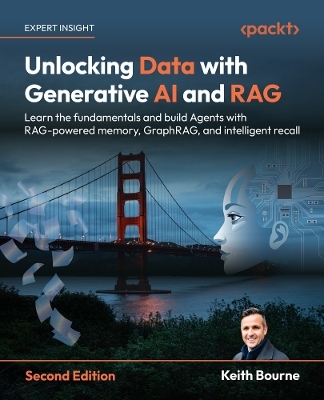
Unlocking Data with Generative AI and RAG
Packt Publishing Limited (Verlag)
978-1-80638-165-4 (ISBN)
- Titel nicht im Sortiment
- Artikel merken
Key Features
Build next-gen AI systems using agent memory, semantic caches, and LangMem
Implement graph-based retrieval pipelines with ontologies and vector search
Create intelligent, self-improving AI agents with agentic memory architectures
Free with your book: PDF Copy, AI Assistant, and Next-Gen Reader
Book DescriptionDeveloping AI agents that remember, adapt, and reason over complex knowledge is no longer a distant goal- it’s now possible with Retrieval-Augmented Generation (RAG). This second edition of the bestselling guide expands into the future of agentic systems, showing how to build intelligent, explainable, and context-aware applications powered by RAG pipelines.
You’ll explore the building blocks of agentic memory, including semantic caches, procedural learning via LangMem, and the emerging CoALA framework for cognitive agents. You’ll also learn to integrate GraphRAG with tools like Neo4j to create deeply contextualized AI responses grounded in ontology-driven data.
This book walks you through real implementations of working, episodic, semantic, and procedural memory using vector stores, prompting strategies, and feedback loops. With hands-on code and production-ready patterns, you’ll gain the skills to build advanced AI systems that don’t just generate answers- they learn, recall, and evolve.
Written by a seasoned AI educator and engineer, this book blends theoretical clarity with deep practical insight, offering both foundational knowledge and cutting-edge tools for modern AI development. What you will learn
Architect graph-powered RAG agents with ontology-driven knowledge bases
Build semantic caches to improve response speed and reduce hallucinations
Code memory pipelines for working, episodic, semantic, and procedural recall
Implement agentic learning using LangMem and prompt optimization strategies
Integrate retrieval, generation, and consolidation for self-improving agents
Design caching and memory schemas for scalable, adaptive AI systems
Use Neo4j, LangChain, and vector databases in production-ready RAG pipelines
Who this book is forAI engineers, data scientists, and developers building agent-based AI systems will benefit from this book’s deep dive into Retrieval-Augmented Generation, memory components, and intelligent prompting. Foundational knowledge of Python and LLMs is recommended.
Keith Bourne is a senior Generative AI data scientist at Johnson & Johnson. He has over a decade of experience in machine learning and AI working across diverse projects in companies that range in size from start-ups to Fortune 500 companies. With an MBA from Babson College and a master's in applied data science from the University of Michigan, he has developed several sophisticated modular Generative AI platforms from the ground up, using numerous advanced techniques, including RAG, AI agents, and foundational model fine-tuning. Keith seeks to share his knowledge with a broader audience, aiming to demystify the complexities of RAG for organizations looking to leverage this promising technology.
Table of Contents
What is Retrieval-Augmented Generation (RAG)
Code Lab - An Entire RAG Pipeline
Practical Applications of RAG
Components of a RAG System
Managing Security in RAG Applications
Interfacing with RAG and Gradio
The Key Role Vectors and Vector Stores Play in RAG
Similarity Searching with Vectors
Evaluating RAG Quantitatively and with Visualizations
Key RAG Components in LangChain
Using LangChain to get More from RAG
Combining RAG with the Power of AI Agents and LangGraph
Graph-Based RAG
Semantic Caches
Agentic Memory - The Secret Power Behind the Best Agents
RAG-Based Memory Components in Code
Prompt Optimization and Self-Improvement with LangMem
Additional chapter 1
Additional Chapter 2
| Erscheinungsdatum | 18.11.2025 |
|---|---|
| Verlagsort | Birmingham |
| Sprache | englisch |
| Maße | 178 x 254 mm |
| Themenwelt | Mathematik / Informatik ► Informatik ► Datenbanken |
| Informatik ► Software Entwicklung ► User Interfaces (HCI) | |
| Mathematik / Informatik ► Informatik ► Theorie / Studium | |
| ISBN-10 | 1-80638-165-6 / 1806381656 |
| ISBN-13 | 978-1-80638-165-4 / 9781806381654 |
| Zustand | Neuware |
| Informationen gemäß Produktsicherheitsverordnung (GPSR) | |
| Haben Sie eine Frage zum Produkt? |
aus dem Bereich