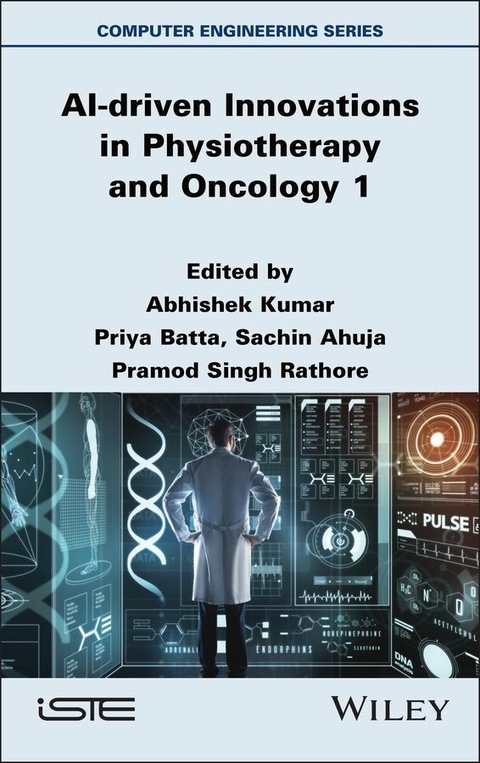
AI-driven Innovations in Physiotherapy and Oncology, Volume 1 (eBook)
569 Seiten
Wiley-Iste (Verlag)
978-1-394-42351-4 (ISBN)
The book explores how AI supports early cancer detection, personalized treatment planning and monitoring of disease progression, while also playing a pivotal role in physiotherapy by enabling intelligent rehabilitation strategies tailored to oncology patients. From AI-driven motion analysis and virtual physiotherapy assistants to predictive models for treatment response and functional recovery, this book showcases innovations that optimize physical therapy outcomes for cancer patients. It also addresses ethical challenges, data governance and the integration of AI within clinical workflows. Designed for clinicians, researchers and healthcare innovators, this book is a vital resource for understanding how AI bridges the gap between oncology care and rehabilitative physiotherapy.
Abhishek Kumar, Senior IEEE Member and Professor at Chandigarh University, India, is a prolific researcher with 170+ publications and has international postdoctoral experience. His expertise spans AI, renewable energy and image processing.
Priya Batta is Associate Professor at Amity School of Engineering and Technology, Amity University Punjab, Mohali, India. Her expertise includes AI, blockchain and IoT.
Sachin Ahuja is Executive Director of Engineering and Professor at Chandigarh University, India. He has guided numerous ME and PhD scholars and currently specializes in AI, machine learning, data mining and related areas.
Pramod Singh Rathore, Assistant Professor at Manipal University Jaipur, India, has over 12 years of experience and 85+ publications. His research interests include NS2, networks, data mining, DBMS and professional memberships including ACM and IAENG.
1
Transforming Post-Operative Rehabilitation: AI-integrated Physiotherapy in Orthopedics and Oncology
The field of orthopedic rehabilitation has witnessed significant evolution with the integration of biomechanical understanding, physiotherapy protocols and advanced technologies like artificial intelligence (AI). This chapter presents an in-depth exploration of implant biomechanics and their critical role in post-surgical physiotherapy, focusing on internal and external fixators. Implant biomechanics, which deals with the interaction of implants with biological tissues under various mechanical loads, directly influences implant design, placement and long-term function. Physiotherapists must understand these biomechanical principles in order to design safe and effective rehabilitation protocols that align with the implant’s mechanical properties. The chapter outlines the essential distinctions between internal and external fixators, detailing their principles, applications and physiotherapy interventions across different rehabilitation phases: acute, subacute and chronic. Emphasis is placed on early mobilization, pain management and strength restoration to ensure optimal functional recovery while minimizing complications. Furthermore, the chapter highlights the integration of AI in physiotherapy, showcasing the potential of machine learning, deep learning and computer vision algorithms to personalize rehabilitation strategies, predict complications and monitor recovery in real time. AI tools such as supervised and unsupervised learning, reinforcement learning and predictive analytics are explored for their roles in optimizing exercise regimens, improving diagnostic accuracy and enhancing patient outcomes.
This chapter serves as a comprehensive guide for clinicians, therapists and researchers by bridging implant biomechanics with modern physiotherapy and intelligent technology to achieve efficient and evidence-based orthopedic rehabilitation.
1.1. Introduction
1.1.1. Definition
A surgical procedure that stabilize and join the ends of fractured bones by internally placed mechanical devices such as metal plates, pins, rods and wires (Azar et al. 2020).
Implant biomechanics refers to the study of how implants interact with the body’s natural structures and how they respond to mechanical forces, such as stress, strain and movement. This field focuses on understanding how implants (e.g. joint replacements, prosthetics, dental implants or spinal devices) behave under various loading conditions and how they affect the surrounding tissues, including bones, muscles and ligaments.
Implant biomechanics involves evaluating the design, material properties and placement of implants to ensure they function effectively and safely within the body (Anderson et al. 2020).
1.1.2. Important characteristics of implant biomechanics
- Load distribution: the process by which forces are transferred from the implant onto the surrounding tissue when performing everyday tasks such as lifting or walking.
- Stability: making sure the implant doesn’t move or come free over time and stays firmly in place.
- Stress and strain: assessing how the implant responds to mechanical strains and how it may affect the surrounding bone or tissue’s mechanical environment.
- Wear and tear: evaluating how the materials used in implants withstand repeated loads and movements over time and how they impact tissue deterioration.
- Biomechanical compatibility: avoiding issues and guarantee pain-free movement, making the implant’s mechanical characteristics (such as stiffness, strength and flexibility) match the body’s natural biomechanics (Anderson et al. 2020; Azar et al. 2020).
1.1.3. Implant biomechanics is crucial for physiotherapy
As it directly influences the design, function and longevity of implants used in surgical procedures, such as joint replacements, fractures and spinal surgeries implant biomechanics should be known by physiotherapists. Understanding the biomechanics of implants ensures that they mimic the natural movement and stress distribution of the body’s original structures, promoting more efficient rehabilitation.
In physiotherapy, knowledge of implant biomechanics helps physiotherapists to design rehabilitation programs that consider the limitations and capacity of the implant, ensuring that exercises and treatments do not overload or stress the implant, reducing the risk of complications such as implant failure or dislocation. Proper alignment and material choice of implants also affect the healing process, mobility and comfort post-surgery, making biomechanical considerations key to preventing injuries, ensuring functional recovery and enhancing patient outcomes (Venkatesan and Balasubramanian 2020). Furthermore, the biomechanical properties of implants can guide physiotherapists in managing load distribution and joint stability, which are vital for restoring strength and improving range of motion (ROM) during rehabilitation.
1.2. Internal and external fixators
Internal and external fixators are crucial devices used in orthopedic surgery to stabilize and align fractured bones, promoting effective healing and reducing complications. Internal fixators are surgically placed inside the body, often using screws, plates, rods or intramedullary nails. These devices are typically used in fractures where precise alignment and early mobilization are critical, such as fractures of long bones (e.g. femur, tibia, etc.) or complex joint fractures. The main advantage of internal fixators is that they are less visible once implanted and allow for more stable fixation, which can lead to quicker recovery and improved functional outcomes. External fixators, in contrast, are placed outside the body and involve the use of pins or wires inserted through the skin into the bone, connected by an external frame (Sahu and Rathi 2020). These are commonly used for fractures with extensive soft tissue damage, open fractures, or when internal fixation is not possible due to the location or severity of the injury. External fixators offer the advantage of being adjustable and can be used to apply controlled forces to the bone, especially in cases where gradual bone lengthening or correction of deformities is needed (Kumar and Singh 2019). Both internal and external fixators are designed to stabilize the fracture, prevent movement and allow proper bone healing, but the choice of fixator depends on factors such as fracture type, location and the patient’s overall condition.
1.2.1. Principle of fixation
Lambotte’s principles of fixation are foundational guidelines for achieving successful bone healing through proper stabilization, regardless of whether internal or external fixation is used. These principles emphasize the importance of stability, alignment and gradual healing to optimize recovery. Lambotte’s principles apply to both types of fixations, although the specific application may differ between internal and external methods. They key principles are explained below.
The principles of fracture fixation involve several key strategies to optimize healing. Anatomical reduction emphasizes achieving and maintaining proper alignment of the fractured bone to restore its function, with both internal fixation (plates, screws) and external fixation systems aiming to align the bone ends for optimal healing. Stable fixation is crucial, ensuring that the fracture site is stabilized to prevent movement that would hinder healing, whereas internal fixation uses rigid devices for secure stabilization, while external fixators offer stability with adjustable external frames, particularly for fractures with soft tissue damage. Preservation of blood supply ensures adequate circulation to the fractured bone to promote healing and prevent complications, with internal fixation techniques minimizing vascular disruption and external fixators designed to avoid trauma to soft tissues. Minimal soft tissue damage reduces healing challenges, with internal fixation requiring surgical incisions that may damage tissues, while external fixators cause less disruption, which is especially beneficial for cases with significant soft tissue injury. Early mobilization encourages movement to prevent stiffness and atrophy, with internal fixation allowing quicker mobilization and external fixators enabling controlled movement as healing progresses.
Finally, gradual load bearing ensures that the injured bone is stressed cautiously during healing. Both internal and external fixation systems support staged load-bearing, with internal fixation allowing for early weight-bearing and external fixators enabling gradual load adjustments (Bhaskar and Suryanarayan 2013).
1.2.2. Physiotherapy for internal fixators
Physiotherapy plays a critical role in the rehabilitation of patients with internal fixators, which are devices used to stabilize broken bones during the healing process. These fixators are typically used in fractures that require surgical intervention, such as in the case of complex fractures or those involving joints. After the surgical procedure, physiotherapy is essential to ensure proper recovery, restore function and prevent complications (Suresh and Tiwari 2018).
Physiotherapy helps in several ways (Patel and Sharma 2018):
- Restoring mobility:...
| Erscheint lt. Verlag | 11.11.2025 |
|---|---|
| Reihe/Serie | ISTE Invoiced |
| Sprache | englisch |
| Themenwelt | Mathematik / Informatik ► Informatik |
| Schlagworte | Artificial Intelligence • Cancer Detection • data governance • monitoring of disease progression • motion analysis • Oncology • personalized treatment planning • physiotherapy • Rehabilitation Strategies |
| ISBN-10 | 1-394-42351-9 / 1394423519 |
| ISBN-13 | 978-1-394-42351-4 / 9781394423514 |
| Informationen gemäß Produktsicherheitsverordnung (GPSR) | |
| Haben Sie eine Frage zum Produkt? |
 EPUB (Adobe DRM)
Kopierschutz: Adobe-DRM
Adobe-DRM ist ein Kopierschutz, der das eBook vor Mißbrauch schützen soll. Dabei wird das eBook bereits beim Download auf Ihre persönliche Adobe-ID autorisiert. Lesen können Sie das eBook dann nur auf den Geräten, welche ebenfalls auf Ihre Adobe-ID registriert sind.
Details zum Adobe-DRM
Dateiformat: EPUB (Electronic Publication)
EPUB ist ein offener Standard für eBooks und eignet sich besonders zur Darstellung von Belletristik und Sachbüchern. Der Fließtext wird dynamisch an die Display- und Schriftgröße angepasst. Auch für mobile Lesegeräte ist EPUB daher gut geeignet.
Systemvoraussetzungen:
PC/Mac: Mit einem PC oder Mac können Sie dieses eBook lesen. Sie benötigen eine
eReader: Dieses eBook kann mit (fast) allen eBook-Readern gelesen werden. Mit dem amazon-Kindle ist es aber nicht kompatibel.
Smartphone/Tablet: Egal ob Apple oder Android, dieses eBook können Sie lesen. Sie benötigen eine
Geräteliste und zusätzliche Hinweise
Buying eBooks from abroad
For tax law reasons we can sell eBooks just within Germany and Switzerland. Regrettably we cannot fulfill eBook-orders from other countries.
aus dem Bereich