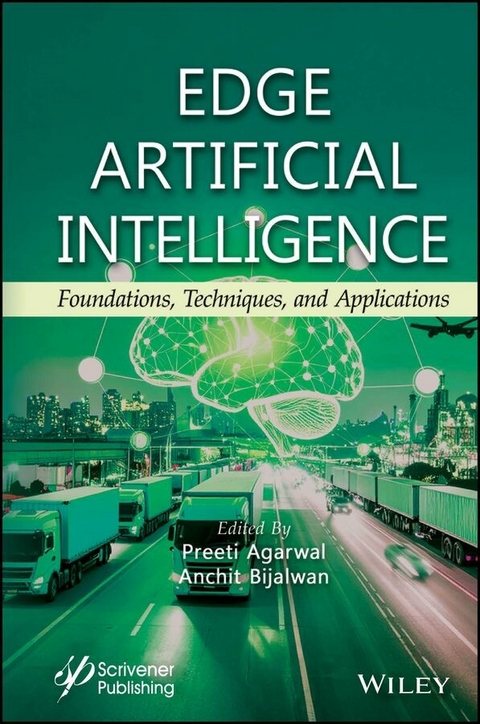
Edge Artificial Intelligence (eBook)
890 Seiten
Wiley (Verlag)
978-1-394-35501-3 (ISBN)
Secure your expertise in the next wave of computing with this essential book, which provides a comprehensive guide to Edge AI, detailing its foundational concepts, deployment strategies, and real-world applications for revolutionizing performance and privacy across various industries.
Edge AI has the potential to bring the computational power of AI algorithms closer to where data is generated, processed, and utilized. Traditionally, AI models are deployed in centralized cloud environments, leading to latency issues, bandwidth constraints, and privacy concerns. Edge AI addresses these limitations by enabling AI inference and decision-making directly on edge devices, such as smartphones, IoT sensors, and edge servers. Despite its challenges, edge AI presents numerous opportunities across various domains. From real-time health monitoring and predictive maintenance in industrial IoT to personalized recommendations in retail and immersive experiences in augmented reality, edge AI has the potential to revolutionize how we interact with technology. This book aims to provide a comprehensive exploration of edge AI, covering its foundational concepts, development frameworks, deployment strategies, security considerations, ethical implications, emerging trends, and real-world applications. This guide is essential for anyone pushing the boundaries to leverage edge computing for enhanced performance and efficiency.
Readers will find this volume:
- Dives deep into the world of edge AI with a comprehensive exploration covering foundational concepts, development frameworks, deployment strategies, security considerations, ethical implications, governance frameworks, optimization techniques, and real-world applications;
- Offers practical guidance on implementing edge AI solutions effectively in various domains, including architecture design, development frameworks, deployment strategies, and optimization techniques;
- Explores concrete examples of edge AI applications across diverse domains such as healthcare, industrial IoT, smart cities, and autonomous systems, providing insights into how edge AI is revolutionizing industries and everyday life;
- Provides insights into emerging trends and technologies in the field of edge AI, including convergence with blockchain, augmented reality, virtual reality, autonomous systems, personalized experiences, and cybersecurity.
Audience
Researchers, AI experts, and industry professionals in the field of computer science, IT, and business management.
Preeti Agarwal, PhD is an assistant professor in the School of Technology Management and Engineering at the Narsee Monjee Institute of Management Studies with more than 13 years of experience. She has extensive publications in international journals and conferences. Her research focuses on optimizing edge-based frameworks for human activity recognition.
Anchit Bijalwan, PhD an Associate Professor in the School of Computing and Innovative Technologies at the British University Vietnam, Hanoi, Vietnam. He has authored two books and published more than fifty research papers in reputed international journals and conferences. His specialization is in privacy and security.
Secure your expertise in the next wave of computing with this essential book, which provides a comprehensive guide to Edge AI, detailing its foundational concepts, deployment strategies, and real-world applications for revolutionizing performance and privacy across various industries. Edge AI has the potential to bring the computational power of AI algorithms closer to where data is generated, processed, and utilized. Traditionally, AI models are deployed in centralized cloud environments, leading to latency issues, bandwidth constraints, and privacy concerns. Edge AI addresses these limitations by enabling AI inference and decision-making directly on edge devices, such as smartphones, IoT sensors, and edge servers. Despite its challenges, edge AI presents numerous opportunities across various domains. From real-time health monitoring and predictive maintenance in industrial IoT to personalized recommendations in retail and immersive experiences in augmented reality, edge AI has the potential to revolutionize how we interact with technology. This book aims to provide a comprehensive exploration of edge AI, covering its foundational concepts, development frameworks, deployment strategies, security considerations, ethical implications, emerging trends, and real-world applications. This guide is essential for anyone pushing the boundaries to leverage edge computing for enhanced performance and efficiency. Readers will find this volume: Dives deep into the world of edge AI with a comprehensive exploration covering foundational concepts, development frameworks, deployment strategies, security considerations, ethical implications, governance frameworks, optimization techniques, and real-world applications; Offers practical guidance on implementing edge AI solutions effectively in various domains, including architecture design, development frameworks, deployment strategies, and optimization techniques; Explores concrete examples of edge AI applications across diverse domains such as healthcare, industrial IoT, smart cities, and autonomous systems, providing insights into how edge AI is revolutionizing industries and everyday life; Provides insights into emerging trends and technologies in the field of edge AI, including convergence with blockchain, augmented reality, virtual reality, autonomous systems, personalized experiences, and cybersecurity. Audience Researchers, AI experts, and industry professionals in the field of computer science, IT, and business management.
1
Edge AI Demystified: From Its Origins to Future Frontiers
Preeti Agarwal1*, Anchit Bijalwan2, Ayesha Patel1, Atharv Amit Deshpande1 and Vidhi Panchal1
1School of Technology Management & Engineering, Narsee Monjee Institute of Management Studies (Deemed to-be University), Navi Mumbai, Maharashtra, India
2School of Computing and Innovative Technologies, British Vietnam University, Hanoi, Vietnam
Abstract
Edge AI is the new paradigm for artificial intelligence and computing that brings the processing of data much closer to its source, including IoT devices, smartphones, and sensors, rather than sending it to the traditional cloud systems. The key benefits of this decentralized approach include lower latency, better privacy, energy efficiency, and challenges that exist with centralized cloud architectures. The evolution of Edge AI comes from its development in edge computing, mobile access edge computing, and fog computing, together with the rise of both 5G and IoT devices. The combination of lightweight AI models with edge devices enables Edge AI to offer the possibility of having real-time decision-making and autonomy in industries that were once unimaginable, such as healthcare, transportation, and smart cities. Despite its huge potential, Edge AI faces several challenges, including resource constraints, security vulnerabilities, and interoperability challenges. Those will be solved only through the collaboration of researchers, industry leaders, and policymakers. This chapter discusses the evolution, ecosystem, benefits, challenges, and future research directions of Edge AI and shares insights on how it will shape a sustainable and intelligent future.
Keywords: Edge AI, edge intelligence, artificial intelligence, cloud computing, fog computing, internet of things, edge computing
1.1 Introduction
Edge AI is a framework wherein the computing functions of artificial intelligence (AI) are invoked on the far ends of a network, closer to where data comes from. In contrast to traditional cloud computing, which has centralized processing located remotely in the cloud data center, Edge AI shifts it to decentralized processing for several good reasons. It brings Edge AI power much closer to such devices as sensors, cameras, and smartphones—all toward achieving real-time mission-critical decision-support capability [1].
1.1.1 Edge AI Evolution
Edge AI is the new, revolutionary face of how computation and AI are now being deployed and used. This trend, initiated by the rise of Cloud PCs in the early 2000s, ushered in a new PC infrastructure built on resource-intensive data centers. Cloud computing rapidly developed into an ideal worldwide, since it offered seemingly ‘unlimited’ storage space, reduced capital expenditures, and a smaller environmental footprint. In 2020, cloud services accounted for over 90% of global data center traffic [1]. However, with the increase in the number of mobile and fixed internet-connected devices, inherent problems related to high latency, low bandwidth, and reduced Quality of Experience (QoE) for users started to surface, mostly in the mobile ecosystem where computational tasks were offloaded to remote cloud servers [2].
The concept of Edge Computing was born as a solution to these limitations. Figure 1.1 shows the roadmap leading to the emergence of edge computing. Unlike cloud computing, which is centralized, edge computing processes data are closer to its source, like local servers, in order to reduce latency and maximize bandwidth. Initial discourse around this idea questioned the requirement of vast data centers, and instead, argued for a geo-distributed approach with localized servers. For example, Microsoft pioneered the idea of micro data centers (mDCs) that act like dispersed nodes that are closer to users [3]. These centers, housing just a handful of servers and terabytes of memory, are used for the concerted processing of data. This enabled Edge Computing to support applications requiring real-time answers, such as spam filtering and localized traffic control. Edge Computing was brought to the next level when the concept of ‘cloudlets ‘came into existence. Cloudlets are small-scale data centers to provide services for casual and temporary users in internet cafes and small areas [4]. Combination of these cloudlets along with the increasing trend of Internet of Things (IoT) led to the development of ‘fog computing’ (FC).
Figure 1.1 Evolution roadmap of edge AI.
Fog computing acts as a bridge between edge devices and cloud infrastructure, enabling sensors and security cameras to perform initial data processing before transmitting filtered data to fog nodes. This has been very vital for IoT applications that demand fast responses and localized decision-making. The rapid development of cellular technology increased the evolution of lateral computing. Since 2011, mobile phones and other cellular devices have revolutionized how humans interact with IT. However, the high processing demands of cellular apps—combined with the need to provide persistent connectivity to remote data centers—rubbed against users’ expectations of the ideal service.
To this end, Mobile-Access Edge Computing, or MEC, came into existence. MEC allows cellular clients to tap the community aspect for computing and document processing as an alternative to relying on geographically distant cloud servers. MEC was at first introduced through a 2014 whitepaper by the use of the European Telecommunications Requirements Institute (ETSI) with the intent of reducing latency, increasing throughput and providing cellular patrons with real-time network information. Over time, MEC has broadened its scope of applicability, rebranded as Multi-Access Edge Computing, and highlighted the potential for it to enable a much wider variety of use cases [5]. Those are some of the advances that have led to what’s now being referred to as ‘Edge Artificial Intelligence (Edge AI)’. In Edge AI, AI computation is performed on nodes or devices near to where the data is created, not in a centralized data center. Edge AI is the leveraging of the real-time processing capabilities of edge computing to empower intelligent IoT devices to adapt to new conditions, learn from data, and complete tasks autonomously. With the arrival of 5G and future 6G networks, Edge AI has become one of the most crucial elements for applications that demand low latency and high reliability [6].
Today, with the rise of Edge AI, it marks a shift from the centralized cloud architectures and towards the distributed, intelligent edge systems. This is a major milestone in the history of computing and AI.
1.1.2 What is Edge AI, and How Does It Work?
Edge AI is the convergence of Artificial Intelligence with Edge Computing. It means that AI algorithms are processed directly on devices located at or near the data source, not fully dependent on cloud infrastructure. Computing closer to the data source is what differentiates it from the traditional approach, often called Cloud AI, where AI processing happens remotely in large data centers. Edge AI, therefore, brings computation closer to the source, reducing the time it takes for data to be processed and decisions to be made—offering several advantages, such as faster responses, lower bandwidth usage, and better security [1].
One of the integral parts of Edge AI is Edge Computing, which shifts the processing power to the devices or endpoints on a network, like IoT devices, mobile phones, or sensors. This reduces reliance on cloud services since it allows data analysis on site, increasing the system’s independence and efficiency. Artificial Intelligence employs machine learning algorithms that mimic human intelligence in processing large data sets to forecast or make decisions. With Edge AI, such algorithms are now able to run on the edge devices themselves, enabling immediate real-time decision-making [2]. For example, in smart cameras or autonomous vehicles, data in the form of images or sensor readings are analyzed directly on the device. This provides not only a much faster response but also saves the necessity of sending the data to some remote server for processing—concrete benefits and applications of Edge AI. There exist two ways to run AI applications: Edge AI and Cloud AI. Each has its advantages and disadvantages. The most basic difference lies in where the AI algorithms are processed and how they handle some of the challenges such as latency, power consumption, and data privacy [7].
1.1.3 Difference Between Edge AI and Cloud AI
The major differences between processing at edge and cloud lies in following points, as stated in [8]. Figure 1.2 gives an overview of the vision.
- Location of Processing
- Cloud AI: The AI and ML tasks are offloaded to the data center or cloud servers. The devices just do the task of gathering and sending data to the cloud, and the algorithms work on it there to send back the results. Hence, it avails the high computing power of the cloud but is dependent on network availability and speed.
- Edge AI: Edge AI is a type of data processing where the data is processed directly on a device like a sensor, camera, or smartphone at the “edge” of the network, reducing reliance on cloud services and enabling faster, localized decision-making without needing constant internet...
| Erscheint lt. Verlag | 6.11.2025 |
|---|---|
| Sprache | englisch |
| Themenwelt | Mathematik / Informatik ► Informatik ► Theorie / Studium |
| ISBN-10 | 1-394-35501-7 / 1394355017 |
| ISBN-13 | 978-1-394-35501-3 / 9781394355013 |
| Informationen gemäß Produktsicherheitsverordnung (GPSR) | |
| Haben Sie eine Frage zum Produkt? |
 EPUB (Adobe DRM)
Kopierschutz: Adobe-DRM
Adobe-DRM ist ein Kopierschutz, der das eBook vor Mißbrauch schützen soll. Dabei wird das eBook bereits beim Download auf Ihre persönliche Adobe-ID autorisiert. Lesen können Sie das eBook dann nur auf den Geräten, welche ebenfalls auf Ihre Adobe-ID registriert sind.
Details zum Adobe-DRM
Dateiformat: EPUB (Electronic Publication)
EPUB ist ein offener Standard für eBooks und eignet sich besonders zur Darstellung von Belletristik und Sachbüchern. Der Fließtext wird dynamisch an die Display- und Schriftgröße angepasst. Auch für mobile Lesegeräte ist EPUB daher gut geeignet.
Systemvoraussetzungen:
PC/Mac: Mit einem PC oder Mac können Sie dieses eBook lesen. Sie benötigen eine
eReader: Dieses eBook kann mit (fast) allen eBook-Readern gelesen werden. Mit dem amazon-Kindle ist es aber nicht kompatibel.
Smartphone/Tablet: Egal ob Apple oder Android, dieses eBook können Sie lesen. Sie benötigen eine
Geräteliste und zusätzliche Hinweise
Buying eBooks from abroad
For tax law reasons we can sell eBooks just within Germany and Switzerland. Regrettably we cannot fulfill eBook-orders from other countries.
aus dem Bereich