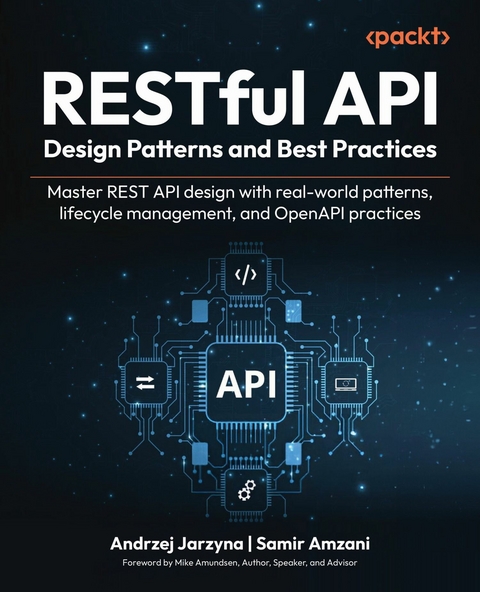
RESTful API Design Patterns and Best Practices (eBook)
406 Seiten
Packt Publishing (Verlag)
978-1-83588-529-1 (ISBN)
Designing scalable, user-focused, and robust APIs that last isn't just a technical challenge but a design imperative. Written by API leaders with over 30 years of combined experience in API strategy, governance, and community, this book is your comprehensive guide to API design, focusing on domain-driven, consumer-centric APIs that meet real user needs while remaining flexible and maintainable over time. It covers modern REST API design, tools like OpenAPI and JSON Schema, and the importance of a product-based approach. The chapters help you explore best practices, potential pitfalls, and anti-patterns, extending beyond the design phase.
Starting with the 'why' behind building an API, its intended users, and value, this book walks you through the API lifecycle, the role of contracts, and applying domain-driven design. You'll develop a solid foundation in REST API design as you discover different styles, constraints, and more. Beyond design, the book covers testing techniques, API evolution, maintenance, and deprecation.
By the end, you'll not only know how to design great APIs but understand how to treat them as products, manage their lifecycle, and deliver real value by keeping your APIs relevant and reliable long after release.
*Email sign-up and proof of purchase required
Preface
APIs are everywhere, yet many of us have learned to design them through trial and error, often more error than we’d care to admit. RESTful API Design Patterns and Best Practices was born from our collective “aha moments” and, frankly, our mistakes while working with teams across different organizations. We noticed that most API design resources fall into two camps: highly technical guides that assume you’re building in a vacuum, or business-focused books that gloss over the nitty-gritty details. The reality? Great API design happens at the intersection of both worlds.
Between the two of us, we’ve run API initiatives at companies like Adidas, Backmarket, ING, and PZU; watched countless teams struggle with the same challenges; and celebrated when they finally clicked with the right approach. What became clear is that there’s a sweet spot between technical excellence and business value, and that’s exactly where this book aims. Plus, with AI systems getting chattier and more dependent on well-crafted APIs, the bar for good API design just got higher.
Think of this book as your guided tour through three distinct territories. Part 1: The Apprentice’s Study is where we get comfortable with the fundamentals—why APIs exist, how to think about them as products, and how to apply domain thinking that actually makes sense. Part 2: The Wizard’s Grimoire is where we roll up our sleeves and dive deep into REST design, comparing different approaches and building solid foundations. Part 3: The Archmage’s Circle is where we get practical with OpenAPI, JSON Schema, hypermedia, and keeping your APIs healthy as they evolve.
While you could jump around the book like a choose-your-own-adventure novel, we’ve structured it with some method to our madness. The Domain-Driven Design chapters in Part 1 build on each other, and the technical chapters in Part 3 are definitely better as a progression. Trust us on this one; we’ve seen what happens when teams skip the foundation work.
To keep things practical, we follow a “Magic Items store” through Chapters 9–12. This isn’t just academic theory; these patterns come from real projects, real deadlines, and real conversations with development teams who needed solutions yesterday.
Here’s the thing: we’re at a fascinating moment where traditional API design meets AI-driven interactions. The APIs you design today need to work for both human developers debugging at 2 a.m. and AI agents that might consume your endpoints in ways you never imagined. This book gives you the tools to build for both audiences without losing your sanity.
Whether you’re designing your first API or you’re the person everyone turns to when things get complicated, we hope this book becomes the resource you wish you’d had when you started, practical, comprehensive, and maybe even a little fun.
Andrzej Jarzyna & Samir Amzani
Who this book is for
This book is for professionals involved in the digital product lifecycle who want to deepen their understanding of API design and build future-proof APIs with a product-centric approach. API developers, solution architects and engineers, technical product owners, and software architects looking to extend their skills in creating efficient, scalable, and maintainable APIs will find this book particularly useful. Basic knowledge of APIs and the HTTP protocol is recommended to fully benefit from the design principles and practices covered.
What this book covers
Chapter 1, The “Why” of API Development, Before venturing into the realm of API design and development, it’s crucial to address the fundamental question: “Why?” Is it the purpose to unveil functionalities to other applications, broadening your business offerings, or is it the backbone of your enterprise? Crafting APIs also necessitates a clear understanding of the intended target audience.
Chapter 2, API as a Product: Designing APIs with a Product Mindset, This chapter discusses how to approach API design with a product mindset, focusing on the value the API provides to its consumers. It focuses on treating APIs as products rather than mere technical components.
Chapter 3, Understanding Application and API Lifecycles, This chapter explains how a holistic look on the whole API lifecycle influences your API Design. It explains how your API Lifecycle and your Application Lifecycle are interwoven and provides a comprehensive overview of the stages that an application and its APIs go through, from inception to deprecation.
Chapter 4, Applying Domain-Driven Design to APIs, This chapter guides readers on how to incorporate domain-driven design principles into API development. It provides strategies for aligning API design with business domains, ensuring that APIs accurately reflect and serve business needs.
Chapter 5, Comparing and Choosing the Right API Style, This chapter explores RESTful APIs, their popularity, and unique features. We compare REST with other API styles like GraphQL, SOAP, gRPC, and asynchronous APIs, highlighting their strengths and weaknesses. The choice of API style significantly impacts your application’s lifecycle, influencing its design, implementation, testing, and maintenance.
Chapter 6, REST Design Constraints and Maturity Models, This chapter dives into the depths of API Design specifics. It delves into the core principles that guide RESTful API design as originally introduced by Roy Fielding. It explores the main REST design constraints that shape effective APIs.
Chapter 7, Constructing an API Design Domain Model, This chapter provides a comprehensive guide on building a domain model for API design. It emphasizes the importance of a well-structured domain model in creating effective and efficient APIs. It teaches how to understand your API business domain, how to identify key entities in it and define proper relationships between them.
Chapter 8, Designing and Managing Effective API Contracts, This chapter delves into the significance of a well-crafted API design document and its role as a contract in API design. It sheds light on the creation of clear, all-encompassing design documents that act as agreements between API providers and consumers. The objective is to streamline future API usage and cultivate open communication among all stakeholders from the outset.
Chapter 9, Understanding the OpenAPI Specification, This chapter delves into the utilization of OpenAPI Specification (OAS) in the design of REST APIs. It underscores the dual role of the OpenAPI specification as a design blueprint and a binding contract for your API, guaranteeing uniformity and clarity.
Chapter 10, OpenAPI as a Contract: Best Practices and Implementation, This chapter explores practical implementation patterns, from contract validation to tool integration. You’ll learn how to design intuitive APIs with consistent resources, error handling, and asynchronous operations while discovering how contract-first approaches transform team collaboration.
Chapter 11, Using JSON Schema to Define Your Object Models, This chapter delves into the utilization of JSON Schema in the design of REST APIs. It builds upon the domain model created in the previous chapters and introduces the reader to how to formally describe those models. It covers the creation, validation, and documentation of complex JSON structures, ensuring consistency and reliability in your API design.
Chapter 12, Don’t Hate Your Hypermedia: Creating APIs For Humans and AIs, This chapter explores the concept of hypermedia and its role in API design. It provides insights into how hypermedia can enhance API functionality, improve user experience, and make APIs more adaptable and scalable. It also explains how to design REST APIs beyond CRUD operations.
Chapter 13, API Change Management: Strategies for Versioning and Evolution, This chapter delves into strategies for API change management, focusing on versioning and evolution while balancing stability and innovation. It emphasizes the critical importance of preserving backward compatibility and maintaining a seamless experience for existing consumers.
To get the most out of this book
This book is a valuable resource for professionals involved in the digital product lifecycle who wish to enhance their understanding of API design. It provides insights into designing robust and future-proof APIs with a product-centric approach. Before starting this book, readers should have a basic understanding of APIs and the HTTP protocol. This foundational knowledge will help them grasp the concepts of API design and best practices presented in the book.
Download the example code files
The code bundle for the book is hosted on GitHub at https://github.com/PacktPublishing/RESTful-Design-Patterns-and-Best-Practices. We also have other code bundles from our rich catalog of books and videos available at https://github.com/PacktPublishing. Check them out!
Conventions used
There are a number of text conventions used throughout this book.
CodeInText: Indicates code words in text, database table names, folder names, filenames, file extensions, pathnames, dummy URLs, user input, and Twitter handles. For example: “ Let’s say we define an endpoint such as...
| Erscheint lt. Verlag | 6.10.2025 |
|---|---|
| Sprache | englisch |
| Themenwelt | Mathematik / Informatik ► Informatik ► Web / Internet |
| ISBN-10 | 1-83588-529-2 / 1835885292 |
| ISBN-13 | 978-1-83588-529-1 / 9781835885291 |
| Informationen gemäß Produktsicherheitsverordnung (GPSR) | |
| Haben Sie eine Frage zum Produkt? |
 EPUB (Adobe DRM)
Größe: 3,7 MB
Kopierschutz: Adobe-DRM
Adobe-DRM ist ein Kopierschutz, der das eBook vor Mißbrauch schützen soll. Dabei wird das eBook bereits beim Download auf Ihre persönliche Adobe-ID autorisiert. Lesen können Sie das eBook dann nur auf den Geräten, welche ebenfalls auf Ihre Adobe-ID registriert sind.
Details zum Adobe-DRM
Dateiformat: EPUB (Electronic Publication)
EPUB ist ein offener Standard für eBooks und eignet sich besonders zur Darstellung von Belletristik und Sachbüchern. Der Fließtext wird dynamisch an die Display- und Schriftgröße angepasst. Auch für mobile Lesegeräte ist EPUB daher gut geeignet.
Systemvoraussetzungen:
PC/Mac: Mit einem PC oder Mac können Sie dieses eBook lesen. Sie benötigen eine
eReader: Dieses eBook kann mit (fast) allen eBook-Readern gelesen werden. Mit dem amazon-Kindle ist es aber nicht kompatibel.
Smartphone/Tablet: Egal ob Apple oder Android, dieses eBook können Sie lesen. Sie benötigen eine
Geräteliste und zusätzliche Hinweise
Buying eBooks from abroad
For tax law reasons we can sell eBooks just within Germany and Switzerland. Regrettably we cannot fulfill eBook-orders from other countries.
aus dem Bereich