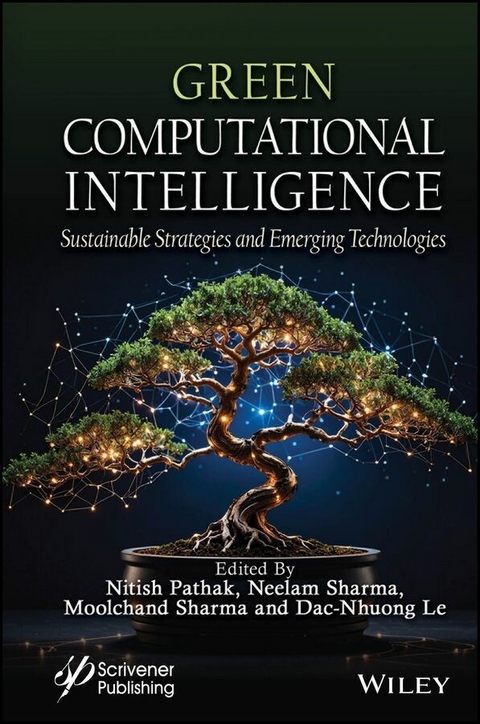
Green Computational Intelligence (eBook)
743 Seiten
Wiley-Scrivener (Verlag)
978-1-394-38362-7 (ISBN)
Transform your approach to technology and sustainability with this comprehensive guide to green computing and computational intelligence.
The global pursuit of sustainability has placed an urgent emphasis on developing innovative and eco-friendly technological solutions. Green computing has the potential to revolutionize the way we evaluate sustainability with the use of energy-efficient algorithms for resource optimization, sustainable hardware design, and smart resource management. Recognizing the intersection of computational intelligence and environmental stewardship, this book seeks to address the pressing challenges of integrating green practices into the realm of computational intelligence and aligning them with global sustainable development goals. Through global expertise from researchers and industry professionals, this book comprehensively covers the many applications of these innovative new technologies, as well as the challenges surrounding their implementation.
Readers will find the book:
- Explores the convergence of environmental sustainability and advanced computational techniques, addressing the global call for energy-efficient and eco-friendly technological solutions;
- Integrates perspectives from computer science, engineering, environmental science, and artificial intelligence, providing a holistic view of green computing;
- Examines sustainable practices across diverse topics, including energy-efficient algorithms and resource optimization, sustainable hardware design, green software engineering, eco-friendly data centers, and smart resource management;
- Offers practical strategies for implementing sustainable computing practices while addressing theoretical and practical challenges;
- Highlights the role of computational intelligence in promoting sustainability, bridging the gap between technology development and environmental conservation.
Audience
Researchers, students, educators, and industry professionals working towards sustainable practices in and using green technology.
Nitish Pathak, PhD is an associate professor in the Department of Computer Science and Engineering, the Bhagwan Parshuram Institute of Technology, Guru Gobind Singh Indraprastha University, New Delhi, India with over 19 years of teaching experience. He has authored and edited over ten books and published over 125 articles in international journals, conferences, patents, and book chapters. His research interests include intelligent computing techniques, empirical software engineering, trusted operating systems, cloud computing, the IoT, and artificial intelligence.
Neelam Sharma, PhD is a senior assistant professor in the Maharaja Agrasen Institute of Technology, Guru Gobind Singh Indraprastha University, New Delhi, India with over 19 years of teaching experience. She has published over 95 papers in international journals, conferences, patents, and book chapters. Her research focuses on wireless sensor networks, wireless body area networks, mobile communications, AI, IoT, information security, and computer graphics.
Moolchand Sharma, PhD is an assistant professor in the Department of Computer Science and Engineering at the Maharaja Agrasen Institute of Technology, Guru Gobind Singh Indraprastha University, New Delhi, India. He has published four books and several book chapters, as well as numerous scientific research publications in reputed international journals and conferences. His research areas include artificial intelligence, nature-inspired computing, security in cloud computing, machine learning, and search engine optimization.
Dac-Nhuong Le, PhD is an associate professor of Computer Science and Dean of the Faculty of Information Technology at Haiphong University, Vietnam with over 20 years of teaching experience. He has authored and edited over 35 books and numerous articles in international journals and conferences. His areas of research include soft computing, network communication, security and vulnerability, network performance analysis and simulation, cloud computing, IoT, and image processing for biomedicine.
1
Artificial Intelligence and IoT for Smart Farming: Environmental Sustainability
Kshatrapal Singh1*, Yogesh Kumar Sharma2, Vijay Shukla1, Dhiraj Gupta1 and Arun Kumar Rai3
1Department of CSE (AI), Greater Noida Institute of Technology, Gr. Noida, India
2Department of CSE, ITS Engineering College, Gr. Noida, India
3School of CSE, Galgotias University, Gr. Noida, India
Abstract
Agriculture devotes meaningfully to the economy. Agriculture automation is a large source of concern and is currently being discussed around the globe. The world’s population is rapidly increasing, and with it, there is a high demand for food and jobs. The farmers’ conventional techniques were not adequate to meet these targets. Due to this, advanced automated techniques were invented. These new techniques met foodstuff requirements while simultaneously giving work opportunities to a large number of human beings. Agriculture has undergone a transformation as a result of artificial intelligence. This technique has protected crop yields against a diversity of factors like climate change, population growth, labor issues, and food security interests. This chapter’s primary goal is to examine the adoption of automation systems in agriculture, such as irrigation, weeding, and spraying, applying sensors and more equipment integrated into robots and drones. These techniques retain water, pesticides, and herbicides while also maintaining soil fertility as well as helping in the powerful usage of the workforce, resulting in expanded output and better quality.
Keywords: Automation, crop failure, artificial intelligence, Internet of Things, machine learning, expert systems, fuzzy logic, crop monitoring
1.1 Introduction
The world’s population is expected to reach 9 billion persons by 2050. Only around 10% of the additional production could be attributed to the availability of vacant farms, with the remaining 90% coming from the intensification of current operations. In this context, one of the most important needs is the adoption of cutting-edge technical feasibilities to improve agriculture output. Present agricultural intensification techniques need a lot of energy, but the market wants high-quality food. Crop failure owing to illnesses, shortage of rainfall, climate changes, and fall of soil productivity, as well as shifting market rates in agriculture goods, have all had a substantial influence on this backbone population’s socioeconomic condition [1]. On the other hand, as the world’s community grows, so does the demand for food grains, leading to price inflation in agricultural commodities.
We can use automation to design smart farming practices that will cut farmer deficits and boost yield. AI platforms can capture large amounts of data from government websites, as well as real-time monitoring of different data via the IoT, which can then be correctly analyzed to assist farmers with the uncertain points they look at in the agriculture sector. As per the United Nations, two-thirds of the globe’s population will be located in large towns by 2050, diminishing the rural workforce. To relieve farmer’s workloads, new techniques will be required: operations will be performed remotely, processes will be automated, dangers will be found, and concerns will be resolved. In the future, a farmer’s abilities integrate technology and biological skills rather than traditional agricultural skills.
Automation can be applied in a number of fields, and it has the power to alter the way we think about farming. Artificial intelligence–based powered solutions will not only enable farmers to accomplish more with less, but they will also enhance crop quality and minimize the time it takes for items to reach market. AI, big data, and the IoT are all the main factors that contribute to digital information technology solutions in today’s world. As a result, it is suggested that a digital solution, helped by AI, be deployed to improve the environment of the farmer community.
With the availabilities of various technologies in digital time, we people have pushed the limitations of our thinking approaches as we are trying to combine a general brainpower with an artificial one. This continuous analysis generates a new field called artificial intelligence (AI). With the help of this technique, a man can make a machine that is intelligent. Artificial intelligence is a part of computer science that can recognize its environment and thrive to increase its probability of success. Artificial intelligence should be able to do jobs on the basis of past experience [2]. Deep learning, artificial neural networks, and machine learning are instances of disciplines that contribute to the creation of more modern techniques and increase machine performance.
The term “Internet of Things” is defined as “thing-to-thing” communication. The system’s three key aims are communication, automation, and expense savings. Automation has had an impact on medical science, education, economics, farming, manufacturing, safety, and a range of other disciplines. Machine learning is required for AI implementation. This brings us to the AI area’s “machine learning” subfield. The fundamental goal of machine learning is to provide the machine with information from historical context and statistical data in order to carry out its given task of addressing a particular problem. Data analysis on the basis of past and experience, audio and face reorganization, weather information, and health diagnostics are all examples of current applications. As a result of the ML approach, the disciplines of big data and data science have developed significantly [3]. Machine learning is a mathematically based technique for creating intelligent machines. As automation grew in popularity, many new logics and methods were devised and found, simplifying the problem-solving process.
The following are some examples of such methods.
- Fuzzy Logic
- Artificial Neural Network
- Neuro-fuzzy Logic
- Expert Systems
ANN is the most commonly utilized and generally used method for research purposes between all of these. The brain serves as the most intricate part of the human body. Axons, which are composed of interconnected brain networks, are used to transmit electric signals between neurons. At the final node of each node, synapses are used to forward the signals.
The ANN approach was created with a similar idea of how the person’s brain works in the mind. Depending on the application, algorithms such as the Silva and Almeida techniques, Delta-bar-delta, Rprops, the dynamic adaption method, and Quickprop are applied to train this model [4]. Nine neurons are used in the technique. ANN is an assignment procedure that tells the system to perform a pre-programmed task instead of a computationally created task. The ANN architecture, as shown in Figure 1.1, consists of three layers:
Figure 1.1 ANN layers.
- Input Layer
- Hidden Layer
- Output Layer
Furthermore, AI and machine learning are generally based on theories and hypotheses. This is where programming and procedures come in. For executing these techniques and reasoning conceptions, there needs be a hardware-software alliance. The framework that permits this to occur is known as “embedded systems.” Embedded devices are hardware-based devices with proprietary software that are composed of memory chips.
This chapter examines the ties that bind embedded systems and artificial intelligence to the agricultural sector. The use of artificial intelligence and expert systems in farming is a narrowly explained concept. Agriculture is a major factor in any country’s economic development. South Korea, China, and the United States are making significant investments in hundreds of billions of dollars in agricultural development and modern technology. The population has been growing, and the increase in food demand is exactly related. India has a wide variety of food grains and, more importantly, species. Agriculture is one of India’s most susceptible sectors, as it underpins all other sectors and has far-reaching consequences. Automation in agribusiness is becoming increasingly crucial as technology advances in other industries.
Agriculture will become more vital as the human population continues to grow, and agri-techniques and precise farming will become helpful in today’s society.
Any application of high-tech computer machines to compute numerous metrics including weeds detection, crop predictions, yield detection, crop quality, and a range of other machine learning methodologies is referred to as digital agriculture. This chapter looks at how ANN, ML, and IoT can be used in agricultural production, and some models that can help with precision farming.
Agriculture is a subject that is challenging to provide since it constantly runs into issues. From planting seeds to harvesting crops, farmers face the following challenges:
- Crop disease infestations.
- Pesticide control.
- Weed managing.
- Shortage of irrigation and drainage facility.
- Shortage of storage management.
Each category listed above has been penetrated by Ai technology and advanced analytics. Automation and robotics began to infiltrate this industry around 1983. Various recommendations and solutions for enhancing farming have been made since...
| Erscheint lt. Verlag | 2.10.2025 |
|---|---|
| Sprache | englisch |
| Themenwelt | Mathematik / Informatik ► Informatik |
| ISBN-10 | 1-394-38362-2 / 1394383622 |
| ISBN-13 | 978-1-394-38362-7 / 9781394383627 |
| Informationen gemäß Produktsicherheitsverordnung (GPSR) | |
| Haben Sie eine Frage zum Produkt? |
 EPUB (Adobe DRM)
Kopierschutz: Adobe-DRM
Adobe-DRM ist ein Kopierschutz, der das eBook vor Mißbrauch schützen soll. Dabei wird das eBook bereits beim Download auf Ihre persönliche Adobe-ID autorisiert. Lesen können Sie das eBook dann nur auf den Geräten, welche ebenfalls auf Ihre Adobe-ID registriert sind.
Details zum Adobe-DRM
Dateiformat: EPUB (Electronic Publication)
EPUB ist ein offener Standard für eBooks und eignet sich besonders zur Darstellung von Belletristik und Sachbüchern. Der Fließtext wird dynamisch an die Display- und Schriftgröße angepasst. Auch für mobile Lesegeräte ist EPUB daher gut geeignet.
Systemvoraussetzungen:
PC/Mac: Mit einem PC oder Mac können Sie dieses eBook lesen. Sie benötigen eine
eReader: Dieses eBook kann mit (fast) allen eBook-Readern gelesen werden. Mit dem amazon-Kindle ist es aber nicht kompatibel.
Smartphone/Tablet: Egal ob Apple oder Android, dieses eBook können Sie lesen. Sie benötigen eine
Geräteliste und zusätzliche Hinweise
Buying eBooks from abroad
For tax law reasons we can sell eBooks just within Germany and Switzerland. Regrettably we cannot fulfill eBook-orders from other countries.
aus dem Bereich