


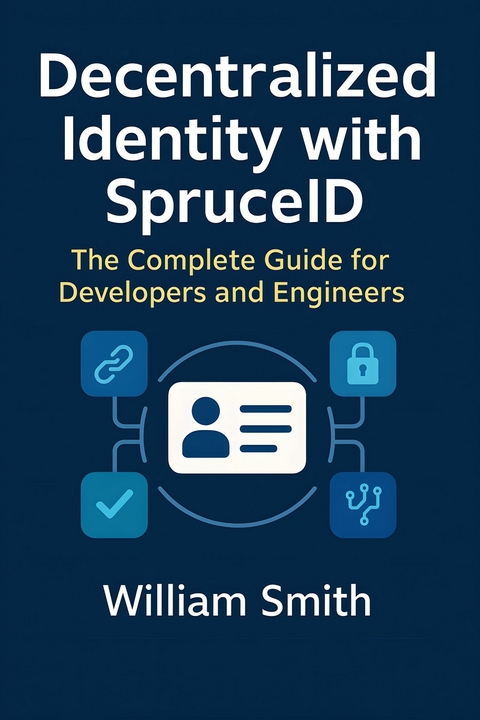
Decentralized Identity with SpruceID (eBook)
250 Seiten
HiTeX Press (Verlag)
978-0-00-102327-7 (ISBN)
'Decentralized Identity with SpruceID'
'Decentralized Identity with SpruceID' is an authoritative guide to the latest advancements in digital identity, providing a comprehensive and technical exploration of self-sovereign identity, trustless networks, verifiable credentials, and the architectural foundations that define modern decentralized systems. The book begins by grounding readers in the essential concepts, motivations, and cryptographic underpinnings of decentralized identity, while drawing crucial comparisons with legacy federated and enterprise identity paradigms. Through thorough examinations of privacy, security, and data sovereignty, it delivers actionable insights for both architects and practitioners striving to enable secure, user-centric identity ecosystems.
At the heart of the text lies an exhaustive reference to the SpruceID platform, meticulously detailing its modular architecture, supported DID methods, extensibility, and integration with blockchain networks. Readers will find extensive coverage of credential lifecycle management, advanced storage models, and cross-ecosystem interoperability strategies, as well as deep dives into sophisticated cryptographic protocols, distributed key management, hardware security, and risk mitigation. From credential issuance and selective disclosure to revocation and anti-fraud mechanisms, the book unpacks the workflows and governance patterns that power scalable, resilient decentralized identity deployments at both enterprise and consumer scales.
Going beyond technical infrastructure, the book addresses real-world integration challenges, highlighting best practices for bridging SpruceID with enterprise IAM systems, API and SDK design, multi-tenancy governance, and CI/CD pipelines tailored for secure identity operations. It further explores end-user experience, wallet architectures, consent management, and regulatory compliance, including alignment with global standards like GDPR and CCPA. Concluding with an insightful look at industry applications, ongoing research, and the evolution of global decentralized identity standards, this book is an indispensable resource for engineers, architects, compliance officers, and innovators who are shaping the future of digital identity.
Chapter 1
Principles and Foundations of Decentralized Identity
Step into the transformative world of decentralized identity, where individuals seize full control of their digital presence and trust is redefined for the age of distributed systems. This chapter unpacks the deep motivations, philosophical shifts, and technical underpinnings that power self-sovereign identity. By exploring the evolution from legacy models to trustless networks and cryptographic proof, you’ll gain both the high-level vision and the architectural rigor needed to understand the future of digital identity infrastructure.
1.1 Self-Sovereign Identity: Concepts and Motivations
The evolution of digital identity systems has been marked by a gradual shift from centralized architectures toward more user-centric paradigms, encapsulated in the concept of self-sovereign identity (SSI). SSI emerged as a response to the limitations and vulnerabilities inherent in traditional centralized and federated identity models, which have long dominated both commercial and governmental identity infrastructures. At its core, SSI advocates for the restoration of identity ownership and control directly into the hands of the individual, promoting autonomy, privacy, and interoperability in digital interactions.
The origins of SSI can be traced to contemporary concerns over data breaches, surveillance capitalism, and the asymmetric power dynamics between identity providers and identity subjects. Centralized identity repositories concentrate personal information, creating attractive targets for malicious actors and raising the potential for mass surveillance and unauthorized profiling. Federated systems, while distributing some trusting relationships across identity providers, still require intermediaries that maintain control over credentials and enforce access policies. These architectures not only produce single points of failure but also limit users’ agency over their digital persona, diminishing the meaningfulness of consent in the digital realm.
SSI’s foundational philosophy centers around a set of principles designed to recalibrate digital identity relationships to be fundamentally user-centric. Foremost among these principles is autonomy: individuals must be the authoritative source of their identity data, capable of creating, managing, and selectively disclosing verifiable credentials without undue reliance on intermediaries. Closely linked is the principle of consent, which mandates explicit, informed agreement from the identity holder before any personal data exchange. This requires transparent mechanisms enabling users to understand how their data will be used and by whom, in alignment with evolving privacy regulations such as the General Data Protection Regulation (GDPR).
Control over identity data extends beyond mere consent; it involves end-to-end governance, wherein users decide the lifecycle, revocation, and sharing scope of their credentials. The architecture of SSI leverages decentralized identifiers (DIDs) and blockchain or distributed ledger technologies to provide tamper-evident registries and cryptographic proof without reliance on any single controlling party. This technical empowerment fosters resilience and trustworthiness, as users possess both the data and the cryptographic keys that authenticate it.
Broader societal ramifications of SSI are multifaceted. By enabling inclusive access to digital identity without centralized gatekeepers, SSI has the potential to address inequalities that arise from identity exclusion, particularly in underserved or marginalized communities lacking formal documentation. Moreover, SSI reshapes power relationships by limiting the capacity for data aggregation and profiling inherent to current paradigms, aligning digital identity infrastructures closer to ethical standards that respect human dignity and privacy.
However, the transition to SSI entails significant social, ethical, and technical challenges. Ethically, the delegation of identity sovereignty to individuals raises questions about the responsibilities and risks borne by users, including the management of private cryptographic keys and understanding complex consent workflows. Societally, interoperability and standardization across diverse identity ecosystems are critical to preventing fragmentation and ensuring trust across borders and institutions. Additionally, mechanisms for identity recovery and dispute resolution must be carefully designed to accommodate real-world complexities without compromising SSI’s decentralization ethos.
The technological drivers underpinning SSI include advancements in cryptography, distributed ledger technologies, and secure hardware, which collectively enable decentralized trust frameworks. Cryptographic techniques such as zero-knowledge proofs and selective disclosure credentials allow users to prove attributes or claims without unnecessarily revealing underlying personal data, enhancing privacy and security. Distributed ledgers facilitate verifiable registries and credential revocation in a decentralized manner, attenuating reliance on centralized authorities and mitigating risks of censorship or data manipulation.
Further, SSI is motivated by regulatory and market trends emphasizing user empowerment and data protection. Legislative frameworks increasingly recognize digital identity as a critical component of digital rights management, driving demand for systems that embody principles of transparency, data minimization, and user control. Market forces also incentivize service providers to adopt interoperable, privacy-preserving identity solutions as differentiators in an environment increasingly conscious of trust and security.
In summary, self-sovereign identity represents a paradigm shift in digital identity, moving away from institutional control toward individual ownership grounded in autonomy, informed consent, and robust cryptographic assurance. This transformation addresses systemic vulnerabilities and ethical concerns endemic to centralized identity systems, while laying the groundwork for more inclusive, privacy-respecting, and resilient digital interactions. The consolidation of technological innovations, regulatory pressures, and societal values continues to propel SSI from conceptual frameworks toward practical implementations, promising a fundamentally reimagined landscape for identity in the digital age.
1.2 Decentralized Identifiers (DIDs): Architecture and Standards
Decentralized Identifiers (DIDs) represent a foundational technology for self-sovereign identity systems, emphasizing user control, privacy, and global verifiability without reliance on centralized authorities. The architecture of DIDs is defined by the W3C DID Core specification [?], which standardizes the syntax, semantics, and operations essential for decentralized identifier systems.
A DID is a globally unique persistent identifier that resolves to a DID Document, a machine-readable data structure containing cryptographic material, authentication protocols, and service endpoints. Formally, a DID URI has the following generic syntax:
where method-name denotes the DID method, specifying how the DID is registered, resolved, and updated on a particular decentralized network; and method-specific-id is a unique string defined by that method.
The lifecycle of a DID encompasses creation, update, recovery, and deactivation phases. These phases are orchestrated through cryptographically verifiable operations executed on distributed ledgers or decentralized networks according to each DID method’s protocol. Key lifecycle events include:
- Creation: Publishing an initial DID Document that binds the DID to public keys and service endpoints.
- Update: Modifying authentication keys or services, typically requiring authorization proofs (e.g., digital signatures) from existing keys.
- Recovery: Regaining control of a DID after key compromise, often involving a pre-registered recovery mechanism.
- Deactivation: Rendering a DID unusable, preventing further authentication or service discovery.
Operational integrity in the lifecycle is ensured through the cryptographic binding between identifiers and cryptographic proofs in the DID Document, preventing unauthorized alterations or impersonations.
DIDs must exhibit persistence over time to serve as reliable identifiers. Persistence entails durability of the identifier and its resolvability independent of centralized intermediaries. By leveraging decentralized ledgers or distributed consensus mechanisms, DIDs avoid single points of failure or censorship, addressing limitations of traditional centralized identity frameworks.
A core tenet of DIDs is the cryptographic binding between an identifier and associated cryptographic material. This binding ensures that a DID owner can generate verifiable proofs asserting control of the identifier. The DID Document enumerates one or more public keys, which serve for authentication and cryptographic operations. This mechanism provides strong guarantees against identity spoofing or unauthorized key changes.
Interoperability is fostered through the W3C’s ...
| Erscheint lt. Verlag | 19.8.2025 |
|---|---|
| Sprache | englisch |
| Themenwelt | Mathematik / Informatik ► Informatik ► Programmiersprachen / -werkzeuge |
| ISBN-10 | 0-00-102327-6 / 0001023276 |
| ISBN-13 | 978-0-00-102327-7 / 9780001023277 |
| Informationen gemäß Produktsicherheitsverordnung (GPSR) | |
| Haben Sie eine Frage zum Produkt? |
 EPUB (Adobe DRM)
Größe: 602 KB
Kopierschutz: Adobe-DRM
Adobe-DRM ist ein Kopierschutz, der das eBook vor Mißbrauch schützen soll. Dabei wird das eBook bereits beim Download auf Ihre persönliche Adobe-ID autorisiert. Lesen können Sie das eBook dann nur auf den Geräten, welche ebenfalls auf Ihre Adobe-ID registriert sind.
Details zum Adobe-DRM
Dateiformat: EPUB (Electronic Publication)
EPUB ist ein offener Standard für eBooks und eignet sich besonders zur Darstellung von Belletristik und Sachbüchern. Der Fließtext wird dynamisch an die Display- und Schriftgröße angepasst. Auch für mobile Lesegeräte ist EPUB daher gut geeignet.
Systemvoraussetzungen:
PC/Mac: Mit einem PC oder Mac können Sie dieses eBook lesen. Sie benötigen eine
eReader: Dieses eBook kann mit (fast) allen eBook-Readern gelesen werden. Mit dem amazon-Kindle ist es aber nicht kompatibel.
Smartphone/Tablet: Egal ob Apple oder Android, dieses eBook können Sie lesen. Sie benötigen eine
Geräteliste und zusätzliche Hinweise
Buying eBooks from abroad
For tax law reasons we can sell eBooks just within Germany and Switzerland. Regrettably we cannot fulfill eBook-orders from other countries.
aus dem Bereich


