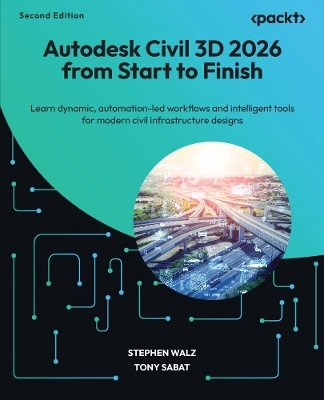
Autodesk Civil 3D 2026 from Start to Finish
Packt Publishing Limited (Verlag)
978-1-80602-835-1 (ISBN)
- Titel nicht im Sortiment
- Artikel merken
Bonus 1: Access chapter-by-chapter video tutorials on YouTube—follow along visually with every topic covered in the book.
Bonus 2: Download exercise files to practice each concept with real-world projects and reinforce your hands-on learning.
Key Features
Master the latest features and interface updates in Civil 3D 2026 to streamline modern infrastructure workflows
Scale your workflows to larger teams and bigger projects while maximizing efficiency
Learn how to work with enhanced modeling, corridor targeting, and pressure tools
Purchase of the print or Kindle book includes a free PDF eBook
Book DescriptionWith engineering projects getting bigger, deadlines getting tighter, and greater demands for precision, you need tools that do more and work smarter. Autodesk Civil 3D 2026 rises to the challenge, delivering powerful new capabilities for high-precision design modeling and streamlined collaboration. In this second edition, Stephen Walz and Tony Sabat, leaders in digital design and innovation in civil infrastructure, walk you through Civil 3D’s cutting-edge features, such as pressure layout improvements, dynamic corridor targeting, and performance enhancements for surface modeling and grading. It’s not just about learning new features; you’ll be able to integrate these new toolsets into real-world workflows, develop standards, and collaborate effectively within distributed teams. From surface development and intelligent utility design to smart document creation, this book explores practical and automated applications of tools and modeling techniques that you’ll use every day. Whether you work independently or are part of a large design team, you’ll walk away knowing how to configure, manage, and deliver projects with Civil 3D 2026 while improving your entire project pipeline.What you will learn
Create and manage surfaces, alignments, and profiles
Import and organize survey data for accurate base maps
Design roadways, parcels, and utility networks
Streamline design with Model Viewer, Dynamo, and Targeted Data References
Eliminate redundancy using intelligent, dynamic Civil 3D objects
Optimize 3D modeling to improve design decisions and outcomes
Automate sheet creation for profiles and sections
Model advanced corridor features such as intersections and rails
Who this book is forThis book is for civil engineers, environmental engineers, civil designers, civil technicians, and professionals working with Civil 3D or InfraWorks who want to maximize Civil 3D’s potential in their everyday design work. To get the most out of this guide, you'll need a basic understanding of civil engineering and surveying workflows, along with foundational knowledge of Autodesk AutoCAD. General familiarity with surveying practices, civil/environmental engineering practices, and AutoCAD drafting is assumed.
Stephen Walz has been working with a multitude of design, collaboration, and visualization platforms supporting the AEC Industry since early 2003. His primary focus has been on the Civil and Environmental Engineering side, where he has held varying levels of design support and CAD/BIM/CIM Management roles. Currently, Stephen is HDR's Corporate Digital Design Lead where he works with Business Group Leadership, Technical Leadership, Technologists, Vendors, and IT, to evaluate and implement new technologies, workflows and adoption strategies supporting the AECOO Industry, build awareness and drive consistency with how HDR's teams are leveraging the various tools and platforms, and identify ways to build skill sets across HDR around each of the platforms and technologies being leveraged. Furthermore, Stephen is an active member of: - AUGIWORLD Magazine as the BIM | CIM Content Manager - buildingSMART International as a member of the Education and Professional Certification Committee within buildingSMART's US Chapter - National Institute of Building Sciences (NIBS) as an NCS V7 Project Committee Member Tony Sabat is a consultant and advisor focusing on improving the built environment. He primarily works with innovative and disruptive companies refining technologies and processes, varying from early-stage startups to Fortune 500 companies. Tony partners with companies to develop their digital transformation strategies, as well as implement and sustain emerging technologies, such as reality data modeling, virtual construction simulation, and distributed ledger technology. Tony began his career in the early iterations of building information modeling and worked on integrating these concepts and technologies into the infrastructure space. Tony focuses primarily on reality capture, building information modeling, digital twin strategies, as well as virtual design and construction.
Table of Contents
Introduction to Civil 3D
Setting Up the Design Environment
Sharing Data within Civil 3D
Existing Conditions Modeling and Analysis
Leveraging Points, Lines, and Curves
Surfaces—The First Foundational Component to Design within Civil 3D
Alignments— The Second Foundational Component to Design within Civil 3D
Profiles—The Third Foundational Component to Design within Civil 3D
Land Development Tool Belt for Everyday Use
Roadway Modeling Tool Belt for Everyday Use
Advanced Roadway Modeling Tool Belt for Everyday Use
Utility Modeling Tool Belt for Everyday Use
Section Creation and Analysis
Automating Sheet Creation
Efficiency Gains Through Civil 3D Advancements
| Erscheinungsdatum | 12.08.2025 |
|---|---|
| Verlagsort | Birmingham |
| Sprache | englisch |
| Maße | 191 x 235 mm |
| Themenwelt | Informatik ► Weitere Themen ► CAD-Programme |
| Technik ► Bauwesen | |
| ISBN-10 | 1-80602-835-2 / 1806028352 |
| ISBN-13 | 978-1-80602-835-1 / 9781806028351 |
| Zustand | Neuware |
| Informationen gemäß Produktsicherheitsverordnung (GPSR) | |
| Haben Sie eine Frage zum Produkt? |
aus dem Bereich