Mathematics and Applications of Computer Graphics (eBook)
196 Seiten
Springer (Verlag)
978-981-96-2933-6 (ISBN)
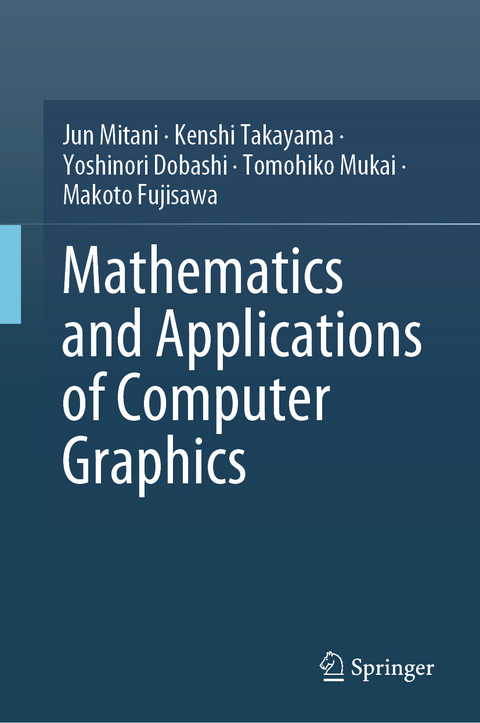
This book equips readers with the fundamentals of 3DCG that support the advanced technologies. The content of this book is divided into four categories: modeling, rendering, character animation, and physical simulation, and each is explained in a separate chapter. In simpler terms, these four technologies can be described as creating shapes, creating images, creating motion, and reproducing the behavior of the natural world. The 'Modeling' chapter describes the theory behind describing the shape of an object using surface meshes and then editing and manipulating them. The chapter 'Rendering' focuses on the calculation of the luminance of an object's surface, and describes methods for calculating global illumination and generating fast images using precomputation to produce realistic images. Physical phenomena such as light scattering, which is necessary to improve realism, are also explained. The 'Character Animation' chapter introduces the skeleton method, a standard technique in animation production, and describes various animation editing techniques for humanoid character models. Finally, the chapter on 'Physical Simulation' describes methods to compute the behavior of complex natural phenomena, including not only hard objects but also flowing objects such as water and air. The four topics listed here are the fundamental elements that support 3DCG. The chapters were written by researchers who are active at the forefront of their respective fields. Each of the authors has a remarkable track record and can be said to have led the development of 3DCG technology in Japan with their wealth of experience and knowledge.
To understand the mathematical content of this book, basic knowledge of analysis and linear algebra is required. This book is suitable for upper undergraduate and graduate students in computer science, engineering, and other fields in science, and is also useful for practitioners in game production and those who are interested in 3DCG.
This book equips readers with the fundamentals of 3DCG that support the advanced technologies. The content of this book is divided into four categories: modeling, rendering, character animation, and physical simulation, and each is explained in a separate chapter. In simpler terms, these four technologies can be described as creating shapes, creating images, creating motion, and reproducing the behavior of the natural world. The "e;Modeling"e; chapter describes the theory behind describing the shape of an object using surface meshes and then editing and manipulating them. The chapter "e;Rendering"e; focuses on the calculation of the luminance of an object's surface, and describes methods for calculating global illumination and generating fast images using precomputation to produce realistic images. Physical phenomena such as light scattering, which is necessary to improve realism, are also explained. The "e;Character Animation"e; chapter introduces the skeleton method, a standard technique in animation production, and describes various animation editing techniques for humanoid character models. Finally, the chapter on "e;Physical Simulation"e; describes methods to compute the behavior of complex natural phenomena, including not only hard objects but also flowing objects such as water and air. The four topics listed here are the fundamental elements that support 3DCG. The chapters were written by researchers who are active at the forefront of their respective fields. Each of the authors has a remarkable track record and can be said to have led the development of 3DCG technology in Japan with their wealth of experience and knowledge.To understand the mathematical content of this book, basic knowledge of analysis and linear algebra is required. This book is suitable for upper undergraduate and graduate students in computer science, engineering, and other fields in science, and is also useful for practitioners in game production and those who are interested in 3DCG.
| Erscheint lt. Verlag | 26.6.2025 |
|---|---|
| Zusatzinfo | IX, 196 p. 105 illus., 17 illus. in color. |
| Sprache | englisch |
| Original-Titel | 3DCGの数理と応用 |
| Themenwelt | Mathematik / Informatik ► Informatik ► Software Entwicklung |
| Schlagworte | 3DCG • 3D modeling • Character animation • Computer Graphics • Rendering |
| ISBN-10 | 981-96-2933-0 / 9819629330 |
| ISBN-13 | 978-981-96-2933-6 / 9789819629336 |
| Informationen gemäß Produktsicherheitsverordnung (GPSR) | |
| Haben Sie eine Frage zum Produkt? |
 PDF (Wasserzeichen)
DRM: Digitales Wasserzeichen
Dieses eBook enthält ein digitales Wasserzeichen und ist damit für Sie personalisiert. Bei einer missbräuchlichen Weitergabe des eBooks an Dritte ist eine Rückverfolgung an die Quelle möglich.
Dateiformat: PDF (Portable Document Format)
Mit einem festen Seitenlayout eignet sich die PDF besonders für Fachbücher mit Spalten, Tabellen und Abbildungen. Eine PDF kann auf fast allen Geräten angezeigt werden, ist aber für kleine Displays (Smartphone, eReader) nur eingeschränkt geeignet.
Systemvoraussetzungen:
PC/Mac: Mit einem PC oder Mac können Sie dieses eBook lesen. Sie benötigen dafür einen PDF-Viewer - z.B. den Adobe Reader oder Adobe Digital Editions.
eReader: Dieses eBook kann mit (fast) allen eBook-Readern gelesen werden. Mit dem amazon-Kindle ist es aber nicht kompatibel.
Smartphone/Tablet: Egal ob Apple oder Android, dieses eBook können Sie lesen. Sie benötigen dafür einen PDF-Viewer - z.B. die kostenlose Adobe Digital Editions-App.
Buying eBooks from abroad
For tax law reasons we can sell eBooks just within Germany and Switzerland. Regrettably we cannot fulfill eBook-orders from other countries.
aus dem Bereich