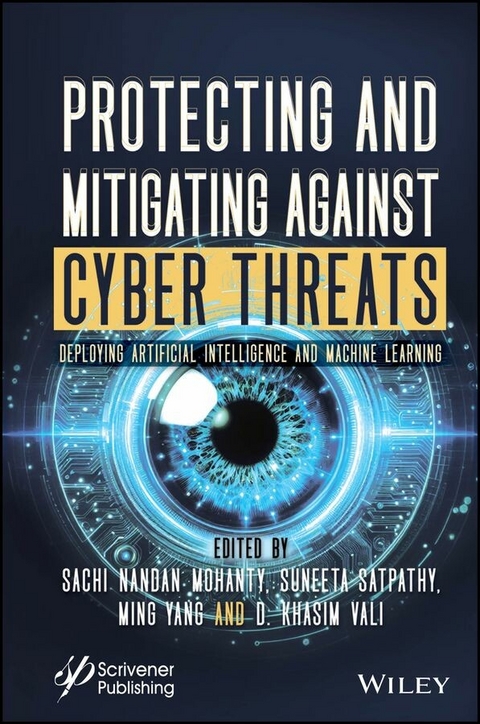
Protecting and Mitigating Against Cyber Threats (eBook)
790 Seiten
Wiley-Scrivener (Verlag)
978-1-394-30517-9 (ISBN)
The book provides invaluable insights into the transformative role of AI and ML in security, offering essential strategies and real-world applications to effectively navigate the complex landscape of today's cyber threats.
Protecting and Mitigating Against Cyber Threats delves into the dynamic junction of artificial intelligence (AI) and machine learning (ML) within the domain of security solicitations. Through an exploration of the revolutionary possibilities of AI and ML technologies, this book seeks to disentangle the intricacies of today's security concerns. There is a fundamental shift in the security soliciting landscape, driven by the extraordinary expansion of data and the constant evolution of cyber threat complexity. This shift calls for a novel strategy, and AI and ML show great promise for strengthening digital defenses. This volume offers a thorough examination, breaking down the concepts and real-world uses of this cutting-edge technology by integrating knowledge from cybersecurity, computer science, and related topics. It bridges the gap between theory and application by looking at real-world case studies and providing useful examples.
Protecting and Mitigating Against Cyber Threats provides a roadmap for navigating the changing threat landscape by explaining the current state of AI and ML in security solicitations and projecting forthcoming developments, bringing readers through the unexplored realms of AI and ML applications in protecting digital ecosystems, as the need for efficient security solutions grows. It is a pertinent addition to the multi-disciplinary discussion influencing cybersecurity and digital resilience in the future.
Readers will find in this book:
- Provides comprehensive coverage on various aspects of security solicitations, ranging from theoretical foundations to practical applications;
- Includes real-world case studies and examples to illustrate how AI and machine learning technologies are currently utilized in security solicitations;
- Explores and discusses emerging trends at the intersection of AI, machine learning, and security solicitations, including topics like threat detection, fraud prevention, risk analysis, and more;
- Highlights the growing importance of AI and machine learning in security contexts and discusses the demand for knowledge in this area.
Audience
Cybersecurity professionals, researchers, academics, industry professionals, technology enthusiasts, policymakers, and strategists interested in the dynamic intersection of artificial intelligence (AI), machine learning (ML), and cybersecurity.
Sachi Nandan Mohanty, PhD is an associate professor at the School of Computer Science and Engineering, VIT-AP University, Amaravati, Andhra Pradesh, India, He has published 60 articles in journals of international repute, edited 24 books, and serves as an editor for several international journals. His research interests include data mining, big data analysis, cognitive science, fuzzy decision making, brain-computer interface, cognition, and computational intelligence.
Suneeta Satpathy, PhD is an associate professor in the Center for Artificial Intelligence and Machine Learning at Siksha O. Anusandhan University, India. She has published several papers in international journals and conferences of repute and edited numerous books. Her research interests include computer forensics, cyber security, data fusion, data mining, big data analysis, and decision mining.
Ming Yang, PhD is a professor in the College of Computing and Software Engineering at Kennesaw State University, Georgia, USA and serves as a consultant for many companies. He has published over 70 peer-reviewed conference and journal papers and book chapters in addition to serving as an editor for several journals. His research interests include image processing, multimedia communication, computer vision, and machine learning.
D. Khasim Vali, PhD is an assistant professor in the School of Computer Science and Engineering, the Vellore Institute of Technology, Andhra Pradesh University, India, with over 18 years of teaching experience. He has 21 international publications to his credit and is a life member of ISTE and IETE. His research interests include artificial intelligence, machine learning, and deep learning.
The book provides invaluable insights into the transformative role of AI and ML in security, offering essential strategies and real-world applications to effectively navigate the complex landscape of today s cyber threats. Protecting and Mitigating Against Cyber Threats delves into the dynamic junction of artificial intelligence (AI) and machine learning (ML) within the domain of security solicitations. Through an exploration of the revolutionary possibilities of AI and ML technologies, this book seeks to disentangle the intricacies of today s security concerns. There is a fundamental shift in the security soliciting landscape, driven by the extraordinary expansion of data and the constant evolution of cyber threat complexity. This shift calls for a novel strategy, and AI and ML show great promise for strengthening digital defenses. This volume offers a thorough examination, breaking down the concepts and real-world uses of this cutting-edge technology by integrating knowledge from cybersecurity, computer science, and related topics. It bridges the gap between theory and application by looking at real-world case studies and providing useful examples. Protecting and Mitigating Against Cyber Threats provides a roadmap for navigating the changing threat landscape by explaining the current state of AI and ML in security solicitations and projecting forthcoming developments, bringing readers through the unexplored realms of AI and ML applications in protecting digital ecosystems, as the need for efficient security solutions grows. It is a pertinent addition to the multi-disciplinary discussion influencing cybersecurity and digital resilience in the future. Readers will find in this book: Provides comprehensive coverage on various aspects of security solicitations, ranging from theoretical foundations to practical applications; Includes real-world case studies and examples to illustrate how AI and machine learning technologies are currently utilized in security solicitations; Explores and discusses emerging trends at the intersection of AI, machine learning, and security solicitations, including topics like threat detection, fraud prevention, risk analysis, and more; Highlights the growing importance of AI and machine learning in security contexts and discusses the demand for knowledge in this area. Audience Cybersecurity professionals, researchers, academics, industry professionals, technology enthusiasts, policymakers, and strategists interested in the dynamic intersection of artificial intelligence (AI), machine learning (ML), and cybersecurity.
1
Foundations of AI and ML in Security
Sunil Kumar Mohapatra*, Ankita Biswal, Harapriya Senapati, Adyasha Swain and Swarupa Pattanaik
Centurion University of Technology and Management, Bhubaneswar, India
Abstract
The Internet has been ingrained in people’s daily lives worldwide; simultaneously, online criminal behavior has inspired advances in cybersecurity. Traditional cybersecurity approaches involve proactive efforts involving technologies, best practices, and policies to ensure information confidentiality, integrity, and availability. However, they have limitations, such as relying on static defense mechanisms, struggling with advanced threats, being dependent on perimeter defense, and the false positives/negatives. These vulnerabilities lead to increased Phishing attacks, Ransomware attacks, DDoS, MitM attacks, SQL Injection, IOT exploitation, and Social Engineering attacks. So, several data-driven computational models such as AI and ML have been revolutionized to address these security issues. The pillar of AI and ML in security lies in their potential to inspect vast amounts of data, make predictions, and detect patterns or decisions without explicit programming. Feature engineering methodology selects, manipulates, and builds essential features from raw data to improve the effectiveness of machine learning models in detecting and preventing cyber-attacks. These processes contribute to developing a clean, informative, and balanced dataset to train accurate and trustworthy machine learning models for cybersecurity tasks. Integrating real-time detection with WAF provides a proactive and dynamic security mechanism, allowing enterprises to respond quickly to developing cyber threats and defend their web applications from diverse attacks. This chapter elaborates on the technique for leveraging AI and ML in cybersecurity, emphasizing their synergistic role in improving attack detection, response, and overall system resilience.
Keywords: Artificial intelligence, machine learning, cybersecurity, data acquisition, web application firewall, SQL injection
Abbreviations
| AI | Artificial Intelligence |
| ML | Machine Learning |
| DDoS | Distributed Denial of Service |
| WAF | Web application Firewalls |
| IoT | Internet of Things |
| ALF | Application-Layer Filtering |
| IDS | Intrusion Detection Systems |
| NS | Network Segmentation |
| VPN | Virtual Private Network |
| ODK | Open Data Kit |
| DNN | Deep Neural Network MANET |
| Mobile Ad-hoc Network MAC | Media Access Control |
| SIEM | Security Information and Event Management |
| SOC | Security Operation Center |
| EDR | Endpoint Detection and Response |
| LOLBins | Living-off-the-Land Binaries |
| C&A | Certificate and Accreditation |
| SSDLC | Secure Software Development Life Cycle |
1.1 Introduction
In the digital age, Artificial Intelligence (AI) and Machine Learning (ML) are leading the way in technological advancements, bringing innovation to various fields, including healthcare, finance, and especially cybersecurity [1]. This chapter explores how AI and ML play a crucial role in strengthening digital security measures against the complex and evolving cyber threats accompanying the increasing use of the internet in our daily lives. As online criminal activities grow, there’s a pressing need to rethink our approach to cybersecurity. Traditional security strategies, although foundational, show significant shortcomings. These methods often rely on set rules and focus on defending the network’s perimeter. However, they struggle to keep up with the speed and sophistication of modern cyber threats. This struggle manifests in several ways: an over-reliance on known threat patterns makes it hard to identify new types of attacks; there’s difficulty managing false alarms, where legitimate activities are wrongly flagged as threats, and vice versa; and there’s a general lack of flexibility in responding to evolving threats. These issues highlight the urgent need for security solutions that are more dynamic and adaptable. This necessity for cybersecurity innovation has made AI and ML valuable tools in the fight against cybercrime. Unlike traditional methods, AI and ML can analyze vast amounts of data to spot patterns, anomalies, and potential vulnerabilities without being explicitly programmed to look for them. This ability is essential in cybersecurity, where threats continually change and new vulnerabilities emerge. By integrating AI and ML into cybersecurity practices, we enable a more proactive and intelligent defense system. This system can adapt to new threats in real time, offering a more effective way to protect digital assets and information.
1.1.1 The Convergence of AI and ML in Security
The convergence of AI and ML with cybersecurity represents a pivotal shift in addressing digital threats, heralding a new era of innovation that promises to enhance cyber threats’ identification, anticipation, and neutralization with unparalleled efficiency and accuracy. Traditional cybersecurity methods, largely dependent on static databases filled with signatures of known threats, are increasingly inadequate in the face of sophisticated and evolving cyber-attacks. In stark contrast, AI and ML algorithms excel at parsing through extensive and intricate datasets, identifying subtle patterns, anomalies, and potential vulnerabilities without being programmed to look for specific threats. This capability is indispensable in cybersecurity, where the threat landscape is dynamic but rapidly and continuously evolves, rendering previously effective threat signatures obsolete. AI and ML stand out by offering cybersecurity systems the ability to transition from reactive postures—where responses are only initiated after an attack has been detected—to proactive stances that predict and adapt to new threats in real time. This shift is crucial for modern cybersecurity frameworks, which must be agile enough to anticipate and mitigate threats before they can cause harm. Traditional cybersecurity defense, relying on predefined rules and known threat signatures, often fails to detect novel or sophisticated cyber-attacks until too late. AI and ML, however, can uncover and respond to such threats more swiftly and effectively through continuous learning and analysis. The integration of AI and ML into cybersecurity tools and practices enhances the ability to detect complex attacks, such as polymorphic malware, which changes its code to avoid detection or sophisticated phishing schemes that conventional systems might overlook. By analyzing user behavior, network traffic, and other indicators of compromise in real-time, AI-driven systems can identify potential security breaches with a high degree of accuracy, significantly reducing the incidence of false positives and negatives that can hinder the effectiveness of traditional security measures.
Moreover, the adaptability of AI and ML algorithms means that cybersecurity systems can learn from each attack, improving their predictive capabilities over time [2]. This learning process is crucial for keeping pace with the rapidly changing tactics employed by cybercriminals. For instance, machine learning models that analyze network traffic patterns can adapt to recognize the shifting behaviors indicative of a Distributed Denial of Service (DDoS) attack, enabling pre-emptive action to mitigate the attack before it can cause significant disruption. However, the potential of AI and ML in cybersecurity is challenging. The reliance on quality data for training models means that any biases in the data can lead to inaccurate predictions or overlooked threats. Additionally, as cyber attackers become more sophisticated, there is a growing risk of adversarial AI, where attackers use AI techniques to evade detection or to create more effective attacks. This cat-and-mouse game underscores the need for ongoing research, development, and ethical considerations in deploying AI and ML in cybersecurity.
A visual representation of this integration can be depicted in a block diagram illustrating the cybersecurity model powered by AI and ML. This model starts with data collection, gathering diverse datasets from network traffic, endpoints, and logs. It then proceeds to data preprocessing and feature engineering, where raw data is transformed into a format that ML algorithms can efficiently process. The heart of the model lies in the threat detection and analysis phase, where AI and ML techniques are employed to identify potential threats and vulnerabilities. Finally, the response mechanism, informed by the insights generated through AI and ML analysis, takes actions to mitigate identified threats, thereby closing the loop in a dynamic and adaptive cybersecurity system. Figure 1.1 represents the general overview of an AI/ML-based security model to mitigate different attack types.
Figure 1.1 General overview of a security model...
| Erscheint lt. Verlag | 24.6.2025 |
|---|---|
| Sprache | englisch |
| Themenwelt | Mathematik / Informatik ► Informatik ► Theorie / Studium |
| ISBN-10 | 1-394-30517-6 / 1394305176 |
| ISBN-13 | 978-1-394-30517-9 / 9781394305179 |
| Informationen gemäß Produktsicherheitsverordnung (GPSR) | |
| Haben Sie eine Frage zum Produkt? |
 EPUB (Adobe DRM)
Kopierschutz: Adobe-DRM
Adobe-DRM ist ein Kopierschutz, der das eBook vor Mißbrauch schützen soll. Dabei wird das eBook bereits beim Download auf Ihre persönliche Adobe-ID autorisiert. Lesen können Sie das eBook dann nur auf den Geräten, welche ebenfalls auf Ihre Adobe-ID registriert sind.
Details zum Adobe-DRM
Dateiformat: EPUB (Electronic Publication)
EPUB ist ein offener Standard für eBooks und eignet sich besonders zur Darstellung von Belletristik und Sachbüchern. Der Fließtext wird dynamisch an die Display- und Schriftgröße angepasst. Auch für mobile Lesegeräte ist EPUB daher gut geeignet.
Systemvoraussetzungen:
PC/Mac: Mit einem PC oder Mac können Sie dieses eBook lesen. Sie benötigen eine
eReader: Dieses eBook kann mit (fast) allen eBook-Readern gelesen werden. Mit dem amazon-Kindle ist es aber nicht kompatibel.
Smartphone/Tablet: Egal ob Apple oder Android, dieses eBook können Sie lesen. Sie benötigen eine
Geräteliste und zusätzliche Hinweise
Buying eBooks from abroad
For tax law reasons we can sell eBooks just within Germany and Switzerland. Regrettably we cannot fulfill eBook-orders from other countries.
aus dem Bereich