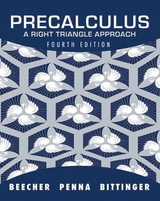
Precalculus
Pearson (Verlag)
978-0-321-46006-6 (ISBN)
- Titel erscheint in neuer Auflage
- Artikel merken
Judy Beecher has an undergraduate degree in mathematics from Indiana University and a graduate degree in mathematics from Purdue University. She has taught at both the high school and college levels with many years of developmental math and precalculus teaching experience at Indiana University - Purdue University Indianapolis. In addition to her career in textbook publishing, she spends time traveling, enjoying her grandchildren, and promoting charity projects for a children's camp. Judy Penna received her undergraduate degree in mathematics from Kansas State University and her graduate degree in mathematics from the University of Illinois. Since then, she has taught at Indiana University - Purdue University Indianapolis and at Butler University, and continues to focus on writing quality textbooks for undergraduate mathematics students. In her free time she likes to travel, read, knit and spend time with her children. Marvin Bittinger For over thirty-eight years, Professor Marvin L. Bittinger has been teaching math at the university level. Since 1968, he has been employed at Indiana University - Purdue University Indianapolis, and is now professor emeritus of mathematics education. Professor Bittinger has authored over 190 publications on topics ranging from basic mathematics to algebra and trigonometry to applied calculus. He received his BA in mathematics from Manchester College and his PhD in mathematics education from Purdue University. Special honors include Distinguished Visiting Professor at the United States Air Force Academy and his election to the Manchester College Board of Trustees from 1992 to 1999. His hobbies include hiking in Utah, baseball, golf, and bowling. Professor Bittinger has also had the privilege of speaking at many mathematics conventions, most recently giving a lecture entitled "Baseball and Mathematics." In addition, he also has an interest in philosophy and theology, in particular, apologetics. Professor Bittinger currently lives in Carmel, Indiana with his wife Elaine. He has two grown and married sons, Lowell and Chris, and four granddaughters.
Chapter R Basic Concepts of Algebra
R.1 The Real-Number System
R.2 Integer Exponents, Scientific Notation, and Order of Operations
R.3 Addition, Subtraction, and Multiplication of Polynomials
R.4 Factoring
R.5 Rational Expressions
R.6 Radical Notation and Rational Exponents
R.7 The Basics of Equation Solving
Chapter 1 Graphs, Functions, and Models
1.1 Introduction to Graphing
1.2 Functions and Graphs
1.3 Linear Functions, Slope, and Applications
1.4 Equations of Lines and Modeling
1.5 More on Functions
1.6 The Algebra of Functions
1.7 Symmetry and Transformations
Chapter 2 Functions, Equations, and Inequalities
2.1 Linear Equations, Functions, and Models
2.2 The Complex Numbers
2.3 Quadratic Equations, Functions, and Models
2.4 Analyzing Graphs of Quadratic Functions
2.5 More Equation Solving
2.6 Solving Linear Inequalities
Chapter 3 Polynomial And Rational Functions
3.1 Polynomial Functions and Models
3.2 Graphing Polynomial Functions
3.3 Polynomial Division; The Remainder and Factor Theorems
3.4 Theorems about Zeros of Polynomial Functions
3.5 Rational Functions
3.6 Polynomial and Rational Inequalities
3.7 Variation and Applications
Chapter 4 Exponential and Logarithmic Functions
4.1 Inverse Functions
4.2 Exponential Functions and Graphs
4.3 Logarithmic Functions and Graphs
4.4 Properties of Logarithmic Functions
4.5 Solving Exponential and Logarithmic Equations
4.6 Applications and Models: Growth and Decay, and Compound Interest
Chapter 5 The Trigonometric Functions
5.1 Trigonometric Functions of Acute Angles
5.2 Applications of Right Triangles
5.3 Trigonometric Functions of Any Angle
5.4 Radians, Arc Length, and Angular Speed
5.5 Circular Functions: Graphs and Properties
5.6 Graphs of Transformed Sine and Cosine Functions
Chapter 6 Trigonometric Identities, Inverse Functions, and Equations
6.1 Identities: Pythagorean and Sum and Difference
6.2 Identities: Cofunction, Double-Angle, and Half-Angle
6.3 Proving Trigonometric Identities
6.4 Inverses of the Trigonometric Functions
6.5 Solving Trigonometric Equations
Chapter 7 Applications of Trigonometry
7.1 The Law of Sines
7.2 The Law of Cosines
7.3 Complex Numbers: Trigonometric Form
7.4 Polar Coordinates and Graphs
7.5 Vectors and Applications
7.6 Vector Operations
Chapter 8 Systems of Equations and Matrices
8.1 Systems of Equations in Two Variables
8.2 Systems of Equations in Three Variables
8.3 Matrices and Systems of Equations
8.4 Matrix Operations
8.5 Inverses of Matrices
8.6 Determinants and Cramer's Rule
8.7 Systems of Inequalities and Linear Programming
8.8 Partial Fractions
Chapter 9 Analytic Geometry Topics
9.1 The Parabola
9.2 The Circle and the Eclipse
9.3 The Hyperbola
9.4 Nonlinear Systems of Equations and Inequalities
9.5 Rotation of Axes
9.6 Polar Equations of Conics
9.7 Parametric Equations
Chapter 10 Sequences, Series, and Combinatorics
10.1 Sequences and Series
10.2 Arithmetic Sequences and Series
10.3 Geometric Sequences and Series
10.4 Mathematical Induction
10.5 Combinatorics: Permutations
10.6 Combinatorics: Combinations
10.7 The Binomial Theorem
10.8 Probability
Appendix: Basic Concepts from Geometry
| Erscheint lt. Verlag | 16.2.2007 |
|---|---|
| Sprache | englisch |
| Maße | 263 x 209 mm |
| Gewicht | 2080 g |
| Themenwelt | Mathematik / Informatik ► Mathematik |
| ISBN-10 | 0-321-46006-5 / 0321460065 |
| ISBN-13 | 978-0-321-46006-6 / 9780321460066 |
| Zustand | Neuware |
| Informationen gemäß Produktsicherheitsverordnung (GPSR) | |
| Haben Sie eine Frage zum Produkt? |
aus dem Bereich