


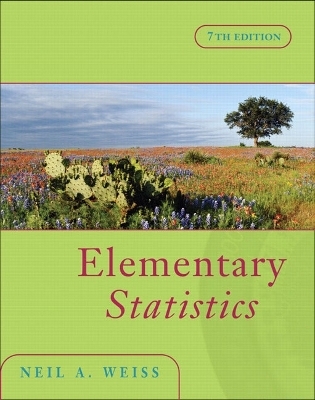
Elementary Statistics
Pearson
978-0-321-42209-5 (ISBN)
- Titel erscheint in neuer Auflage
- Artikel merken

This new edition continues the author’s tradition of cutting-edge statistical pedagogy and seamless integration of technology, and includes hundreds of new exercises with carefully cited data from journals, magazines, newspapers, and Web sites.
Elementary Statistics, Seventh Edition, is the ideal text for instructors who teach a one-semester course and prefer a briefer presentation of topics.
Datasets and other resources (where applicable) for this book are available here.
Neil A. Weiss received his Ph.D. from UCLA in 1970 and subsequently accepted an assistant-professor position at Arizona State University (ASU), where he was ultimately promoted to the rank of full professor. Dr. Weiss has taught statistics, probability, and mathematics—from the freshman level to the advanced graduate level—for more than 30 years. In recognition of his excellence in teaching, he received the Dean’s Quality Teaching Award from the ASU College of Liberal Arts and Sciences. Dr. Weiss’ comprehensive knowledge and experience ensures that his texts are mathematically and statistically accurate, as well as pedagogically sound. In addition to his numerous research publications, Dr. Weiss is the author of A Course in Probability (Addison-Wesley, 2006). He has also authored or coauthored books in finite mathematics, statistics, and real analysis, and is currently working on a new book on applied regression analysis and the analysis of variance. His texts—well known for their precision, readability, and pedagogical excellence—are used worldwide. Dr. Weiss is a pioneer of the integration of statistical software into textbooks and the classroom, first providing such integration over 20 years ago in the book Introductory Statistics (Addison-Wesley, 1982). Weiss and Addison-Wesley continue that pioneering spirit to this day with the inclusion of some of the most comprehensive Web sites in the field. In his spare time, Dr. Weiss enjoys walking, studying and practicing meditation, and playing hold ’em poker. He is married and has two sons.
Preface
Supplements List
Data Sources
PART I INTRODUCTION
Chapter 1 The Nature of Statistics
1.1 Statistics Basics
1.2 Simple Random Sampling
1.3 Other Sampling Designs*
1.4 Experimental Designs*
PART II DESCRIPTIVE STATISTICS
Chapter 2 Organizing Data
2.1 Variables and Data
2.2 Grouping Data
2.3 Graphs and Charts
2.4 Distribution Shapes
2.5 Misleading Graphs
Chapter 3 Descriptive Measures
3.1 Measures of Center
3.2 Measures of Variation
3.3 The Five-Number Summary; Boxplots
3.4 Descriptive Measures for Populations; Use of Samples
Chapter 4 Descriptive Methods in Regression and Correlation
4.1 Linear Equations With One Independent Variable
4.2 The Regression Equation
4.3 The Coefficient of Determination
4.4 Linear Correlation
PART III PROBABILITY, RANDOM VARIABLES, AND SAMPLING DISTRIBUTIONS
Chapter 5 Probability and Random Variables
5.1 Probability Basics
5.2 Events
5.3 Some Rules of Probability
5.4 Discrete Random Variables and Probability Distributions*
5.5 The Mean and Standard Deviation of a Discrete Random Variable*
5.6 The Binomial Distribution*
Chapter 6 The Normal Distribution
6.1 Introducing Normally Distributed Variables
6.2 Areas Under the Standard Normal Curve
6.3 Working with Normally Distributed Variables
6.4 Assessing Normality; Normal Probability Plots
Chapter 7 The Sampling Distribution of the Sample Mean
7.1 Sampling Error; the Need for Sampling Distributions
7.2 The Mean and Standard Deviation of the Sample Mean
7.3 The Sampling Distribution of the Sample Mean
PART IV INFERENTIAL STATISTICS
Chapter 8 Confidence Intervals for One Population Mean
8.1 Estimating a Population Mean
8.2 Confidence Intervals for One Population Mean When ? is Known
8.3 Margin of Error
8.4 Confidence Intervals for One Population Mean When ? is Unknown
Chapter 9 Hypothesis Tests for One Population Mean
9.1 The Nature of Hypothesis Testing
9.2 Terms, Errors, and Hypotheses
9.3 Hypothesis Tests for One Population Mean When ? is Known
9.4 P-Values
9.5 Hypothesis Tests for One Population Mean When ? is Unknown
Chapter 10 Inferences for Two Population Means
10.1 The Sampling Distribution of the Difference Between Two Sample Means for Independent Samples
10.2 Inferences for Two Population Means, Using Independent Samples: Standard Deviations Assumed Equal
10.3 Inferences for Two Population Means, Using Independent Samples: Standard Deviations Not Assumed Equal
10.4 Inferences for Two Population Means, Using Paired Samples
Chapter 11 Inferences for Population Proportions
11.1 Confidence Intervals for One Population Proportion
11.2 Hypothesis Tests for One Population Proportion
11.3 Inferences for Two Population Proportions
Chapter 12 Chi-Square Procedures
12.1 The Chi-Square Distribution
12.2 Chi-Square Goodness-of-Fit Test
12.3 Contingency Tables; Association
12.4 Chi-Square Independence Test
Chapter 13 Analysis of Variance (ANOVA)
13.1 The F-Distribution
13.2 One-Way ANOVA: The Logic
13.3 One-Way ANOVA: The Procedure
Chapter 14 Inferential Methods in Regression and Correlation
14.1 The Regression Model; Analysis of Residuals
14.2 Inferences for the Slope of the Population Regression Line
14.3 Estimation and Prediction
14.4 Inferences in Correlation
APPENDIXES
Appendix A Statistical Tables
I Random numbers
II Areas under the standard normal curve
III Normal scores
IV Values of tα
V Values of χα2
VI Values of Fα
VII Binomial probabilities
Appendix B Answers to Selected Exercises
*indicates an optinoal section
| Erscheint lt. Verlag | 8.6.2007 |
|---|---|
| Sprache | englisch |
| Maße | 216 x 254 mm |
| Gewicht | 1710 g |
| Themenwelt | Mathematik / Informatik ► Mathematik ► Statistik |
| ISBN-10 | 0-321-42209-0 / 0321422090 |
| ISBN-13 | 978-0-321-42209-5 / 9780321422095 |
| Zustand | Neuware |
| Informationen gemäß Produktsicherheitsverordnung (GPSR) | |
| Haben Sie eine Frage zum Produkt? |
aus dem Bereich


