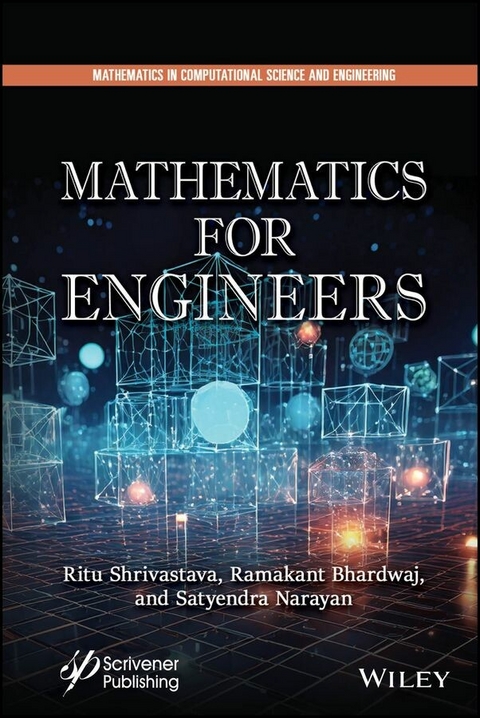
Mathematics for Engineers (eBook)
860 Seiten
Wiley-Scrivener (Verlag)
978-1-394-21459-4 (ISBN)
Mathematics for Engineers serves as a comprehensive guide on the basics of mathematics and their applications in engineering for students and seasoned professionals alike.
Mathematics for Engineers is designed to help students develop mathematical proficiencies, which are required in technical courses and careers involving strategic mathematical competence and adaptive reasoning. This volume also acts as a reference for professionals in engineering who need a refresher for their technical math skills. Through this book, students and professionals in the engineering discipline will build a capacity and expand their fundamental mathematical skills for logical thought, reflection, explanation, and justification in the field of applied science. This book is designed for general use for science and engineering students across the globe.
The book effectively compiles important information in one place alongside examples and practice problems with application and practice based questions. Emphasis is placed on the application of mathematics in appropriate context and modeling of real-world situations. By the end of this book, students and professionals in the engineering discipline will be able to present and process their mathematical reasoning and conclusions numerically, graphically, symbolically, and verbally.
Ritu Shrivastava, PhD, is an assistant professor in the Mathematics Department at Bahrain Polytechnic, India with over 20 years of teaching experience. She has published ten articles in national and international journals and conferences of repute. Her teaching interests include applied mathematics, calculus, algebra, coordinate geometry, trigonometry, and probability.
Ramakant Bhardwaj, PhD, is professor in the Mathematics Department at the Amity Institute of Applied Sciences, Kolkata, India with over 17 years of teaching experience. He has over 200 publications in national and international journals of repute. His research interest include nonlinear analysis, mathematical modeling, phase transition study, and computer oriented mathematics.
Satyendra Narayan, PhD, is a professor in the Applied Science and Technology Department at Sheridan College, Canada with over 25 years of research experience. He has published over 30 articles and worked on a projects with a number of institutions, including the United Nations Development Programme. His research interests include applied computing, geosciences, and electrical monitoring of subsurface processes.
Mathematics for Engineers serves as a comprehensive guide on the basics of mathematics and their applications in engineering for students and seasoned professionals alike. Mathematics for Engineers is designed to help students develop mathematical proficiencies, which are required in technical courses and careers involving strategic mathematical competence and adaptive reasoning. This volume also acts as a reference for professionals in engineering who need a refresher for their technical math skills. Through this book, students and professionals in the engineering discipline will build a capacity and expand their fundamental mathematical skills for logical thought, reflection, explanation, and justification in the field of applied science. This book is designed for general use for science and engineering students across the globe. The book effectively compiles important information in one place alongside examples and practice problems with application and practice based questions. Emphasis is placed on the application of mathematics in appropriate context and modeling of real-world situations. By the end of this book, students and professionals in the engineering discipline will be able to present and process their mathematical reasoning and conclusions numerically, graphically, symbolically, and verbally.
1
Fractions, Decimals, and Percentages
Objectives: This chapter
Introduces terminology associated with Fractions, decimals, and percentages.
Explains the methods to convert Fractions, decimals, and percentages.
1.1 Introduction
You may frequently have seen discounts written as 50% off or rate but never as 0.5 times the original rate in malls and stores. Also, when we convert currency, the exchange rates never show us as a decimal or a percentage.
These presentations are mathematically equivalent and are different ways of saying the same results.
The percentage considered is out of 100. A fraction is considered a number less than a whole. A Decimal is a number where the ‘whole’ part of a number and the ‘fractional’ part is separated by a decimal point.
1.2 Fractions
1.2.1 Definition of Fractions
A fraction is simply a value that represents part of a whole. The critical point that one must understand is that when we speak about a fraction, we generally refer to some whole thing. Whenever we divide a whole into two parts, both must be equal. We will always speak of some whole amount divided into a specified number of equally sized pieces. In short, we can think briefly about a fraction as given below.
Notation for a fraction is the slash (/) written between the two numbers. Another way of representing fractions is to keep a top number, the numerator, and a bottom number, the denominator. For example, we can write a fraction like . “3,” the top number, is the numerator, and “5,” the bottom, is the denominator.
1.2.2 Types of Fractions
We can see many different fractions, but the most popular are three types of fractions in Mathematics.
Common Fraction or Proper Fraction
When a fraction representing a part of the whole is known as a proper fraction (For example: in the case of a proper fraction, the denominator is always greater than the fraction’s numerator).
Look at the fraction . Can you tell if this is a proper fraction or not?
This fraction is a proper fraction as the denominator ‘8’ is greater than the numerator ‘3’.
is not a proper fraction as the numerator ‘8’ is greater than the denominator ‘3’.
Improper Fraction
A fraction that is not a proper fraction is called an improper fraction (e.g., the denominator of the improper fraction is less than or equal to its numerator).
is an improper fraction as the numerator ‘5’ is greater than the denominator ‘3’.
is not an improper fraction as the numerator ‘3’ is less than the denominator ‘5’.
Mixed Fraction
Those fractions expressed as a sum of a whole and a proper fraction number are called mixed fractions.
*How to Convert an Improper Fraction to a Mixed Fraction?
Divide the numerator until the remainder becomes less than the denominator, then the mixed fraction will be in the format shown below.
Integer part (Reminder/Denominator)
- Step 1: Divide the given fraction’s numerator by its denominator and note its quotient and remainder.
- Step 2: The integer part you got by division will be the integer part for a mixed fraction.
- Step 3: Leave the denominator the same as the original.
- Step 4: Write the improper fraction into the mixed fraction.
For example: Convert into a mixed fraction.
- Step 1: has ‘2’ as the quotient and ‘1’ as the remainder.
- Step 2: In this case, ‘2’ is the integer.
- Step 3: Here, the denominator is ‘8’.
- Step 4: Hence, is changed to a mixed fraction .
*How to Convert a Mixed Fraction to an Improper Fraction?
- Step 1: Multiply the denominator of the given fraction with the integer.
- Step 2: Add the fraction’s numerator to the result in step 1.
- Step 3: Leave the denominator the same as the original.
- Step 4: Write the mixed fraction as an improper fraction. Reduce the result to the simplest form.
For example: Convert into Improper fractions.
- Step 1: Multiply 8 with 2 in, , 8 × 2 = 16
- Step 2: Result in step 1 = 16 and numerator = 1, 1+ 16 =17.
- Step 3: Here, the denominator is ‘8’.
- Step 4: Hence, the improper fraction obtained is which is already in its simplest form.
Complex Fractions
A fraction in which the numerator, denominator, or both are fractions is called a complex fraction. , are examples of complex fractions.
Equivalent Fraction
Fractions that have the same final value are known as Equivalent Fractions.
For example:
For any problem, the final answer should be written in the simplest form.
Like Fractions
Like fractions are fractions that have the same denominator. , etc., are like fractions.
Unlike Fractions
Unlike fractions are fractions that have different denominators. , , etc., are unlike fractions.
Unit Fractions
A fraction with ‘1’ as the numerator and a “positive integer” as the denominator is a unit fraction. , , , are called unit fractions.
1.2.3 Simplest Form or Fraction in Lowest Term
A fraction in simplest forms is just a ratio, , where p and q share no common prime factors.
- Step 1: Identify a number that will divide into both the numerator and the denominator.
- Step 2: Divide the numerator and denominator by this number.
For example:
Also,
If a fraction’s numerator and denominator share only ‘1’ as a common factor, it is said to be in its simplest form.
EXAMPLE 1:
Convert to its lowest form.
SOLUTION: The factorization method determines the 225 and 180’s highest common factor (HCF).
The factors of 225 are 1, 3, 5, 9, 15, 25, 45, 75, and 225.
The factors of 180 are 1, 2, 3, 4, 5, 6, 9, 10, 12, 15, 18, 20, 30, 36, 45, 60, 90 and 180.
The common factors of 225 and 180 are 1, 3, 5, 9, 15, and 45.
The highest common factor (HCF) of 225 and 180 is 45.
1.2.4 Comparing Fractions
Looking at two given fractions and then figuring out which one is greater is known as Comparing fractions.
Comparing Like Fractions
It is always easy to compare two or more like fractions because their denominators are the same. Compare only the numerators of the given like fractions to identify which is greater. If there are two like fractions, the fraction with a greater numerator is greater.
For example:
To arrange more than two like fractions in ascending or descending order, we must arrange their numerators in ascending or descending order, respectively.
Comparing Unlike Fractions
If denominators are not the same, follow these steps:
- Step 1: Find the LCM (Least Common Multiple) of their denominators for the given fractions.
- Step 2: Reduce each fraction to its equivalent fraction with a denominator like the LCM obtained in step 1.
- Step 3: Finally, arrange the fractions in ascending or descending order by arranging the numerator in ascending or descending order.
EXAMPLE 2:
Sarah has three-fourths of a pizza, and Aisha has two-thirds. If both pizzas are the same size, which girl has more pizza?
SOLUTION: Fractions and have, unlike denominators, unlike numerators. We must change these fractions into equivalent fractions with a common denominator to simplify comparisons.
Since nine-twelfths is greater than eight-twelfths, three-fourths is greater than two-thirds. Therefore, Sarah had more pizza.
1.2.5 Algebra of Fractions
Addition & Subtraction of Fractions
*How to Add and Subtract Fractions?
- Step 1: Convert fractions to equivalent fractions with a common denominator.
- Step 2: Add or subtract the numerators only.
- Step 3: Leave the denominator the same.
- Step 4: Change the answer to the lowest terms
EXAMPLE 3:
Add and
SOLUTION: Here, the common denominator is “8” because both 2 and 8 are factors of 8
Similarly,
Multiplication of Fractions
*How to Multiply Fractions?
- Step 1: Multiply the numerators.
- Step 2: Multiply the denominators.
- Step 3: Reduce the answer to the lowest terms.
For example:
*How to Multiply Mixed Fractions?
- Step 1: Convert the mixed numbers to improper fractions first.
- Step 2: Multiply the numerators.
- Step 3: Multiply the denominators.
- Step 4: Reduce the answer to the lowest terms.
For example:
Division of Fractions
*How to Divide Fractions?
- Step...
| Erscheint lt. Verlag | 22.4.2025 |
|---|---|
| Sprache | englisch |
| Themenwelt | Mathematik / Informatik ► Mathematik |
| ISBN-10 | 1-394-21459-6 / 1394214596 |
| ISBN-13 | 978-1-394-21459-4 / 9781394214594 |
| Informationen gemäß Produktsicherheitsverordnung (GPSR) | |
| Haben Sie eine Frage zum Produkt? |
 EPUB (Adobe DRM)
Kopierschutz: Adobe-DRM
Adobe-DRM ist ein Kopierschutz, der das eBook vor Mißbrauch schützen soll. Dabei wird das eBook bereits beim Download auf Ihre persönliche Adobe-ID autorisiert. Lesen können Sie das eBook dann nur auf den Geräten, welche ebenfalls auf Ihre Adobe-ID registriert sind.
Details zum Adobe-DRM
Dateiformat: EPUB (Electronic Publication)
EPUB ist ein offener Standard für eBooks und eignet sich besonders zur Darstellung von Belletristik und Sachbüchern. Der Fließtext wird dynamisch an die Display- und Schriftgröße angepasst. Auch für mobile Lesegeräte ist EPUB daher gut geeignet.
Systemvoraussetzungen:
PC/Mac: Mit einem PC oder Mac können Sie dieses eBook lesen. Sie benötigen eine
eReader: Dieses eBook kann mit (fast) allen eBook-Readern gelesen werden. Mit dem amazon-Kindle ist es aber nicht kompatibel.
Smartphone/Tablet: Egal ob Apple oder Android, dieses eBook können Sie lesen. Sie benötigen eine
Geräteliste und zusätzliche Hinweise
Buying eBooks from abroad
For tax law reasons we can sell eBooks just within Germany and Switzerland. Regrettably we cannot fulfill eBook-orders from other countries.
aus dem Bereich