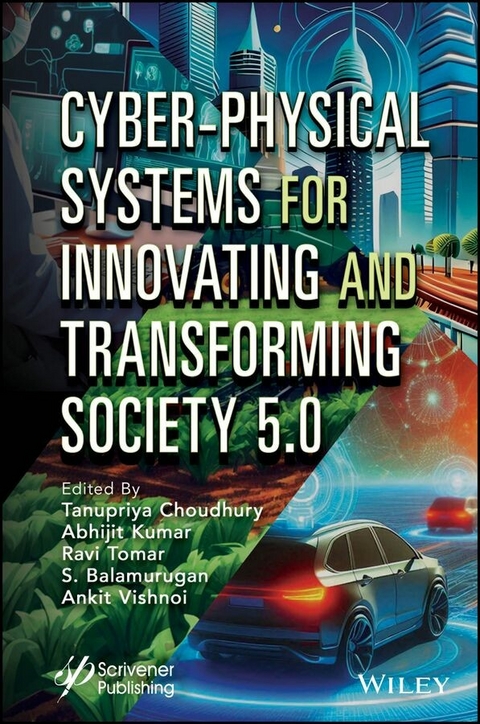
Cyber-Physical Systems for Innovating and Transforming Society 5.0 (eBook)
374 Seiten
Wiley-Scrivener (Verlag)
978-1-394-19773-6 (ISBN)
The book presents a suite of innovative tools to reshape society into an interconnected future where technology empowers humans to efficiently resolve pressing socio-economic issues while fostering inclusive growth.
This book introduces a spectrum of pioneering advancements across various sectors within Society 5.0, all underpinned by cutting-edge technological innovations. It aims to deliver an exhaustive collection of contemporary concepts, practical applications, and groundbreaking implementations that have the potential to enhance diverse areas of society. Society 5.0 signifies human advancement and is distinguished by its unique synthesis of cyberspace with physical space. This integration harnesses data gathered via environmental sensors, processed by artificial intelligence, to enhance real-world interactions. This volume encompasses an extensive array of scholarly works with detailed insights into fields such as image processing, natural language processing, computer vision, sentiment analysis, and analyses based on voice and gestures.
The content presented will be beneficial to multiple disciplines, including the legal system, medical systems, intelligent societal constructs, integrated cyber-physical systems, and innovative agricultural practices. In summary, Cyber-Physical Systems for Innovating and Transforming Society 5.0 presents a suite of innovative tools to reshape society into an interconnected future where technology empowers humans to efficiently resolve pressing socio-economic issues while fostering inclusive growth.
Audience
The book will be beneficial to researchers, engineers, and students in multiple disciplines, including the legal system, medical systems, intelligent societal constructs, integrated cyber-physical systems, and innovative agricultural practices.
Tanupriya Choudhury, PhD, is a professor and Associate Dean of Research at Graphic Era University, Dehradun, India, and a visiting professor at Daffodil International University, Bangladesh, with 15 years of research and teaching experience. He has published hundreds of papers in national and international journals and conferences, and more than 30 books and book chapters. He has also filed 25 patents and secured copyrights for 16 software programs for India's Ministry of Human Resource Development.
Abhijit Kumar, PhD, is an assistant professor in the School of Computer Science, University of Petroleum and Energy Sciences, Dehradun, India, with more than 13 years of academic and industry experience. He has published two patents and many research papers in international peer-reviewed journals and conferences. He is also a seasoned speaker and is a member of several professional bodies, including the International Association of Computer Science and Information Technology, Singapore; the International Association of Engineers, Hong Kong; and the Universal Association of Computer and Electronics Engineers.
Ravi Tomar, PhD, is a Senior Architect for Persistent Systems, India, with a history as an experienced academician in the higher education industry. He has trained numerous national and international corporations, including Confluent Apache Kafka, KeyBank, Accenture, and the Union Bank of the Philippines. He is skilled in programming, computer networking, stream processing, Python, Oracle database, C++, core Java, and CorDApp.
S. Balamurugan, PhD, is the Director of Research and Development, Intelligent Research Consultancy Services (iRCS), Coimbatore, Tamil Nadu, India. He is also Director of the Albert Einstein Engineering and Research Labs (AEER Labs), as well as Vice-Chairman of the Renewable Energy Society of India (RESI), India. He has published 50+ books, 200+ international journals/conferences, and 35 patents.
Ankit Vishnoi, PhD, is an associate professor at Graphic Era University, Dehradun, India, with over 19 years of comprehensive experience in academia and industry. He has published 20 research articles in esteemed journals and conferences, and holds two patents. Notably, he was involved in a Department of Science and Technology project during his tenure at the University of Petroleum and Energy Sciences, Dehradun.
The book presents a suite of innovative tools to reshape society into an interconnected future where technology empowers humans to efficiently resolve pressing socio-economic issues while fostering inclusive growth. This book introduces a spectrum of pioneering advancements across various sectors within Society 5.0, all underpinned by cutting-edge technological innovations. It aims to deliver an exhaustive collection of contemporary concepts, practical applications, and groundbreaking implementations that have the potential to enhance diverse areas of society. Society 5.0 signifies human advancement and is distinguished by its unique synthesis of cyberspace with physical space. This integration harnesses data gathered via environmental sensors, processed by artificial intelligence, to enhance real-world interactions. This volume encompasses an extensive array of scholarly works with detailed insights into fields such as image processing, natural language processing, computer vision, sentiment analysis, and analyses based on voice and gestures. The content presented will be beneficial to multiple disciplines, including the legal system, medical systems, intelligent societal constructs, integrated cyber-physical systems, and innovative agricultural practices. In summary, Cyber-Physical Systems for Innovating and Transforming Society 5.0 presents a suite of innovative tools to reshape society into an interconnected future where technology empowers humans to efficiently resolve pressing socio-economic issues while fostering inclusive growth. Audience The book will be beneficial to researchers, engineers, and students in multiple disciplines, including the legal system, medical systems, intelligent societal constructs, integrated cyber-physical systems, and innovative agricultural practices.
1
Revolutionizing Legal Operations: Benefits and Best Practices of Cyber-Physical Systems in Society 5.0
Ravi Kant*, Anil Kumar Dixit and Reena Roy
Uttaranchal University, Dehradun, India
Abstract
The legal industry is undergoing a change with the adoption of cyber–physical systems (CPS), which are amalgamated systems of physical and computational machineries. The CPS can offer several advantages to the legal fraternity, viz. accelerated performance, improved safety, enhanced collaboration, predictive analytics, and advanced smart contracts.
In this chapter, authors explore the use cases of CPS inside the legal fraternity, which includes case management, contract control, document management, legal research, and support for litigation. Authors additionally discuss the demanding situations of enforcing CPS in the legal organization, inclusive of resistance to transformation, cost of implementation, concerns related to security, and complexity of integration.
To overcome these challenges, authors provide the best practices which can be used for greater inclusion of CPS in the legal field, such as decoding the business case for CPS and assessing the technology panorama. Authors also provide examples of where CPS has been successfully implemented in the legal organizations. Finally, authors discuss the future of CPS for the legal industry, along with the scope of integrating CPS with the emerging technologies for greater efficiency and cost financial savings, and increased accuracy and effectiveness of legal procedures.
Keywords: Cyber–physical systems, legal industry, society 5.0, computational intelligence, use cases, best practices, integration with emerging technologies
1.1 Introduction
1.1.1 Cyber–Physical System
A new technological discipline that is the amalgamation of physical and virtual world is known as a cyber–physical system (CPS). This smart system has physical and computational entities that interact with each other for information sharing. The physical entities may include a machine, sensor, actuators, or a human and the computational entities encompass software, algorithms, and others.
The primary purpose of CPS is to improve performance and effectiveness in different areas of manufacturing, healthcare, energy, transportation. Seamless integration of physical and virtual world is to be done considering the real-time feedback. Different actuators, sensors are used to accumulate data from the physical world and send it to the virtual computational world for better analysis.
A CPS has massive applications in diverse fields. For example, in the healthcare industry, CPS can be utilized for better remote monitoring of patients, providing telemedical consultation with real time data on critical inputs and scientific records. This information will help in making an informed decision regarding the treatment of patients, in getting hold of the attention and caring for their needs.
In the manufacturing sector, CPS may be used to optimize manufacturing line, lowering downtime, and improving efficiency. This can be executed through the usage of sensors and machine learning (ML) algorithms, which can discover patterns and anomalies within the production technique and make modifications in real-time.
In the transportation enterprise, CPS can be used to improve traffic flow, reduce congestion, and improve safety. By tracking the traffic patterns in real-time, transport authorities can optimize traffic flow, decreasing congestion on metropolis roads and enhancing safety for all road travellers.
The blessings of CPS are clear. It can improve efficiency, lessen charges, enhance safety, and allow real-time decision-making. However, it is far essential to observe that CPS additionally comes with its challenges. One of the tremendous problems with CPS is safety. As CPS turns into greater use in diverse industries, the danger of cyber-attacks will increase. Therefore, it is vital to ensure that CPS structures are secure and guarded from malicious assaults.
Overall, CPS is an exciting new field with endless possibilities. It is reworking the way we live, toil, and interact with the people around us [1]. As we keep developing and refining CPS technologies, we will have to be extra innovative and impactful in finding its applications in numerous sectors.
A CPS is a network of physical and computational entities that engage with each other to share data and response; it combines digital and physical machineries to create an interconnected network that permits for the seamless integration of cyber systems with the physical world. A CPS has evolved swiftly in current years, and its usage in numerous fields have grown to be increasingly varied.
The CPS technology entails the development of advanced algorithms, intelligent sensors, and software that allow physical systems to interconnect with each other along with the virtual world; it enables the introduction of smart, linked systems that could examine and respond to changing circumstances in real-time, improving efficiency and enhancing productivity.
The CPS technology has been implemented in numerous regions, viz. transportation, healthcare, power, agriculture, and production. It has the capability to revolutionize how we engage with machines and how machines engage with each other. The CPS has become crucial in the legal field, wherein it has been conducted to enhance the performance of legal operations and enhance the delivery of legal services.
1.1.2 CPS Usage in the Legal Field
Cyber–Physical Systems (CPS) are making waves within the technology arena due to their seamless integration of with the physical entities, growing a “smart” society 5.0 with the use of disruptive technologies [2]. These CPS have emerged as the spine of current industries, inclusive of transportation, energy, healthcare, and manufacturing. However, CPS is not restrained to these industries, and it has diverse applications.
The criminal field is one that is inherently document-heavy and relies closely on manual processes, which is time-consuming and labor-intensive. However, the emergence of CPS has made it possible for the enterprise to adapt, improving its performance and effectiveness. The integration of CPS in the legal enterprise includes the use of technology along with data to create an overall system that could predict the consequences, automate process, and enhance access to legal services. For instance, CPS can help in automating research, drafting legal documents, and reviewing contracts, which will result in saving time, reducing charges, and increasing accuracy.
This can also help in the prediction of legal outcomes with the impactful usage of ML and predictive analytics. Results can be predicted based on the judgements passed in past criminal cases. It will assist in giving insight into the strengths and weaknesses of current cases and help law practitioners in making better decisions.
With the help of CPS, legal services can be made available to a much broader audience through the automation of legal processes. This includes the usage of chatbots to answer common legal questions, the creation of online legal platforms, and the usage of virtual digital assistants to guide individuals in legal processes.
Furthermore, CPS can be used to enhance protection and security of personal information. The legal field is known for its stringent safety features to shield sensitive information. CPS can assist in enhancing these measures by way of the using sensors and different technology to monitor access to exclusive information, pick out suspicious behaviour, and discover security breaches. It can revolutionize the way legal operations are conducted. It can automate some routine processes, improve access and security to legal services, predict the legal outcome, and can overall improve its performance and effectiveness.
1.2 Benefits of CPS in the Legal Field
1.2.1 Increased Efficiency
Biggest advantage of incorporating CPS in the legal field is that it can increase efficiency in its working style. By automating numerous repetitive tasks, it will be available for legal professionals to devote their time to more complicated activities. For instance, it can automatically generate a case number, create a draft of a legal file, and consequently reduce the time and effort on legal drafting and reviewing documents [3].
It can help professionals in managing their workload effectively. The CPS can be used to track work deadlines, which will ensure timely completion of different tasks. It can reduce the error or mistake that arises due to manual fatigue, resulting in improved quality of work.
The CPS can also streamline the way cases are handled. With the help of CPS, legal professionals can obtain vital information, fact, or files from remote locations at any time when required. This eases the collaboration among legal professionals and further reduces the time required to reach finality.
In addition to the above, CPS also can improve the process of legal research. Legal research entails a large amount of time and effort spent attempting to find relevant case laws, statutes, and regulations. With CPS, legal professionals can get access to large databases of legal records in seconds, saving effort and time.
Increased efficiency is one of the main advantages of CPS within the legal discipline. By automating repetitive tasks, streamlining workflow, improving collaboration, and providing statistics-driven insights, CPS can significantly enhance...
| Erscheint lt. Verlag | 28.3.2025 |
|---|---|
| Reihe/Serie | Artificial Intelligence and Soft Computing for Industrial Transformation |
| Sprache | englisch |
| Themenwelt | Mathematik / Informatik ► Informatik ► Theorie / Studium |
| ISBN-10 | 1-394-19773-X / 139419773X |
| ISBN-13 | 978-1-394-19773-6 / 9781394197736 |
| Informationen gemäß Produktsicherheitsverordnung (GPSR) | |
| Haben Sie eine Frage zum Produkt? |
 EPUB (Adobe DRM)
Kopierschutz: Adobe-DRM
Adobe-DRM ist ein Kopierschutz, der das eBook vor Mißbrauch schützen soll. Dabei wird das eBook bereits beim Download auf Ihre persönliche Adobe-ID autorisiert. Lesen können Sie das eBook dann nur auf den Geräten, welche ebenfalls auf Ihre Adobe-ID registriert sind.
Details zum Adobe-DRM
Dateiformat: EPUB (Electronic Publication)
EPUB ist ein offener Standard für eBooks und eignet sich besonders zur Darstellung von Belletristik und Sachbüchern. Der Fließtext wird dynamisch an die Display- und Schriftgröße angepasst. Auch für mobile Lesegeräte ist EPUB daher gut geeignet.
Systemvoraussetzungen:
PC/Mac: Mit einem PC oder Mac können Sie dieses eBook lesen. Sie benötigen eine
eReader: Dieses eBook kann mit (fast) allen eBook-Readern gelesen werden. Mit dem amazon-Kindle ist es aber nicht kompatibel.
Smartphone/Tablet: Egal ob Apple oder Android, dieses eBook können Sie lesen. Sie benötigen eine
Geräteliste und zusätzliche Hinweise
Buying eBooks from abroad
For tax law reasons we can sell eBooks just within Germany and Switzerland. Regrettably we cannot fulfill eBook-orders from other countries.
aus dem Bereich