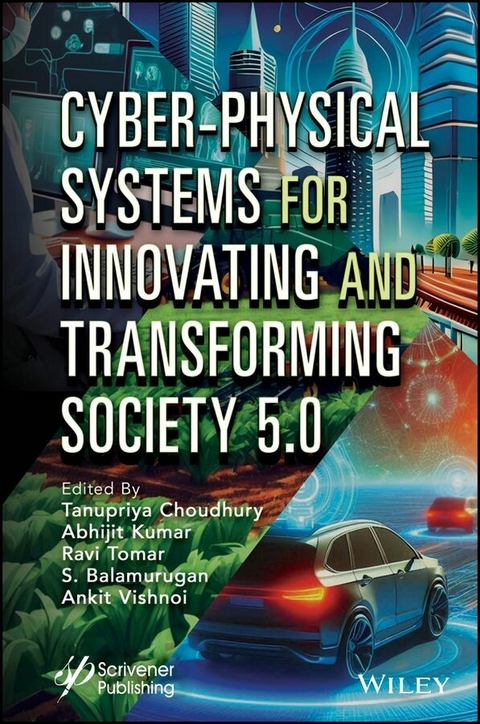
Cyber-Physical Systems for Innovating and Transforming Society 5.0 (eBook)
277 Seiten
Wiley-Scrivener (Verlag)
978-1-394-19774-3 (ISBN)
The book presents a suite of innovative tools to reshape society into an interconnected future where technology empowers humans to efficiently resolve pressing socio-economic issues while fostering inclusive growth.
This book introduces a spectrum of pioneering advancements across various sectors within Society 5.0, all underpinned by cutting-edge technological innovations. It aims to deliver an exhaustive collection of contemporary concepts, practical applications, and groundbreaking implementations that have the potential to enhance diverse areas of society. Society 5.0 signifies human advancement and is distinguished by its unique synthesis of cyberspace with physical space. This integration harnesses data gathered via environmental sensors, processed by artificial intelligence, to enhance real-world interactions. This volume encompasses an extensive array of scholarly works with detailed insights into fields such as image processing, natural language processing, computer vision, sentiment analysis, and analyses based on voice and gestures.
The content presented will be beneficial to multiple disciplines, including the legal system, medical systems, intelligent societal constructs, integrated cyber-physical systems, and innovative agricultural practices. In summary, Cyber-Physical Systems for Innovating and Transforming Society 5.0 presents a suite of innovative tools to reshape society into an interconnected future where technology empowers humans to efficiently resolve pressing socio-economic issues while fostering inclusive growth.
Audience
The book will be beneficial to researchers, engineers, and students in multiple disciplines, including the legal system, medical systems, intelligent societal constructs, integrated cyber-physical systems, and innovative agricultural practices.
Tanupriya Choudhury, PhD, is a professor and Associate Dean of Research at Graphic Era University, Dehradun, India, and a visiting professor at Daffodil International University, Bangladesh, with 15 years of research and teaching experience. He has published hundreds of papers in national and international journals and conferences, and more than 30 books and book chapters. He has also filed 25 patents and secured copyrights for 16 software programs for India's Ministry of Human Resource Development.
Abhijit Kumar, PhD, is an assistant professor in the School of Computer Science, University of Petroleum and Energy Sciences, Dehradun, India, with more than 13 years of academic and industry experience. He has published two patents and many research papers in international peer-reviewed journals and conferences. He is also a seasoned speaker and is a member of several professional bodies, including the International Association of Computer Science and Information Technology, Singapore; the International Association of Engineers, Hong Kong; and the Universal Association of Computer and Electronics Engineers.
Ravi Tomar, PhD, is a Senior Architect for Persistent Systems, India, with a history as an experienced academician in the higher education industry. He has trained numerous national and international corporations, including Confluent Apache Kafka, KeyBank, Accenture, and the Union Bank of the Philippines. He is skilled in programming, computer networking, stream processing, Python, Oracle database, C++, core Java, and CorDApp.
S. Balamurugan, PhD, is the Director of Research and Development, Intelligent Research Consultancy Services (iRCS), Coimbatore, Tamil Nadu, India. He is also Director of the Albert Einstein Engineering and Research Labs (AEER Labs), as well as Vice-Chairman of the Renewable Energy Society of India (RESI), India. He has published 50+ books, 200+ international journals/conferences, and 35 patents.
Ankit Vishnoi, PhD, is an associate professor at Graphic Era University, Dehradun, India, with over 19 years of comprehensive experience in academia and industry. He has published 20 research articles in esteemed journals and conferences, and holds two patents. Notably, he was involved in a Department of Science and Technology project during his tenure at the University of Petroleum and Energy Sciences, Dehradun.
The book presents a suite of innovative tools to reshape society into an interconnected future where technology empowers humans to efficiently resolve pressing socio-economic issues while fostering inclusive growth. This book introduces a spectrum of pioneering advancements across various sectors within Society 5.0, all underpinned by cutting-edge technological innovations. It aims to deliver an exhaustive collection of contemporary concepts, practical applications, and groundbreaking implementations that have the potential to enhance diverse areas of society. Society 5.0 signifies human advancement and is distinguished by its unique synthesis of cyberspace with physical space. This integration harnesses data gathered via environmental sensors, processed by artificial intelligence, to enhance real-world interactions. This volume encompasses an extensive array of scholarly works with detailed insights into fields such as image processing, natural language processing, computer vision, sentiment analysis, and analyses based on voice and gestures. The content presented will be beneficial to multiple disciplines, including the legal system, medical systems, intelligent societal constructs, integrated cyber-physical systems, and innovative agricultural practices. In summary, Cyber-Physical Systems for Innovating and Transforming Society 5.0 presents a suite of innovative tools to reshape society into an interconnected future where technology empowers humans to efficiently resolve pressing socio-economic issues while fostering inclusive growth. Audience The book will be beneficial to researchers, engineers, and students in multiple disciplines, including the legal system, medical systems, intelligent societal constructs, integrated cyber-physical systems, and innovative agricultural practices.
| Erscheint lt. Verlag | 12.3.2025 |
|---|---|
| Reihe/Serie | Artificial Intelligence and Soft Computing for Industrial Transformation |
| Sprache | englisch |
| Themenwelt | Mathematik / Informatik ► Informatik ► Theorie / Studium |
| ISBN-10 | 1-394-19774-8 / 1394197748 |
| ISBN-13 | 978-1-394-19774-3 / 9781394197743 |
| Informationen gemäß Produktsicherheitsverordnung (GPSR) | |
| Haben Sie eine Frage zum Produkt? |
 PDF (Adobe DRM)
Kopierschutz: Adobe-DRM
Adobe-DRM ist ein Kopierschutz, der das eBook vor Mißbrauch schützen soll. Dabei wird das eBook bereits beim Download auf Ihre persönliche Adobe-ID autorisiert. Lesen können Sie das eBook dann nur auf den Geräten, welche ebenfalls auf Ihre Adobe-ID registriert sind.
Details zum Adobe-DRM
Dateiformat: PDF (Portable Document Format)
Mit einem festen Seitenlayout eignet sich die PDF besonders für Fachbücher mit Spalten, Tabellen und Abbildungen. Eine PDF kann auf fast allen Geräten angezeigt werden, ist aber für kleine Displays (Smartphone, eReader) nur eingeschränkt geeignet.
Systemvoraussetzungen:
PC/Mac: Mit einem PC oder Mac können Sie dieses eBook lesen. Sie benötigen eine
eReader: Dieses eBook kann mit (fast) allen eBook-Readern gelesen werden. Mit dem amazon-Kindle ist es aber nicht kompatibel.
Smartphone/Tablet: Egal ob Apple oder Android, dieses eBook können Sie lesen. Sie benötigen eine
Geräteliste und zusätzliche Hinweise
Buying eBooks from abroad
For tax law reasons we can sell eBooks just within Germany and Switzerland. Regrettably we cannot fulfill eBook-orders from other countries.
aus dem Bereich