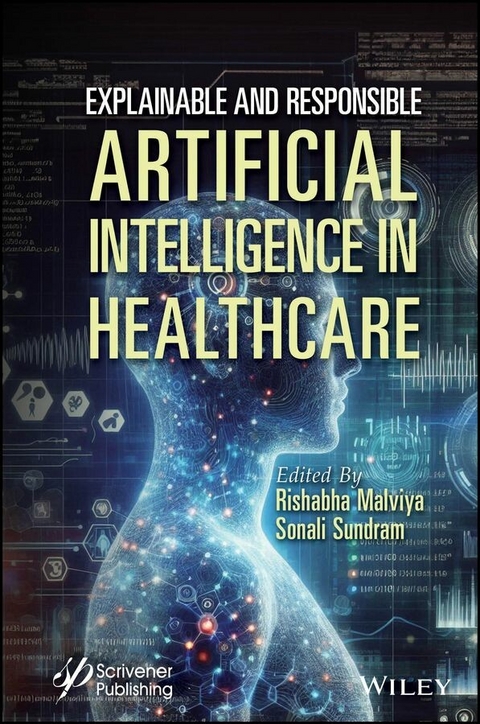
Explainable and Responsible Artificial Intelligence in Healthcare (eBook)
545 Seiten
Wiley-Scrivener (Verlag)
978-1-394-30242-0 (ISBN)
This book presents the fundamentals of explainable artificial intelligence (XAI) and responsible artificial intelligence (RAI), discussing their potential to enhance diagnosis, treatment, and patient outcomes.
This book explores the transformative potential of explainable artificial intelligence (XAI) and responsible AI (RAI) in healthcare. It provides a roadmap for navigating the complexities of healthcare-based AI while prioritizing patient safety and well-being. The content is structured to highlight topics on smart health systems, neuroscience, diagnostic imaging, and telehealth. The book emphasizes personalized treatment and improved patient outcomes in various medical fields. In addition, this book discusses osteoporosis risk, neurological treatment, and bone metastases. Each chapter provides a distinct viewpoint on how XAI and RAI approaches can help healthcare practitioners increase diagnosis accuracy, optimize treatment plans, and improve patient outcomes.
Readers will find the book:
- explains recent XAI and RAI breakthroughs in the healthcare system;
- discusses essential architecture with computational advances ranging from medical imaging to disease diagnosis;
- covers the latest developments and applications of XAI and RAI-based disease management applications;
- demonstrates how XAI and RAI can be utilized in healthcare and what problems the technology faces in the future.
Audience
The main audience for this book is targeted to scientists, healthcare professionals, biomedical industries, hospital management, engineers, and IT professionals interested in using AI to improve human health.
Rishabha Malviya, PhD, is an associate professor in the Department of Pharmacy, School of Medical and Allied Sciences, Galgotias University. He has authored more than 150 research/review papers for national/international journals of repute. He has been granted more than 10 patents from different countries while a further 40 patents have either been published or under evaluation. His areas of interest include formulation optimization, nanoformulation, targeted drug delivery, localized drug delivery, and characterization of natural polymers as pharmaceutical excipients.
Sonali Sundram, PhD and MPharm, completed her doctorate in pharmacy and is an assistant professor at Galgotias University, Greater Noida. Her areas of interest are neurodegeneration, clinical research, and artificial intelligence. She has edited four books.
This book presents the fundamentals of explainable artificial intelligence (XAI) and responsible artificial intelligence (RAI), discussing their potential to enhance diagnosis, treatment, and patient outcomes. This book explores the transformative potential of explainable artificial intelligence (XAI) and responsible AI (RAI) in healthcare. It provides a roadmap for navigating the complexities of healthcare-based AI while prioritizing patient safety and well-being. The content is structured to highlight topics on smart health systems, neuroscience, diagnostic imaging, and telehealth. The book emphasizes personalized treatment and improved patient outcomes in various medical fields. In addition, this book discusses osteoporosis risk, neurological treatment, and bone metastases. Each chapter provides a distinct viewpoint on how XAI and RAI approaches can help healthcare practitioners increase diagnosis accuracy, optimize treatment plans, and improve patient outcomes. Readers will find the book: explains recent XAI and RAI breakthroughs in the healthcare system; discusses essential architecture with computational advances ranging from medical imaging to disease diagnosis; covers the latest developments and applications of XAI and RAI-based disease management applications; demonstrates how XAI and RAI can be utilized in healthcare and what problems the technology faces in the future. Audience The main audience for this book is targeted to scientists, healthcare professionals, biomedical industries, hospital management, engineers, and IT professionals interested in using AI to improve human health.
1
Uncapping Explainable Artificial Intelligence–Centered Reinforcement Learning and Natural Language Processing in Smart Healthcare System
Bhupinder Singh1*, Rishabha Malviya2, Christian Kaunert3,4 and Sathvik Belagodu Sridhar5
1School of Law, Sharda University, Greater Noida, India
2Department of Pharmacy, School of Medical and Allied Sciences, Galgotias University, Greater Noida, India
3School of Law and Government, Dublin City University, Dublin, Ireland
4Director of the International Centre for Policing and Security at the University of South Wales, Cardiff, UK
5Department of Clinical Pharmacy and Pharmacology, RAK College of Pharmacy, RAK Medical and Health Sciences University, Ras Al Khaimah, United Arab Emirates
Abstract
Smart healthcare involves utilizing technologies like cloud computing, Internet of Things (IoT), and artificial intelligence (AI) to establish an effective, convenient, and tailored healthcare system. Health data gathered at a user level can be shared with healthcare professionals for further evaluation. AI, combined with this data, aids in health screening, early disease detection, and treatment planning. Explainable AI (XAI) is a key component of the responsible AI approach and is a prerequisite for the responsible application of AI. The goal of XAI’s approach is to investigate several approaches in order to provide a variety of strategies that will provide future developers with a range of design options that address the trade-off between explainability and performance. Natural language processing (NLP) techniques are revolutionizing electronic health record (EHR) management within the healthcare sector. Utilizing recurrent neural network models, NLP methods are employed to analyze unstructured EHR notes, extracting clinical information such as signs and symptoms represented by named entities. This chapter comprehensively explores the diverse arena of XAI-based reinforcement learning in smart healthcare sector with NLP.
Keywords: Explainable artificial intelligence (XAI), healthcare, natural language processing techniques, patient engagement, clinical practices
1.1 Introduction
The term “smart healthcare” refers to a framework for the delivery of healthcare that makes use of cutting-edge technologies such as big data, blockchain, artificial intelligence (AI), cloud/edge computing, and the Internet of Things (IoT) to create a variety of intelligent systems that connect healthcare stakeholders and improve the standard of care [1, 2]. These applications include medical picture analysis, cancer-related sickness analysis, patient health data recording, and relevant economic data [3]. Historically, cloud-based AI learning and data analytics capabilities have been the main focus of smart healthcare systems [4, 5]. However, because raw data transfer results in inefficient communication delay, this centralized strategy is unable to attain significant network scalability [6, 7]. Regulations like the US Health Insurance Portability and Accountability Act apply to personal data in e-healthcare. Also, a dispersed AI system over a broad Internet-of-Medical-Things (IoMT) network may be required if a centralized AI system is not found to be feasible in future healthcare systems [8]. As such, moving to distributed AI techniques at the network edge is essential for intelligent healthcare systems that are both scalable and privacy-preserving [9].
Smart healthcare involves utilizing technologies like cloud computing, IoT, and AI to establish an effective, convenient, and tailored healthcare system [10]. These technologies enable real-time health monitoring through healthcare apps on smartphones or wearables, empowering individuals to manage their well-being [11]. Health data gathered at a user level can be shared with healthcare professionals for further evaluation. AI, combined with this data, aids in health screening, early disease detection, and treatment planning [12]. However, in healthcare, the ethical dilemma of transparency concerning AI and the skepticism surrounding the opaque nature of AI systems necessitates the development of AI models that can be elucidated [13]. These AI methods, geared toward explaining AI models and their predictions, are referred to as explainable AI (XAI) techniques [14].
Figure 1.1 Landscapes of introduction split section.
1.1.1 XAI in Healthcare: Relevance and Overview
The emergence of the IoMT has led to notable changes in the way healthcare institutions operate, improving the quality of care that they offer [14, 15]. The IoMT devices are frequently used to gather healthcare data because they are capable of sensing and transmitting updates on an individual’s health [15, 16]. Artificial intelligence is then employed to process this data, leading to a variety of healthcare applications, such as illness prognosis and remote patient monitoring [17].
1.1.2 Importance of Explainability in AI
Explainable AI is a key component of the responsible AI approach and is a prerequisite for the responsible application of AI [18, 19]. This method emphasizes justice, model explainability, and accountability while promoting the broad use of AI approaches in actual corporate contexts [20, 21]. The organizations must build AI systems based on trust and transparency by incorporating ethical standards into AI applications and procedures in order to encourage the responsible deployment of AI [22, 23].
1.1.3 Role of Reinforcement Learning and NLP in Smart Healthcare
With new AI technologies enabling a variety of intelligent applications across diverse healthcare contexts, smart healthcare has advanced significantly [24, 25]. Because it can understand and analyze human language, natural language processing (NLP) is one of these technologies that stand out as being essential [26]. In this work, it does a thorough analysis of previous studies on the application of NLP in smart healthcare, looking at both its theoretical underpinnings and real-world uses [27, 28].
Modern technologies have long been adopted by the healthcare industry, where machine learning (ML) and AI have many uses similar to those in business and e-commerce. With this technology, the possibilities are practically endless. With its creative uses, ML is significantly changing the healthcare sector [8]. Driven by prerequisites like electronic medical records (EMR), healthcare institutions have already incorporated next-generation data analytics using big data techniques. With ML technologies, this process may be further improved, leading to higher-quality automation and more intelligent decision-making in public healthcare systems and primary/tertiary patient care [29]. This has the potential to significantly enhance the standard of living for billions of people around the globe. Personalized medicine, treatment planning, scheduling surgeries and appointments, and other complex medical decision-making problems have found a strong advocate in reinforcement learning (RL) [30]. Within the field of NLP, RL has attracted a lot of attention due to its ability to learn the best possible methods for tasks such as question answering, machine translation, and conversation systems [31].
1.1.4 Objectives of the Chapter
This chapter has the following objectives:
- to provide a contemporary overview of federated learning (FL)–based AI in healthcare, starting with fundamental concepts of FL and key AI principles, alongside features of XAI, followed by an in-depth exploration of the efficiency of smart healthcare;
- to introduce recent advancements in FL-XAI taxonomies and emerging integrations of AI-FL, highlighting their relevance to intelligent healthcare applications;
- to tackle technical challenges existing within current systems and propose solutions utilizing a wide array of technologies, including FL, AI, and XAI, within healthcare applications; and
- to scrutinize the challenges posed by various applications and chart a path for further research focusing on XAI in innovative healthcare domains.
Figure 1.2 The objectives of the chapter.
1.1.5 Structure of the Chapter
This chapter comprehensively explores the XAI-based RL and NLP in smart healthcare system. Section 1.2 expresses the XAI-based RL in smart healthcare systems. Section 1.3 discusses the NLP in smart healthcare systems. Section 1.4 specifies the incorporation of XAI-based RL and NLP. Section 1.5 highlights the synergies between XAI, RL, and NLP in healthcare. Section 1.6 elaborates the patient engagement and care management in health sector: XAI and NLP methods. Finally, Section 1.7 concludes the chapter, as well as the future scope and implications for healthcare practice.
1.2 XAI-Based Reinforcement Learning in Smart Healthcare Systems
Reinforcement learning (RL) has become a potent method for addressing intricate medical decision-making challenges, including treatment planning, personalized medicine, and optimizing surgery and appointment schedules [32]. However, the opaque nature of AI based on deep learning algorithms makes physicians unsure about the results of their diagnoses [33, 34]. Providing strong proof of these...
| Erscheint lt. Verlag | 4.3.2025 |
|---|---|
| Sprache | englisch |
| Themenwelt | Mathematik / Informatik ► Informatik ► Theorie / Studium |
| ISBN-10 | 1-394-30242-8 / 1394302428 |
| ISBN-13 | 978-1-394-30242-0 / 9781394302420 |
| Informationen gemäß Produktsicherheitsverordnung (GPSR) | |
| Haben Sie eine Frage zum Produkt? |
 EPUB (Adobe DRM)
Kopierschutz: Adobe-DRM
Adobe-DRM ist ein Kopierschutz, der das eBook vor Mißbrauch schützen soll. Dabei wird das eBook bereits beim Download auf Ihre persönliche Adobe-ID autorisiert. Lesen können Sie das eBook dann nur auf den Geräten, welche ebenfalls auf Ihre Adobe-ID registriert sind.
Details zum Adobe-DRM
Dateiformat: EPUB (Electronic Publication)
EPUB ist ein offener Standard für eBooks und eignet sich besonders zur Darstellung von Belletristik und Sachbüchern. Der Fließtext wird dynamisch an die Display- und Schriftgröße angepasst. Auch für mobile Lesegeräte ist EPUB daher gut geeignet.
Systemvoraussetzungen:
PC/Mac: Mit einem PC oder Mac können Sie dieses eBook lesen. Sie benötigen eine
eReader: Dieses eBook kann mit (fast) allen eBook-Readern gelesen werden. Mit dem amazon-Kindle ist es aber nicht kompatibel.
Smartphone/Tablet: Egal ob Apple oder Android, dieses eBook können Sie lesen. Sie benötigen eine
Geräteliste und zusätzliche Hinweise
Buying eBooks from abroad
For tax law reasons we can sell eBooks just within Germany and Switzerland. Regrettably we cannot fulfill eBook-orders from other countries.
aus dem Bereich