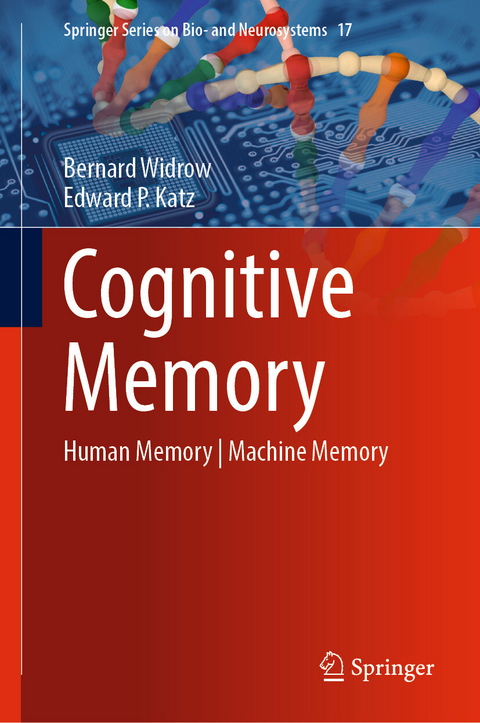
Cognitive Memory (eBook)
XXVII, 197 Seiten
Springer-Verlag
978-3-031-80939-2 (ISBN)
How does human memory work? How does human pattern recognition work? The book’s motivation is twofold, to add to knowledge in the field of neuroscience, and to design a highly simplified cognitive memory constructed using software and existing electronic components. Readers are taken on an inspiring journey through the fundamentals of human memory, how it is constructed, and how it works in everyday life. The book goes more in-depth into the human side of cognitive memory — how seeing, hearing, walking and speaking works. Impairments in cognitive memory are also discussed. Lastly, the book sheds light on how meaning is extracted from sensory inputs and from stored data. This book is not without controversy. Neuroscientists accept the engrams (or memory traces) model that long-term memory is stored in the brain’s neural networks. The authors believe that long-term human memory is stored digitally, in the DNA of brain cells, and not in analog neural networks. Further, the authors believe that innate knowledge of humans and animals is inherited, transmitted from parents to offspring at the moment of conception. The single cell contains the innate knowledge in the DNA of its nucleus. Memory is stored in DNA. The brain’s neural networks are for access and retrieval of memory and not for actual storage. This book offers a unique, inspiring reading to researchers and other readers interested in the science of memory.
| Erscheint lt. Verlag | 1.3.2025 |
|---|---|
| Reihe/Serie | Springer Series on Bio- and Neurosystems |
| Zusatzinfo | XXVII, 197 p. 80 illus., 23 illus. in color. |
| Sprache | englisch |
| Themenwelt | Informatik ► Theorie / Studium ► Künstliche Intelligenz / Robotik |
| Mathematik / Informatik ► Mathematik | |
| Technik ► Bauwesen | |
| Schlagworte | aircraft navigation • Autoassociative Neural Networks • Cognitive Memory Design • Cognitive Memory for Motor Control • Cognitive Memory for Seeing and Hearing • Content Addressable Memory • DNA and Memory • Eric Kandel’s Aplysia experiments • Facial Recognition • feature detection • Hubel and Wiesel’s cat • LMS Algorithm • Memory Capacity • Motor control for Walking and Speaking • Multilayer Backpropagation Algorithm • pattern recognition • Pattern Retrieval from Dreams • Prompting the Memory • Reinforcement Learning • Sigmoid ADALINE |
| ISBN-10 | 3-031-80939-4 / 3031809394 |
| ISBN-13 | 978-3-031-80939-2 / 9783031809392 |
| Informationen gemäß Produktsicherheitsverordnung (GPSR) | |
| Haben Sie eine Frage zum Produkt? |
 PDF (Wasserzeichen)
DRM: Digitales Wasserzeichen
Dieses eBook enthält ein digitales Wasserzeichen und ist damit für Sie personalisiert. Bei einer missbräuchlichen Weitergabe des eBooks an Dritte ist eine Rückverfolgung an die Quelle möglich.
Dateiformat: PDF (Portable Document Format)
Mit einem festen Seitenlayout eignet sich die PDF besonders für Fachbücher mit Spalten, Tabellen und Abbildungen. Eine PDF kann auf fast allen Geräten angezeigt werden, ist aber für kleine Displays (Smartphone, eReader) nur eingeschränkt geeignet.
Systemvoraussetzungen:
PC/Mac: Mit einem PC oder Mac können Sie dieses eBook lesen. Sie benötigen dafür einen PDF-Viewer - z.B. den Adobe Reader oder Adobe Digital Editions.
eReader: Dieses eBook kann mit (fast) allen eBook-Readern gelesen werden. Mit dem amazon-Kindle ist es aber nicht kompatibel.
Smartphone/Tablet: Egal ob Apple oder Android, dieses eBook können Sie lesen. Sie benötigen dafür einen PDF-Viewer - z.B. die kostenlose Adobe Digital Editions-App.
Buying eBooks from abroad
For tax law reasons we can sell eBooks just within Germany and Switzerland. Regrettably we cannot fulfill eBook-orders from other countries.
aus dem Bereich