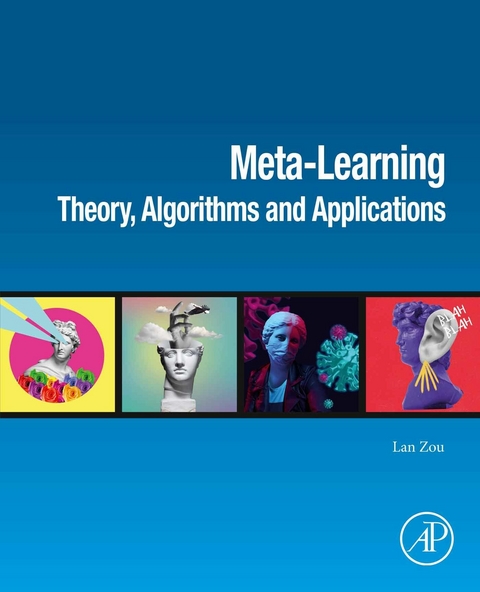
Meta-Learning (eBook)
402 Seiten
Elsevier Science (Verlag)
978-0-323-90370-7 (ISBN)
Lan Zou is a researcher in the field of artificial intelligence (AI) at Silicon Valley and Carnegie Mellon University. She holds a master's degree from Carnegie Mellon University, School of Computer Science, and she earned a dual degree in mathematics and statistics from the University of Washington. She has worked at the United Nations and at the investment bank UBS. Lan Zou is currently serving as an columnist at AIHub.org, the association to connect the AI community to the public by providing information about high-quality AI books and publications by the Association for the Advancement of Artificial Intelligence (AAAI), the International Conference on Machine Learning (ICML), and the Conference and Workshop on Neural Information Processing Systems (NeurIPS).
Deep neural networks (DNNs) with their dense and complex algorithms provide real possibilities for Artificial General Intelligence (AGI). Meta-learning with DNNs brings AGI much closer: artificial agents solving intelligent tasks that human beings can achieve, even transcending what they can achieve. Meta-Learning: Theory, Algorithms and Applications shows how meta-learning in combination with DNNs advances towards AGI. Meta-Learning: Theory, Algorithms and Applications explains the fundamentals of meta-learning by providing answers to these questions: What is meta-learning?; why do we need meta-learning?; how are self-improved meta-learning mechanisms heading for AGI ?; how can we use meta-learning in our approach to specific scenarios? The book presents the background of seven mainstream paradigms: meta-learning, few-shot learning, deep learning, transfer learning, machine learning, probabilistic modeling, and Bayesian inference. It then explains important state-of-the-art mechanisms and their variants for meta-learning, including memory-augmented neural networks, meta-networks, convolutional Siamese neural networks, matching networks, prototypical networks, relation networks, LSTM meta-learning, model-agnostic meta-learning, and the Reptile algorithm. The book takes a deep dive into nearly 200 state-of-the-art meta-learning algorithms from top tier conferences (e.g. NeurIPS, ICML, CVPR, ACL, ICLR, KDD). It systematically investigates 39 categories of tasks from 11 real-world application fields: Computer Vision, Natural Language Processing, Meta-Reinforcement Learning, Healthcare, Finance and Economy, Construction Materials, Graphic Neural Networks, Program Synthesis, Smart City, Recommended Systems, and Climate Science. Each application field concludes by looking at future trends or by giving a summary of available resources. Meta-Learning: Theory, Algorithms and Applications is a great resource to understand the principles of meta-learning and to learn state-of-the-art meta-learning algorithms, giving the student, researcher and industry professional the ability to apply meta-learning for various novel applications. - A comprehensive overview of state-of-the-art meta-learning techniques and methods associated with deep neural networks together with a broad range of application areas- Coverage of nearly 200 state-of-the-art meta-learning algorithms, which are promoted by premier global AI conferences and journals, and 300 to 450 pieces of key research- Systematic and detailed exploration of the most crucial state-of-the-art meta-learning algorithm mechanisms: model-based, metric-based, and optimization-based- Provides solutions to the limitations of using deep learning and/or machine learning methods, particularly with small sample sizes and unlabeled data- Gives an understanding of how meta-learning acts as a stepping stone to Artificial General Intelligence in 39 categories of tasks from 11 real-world application fields
| Erscheint lt. Verlag | 5.11.2022 |
|---|---|
| Sprache | englisch |
| Themenwelt | Mathematik / Informatik ► Informatik ► Netzwerke |
| Informatik ► Theorie / Studium ► Künstliche Intelligenz / Robotik | |
| ISBN-10 | 0-323-90370-3 / 0323903703 |
| ISBN-13 | 978-0-323-90370-7 / 9780323903707 |
| Informationen gemäß Produktsicherheitsverordnung (GPSR) | |
| Haben Sie eine Frage zum Produkt? |
 EPUB (Adobe DRM)
Kopierschutz: Adobe-DRM
Adobe-DRM ist ein Kopierschutz, der das eBook vor Mißbrauch schützen soll. Dabei wird das eBook bereits beim Download auf Ihre persönliche Adobe-ID autorisiert. Lesen können Sie das eBook dann nur auf den Geräten, welche ebenfalls auf Ihre Adobe-ID registriert sind.
Details zum Adobe-DRM
Dateiformat: EPUB (Electronic Publication)
EPUB ist ein offener Standard für eBooks und eignet sich besonders zur Darstellung von Belletristik und Sachbüchern. Der Fließtext wird dynamisch an die Display- und Schriftgröße angepasst. Auch für mobile Lesegeräte ist EPUB daher gut geeignet.
Systemvoraussetzungen:
PC/Mac: Mit einem PC oder Mac können Sie dieses eBook lesen. Sie benötigen eine
eReader: Dieses eBook kann mit (fast) allen eBook-Readern gelesen werden. Mit dem amazon-Kindle ist es aber nicht kompatibel.
Smartphone/Tablet: Egal ob Apple oder Android, dieses eBook können Sie lesen. Sie benötigen eine
Geräteliste und zusätzliche Hinweise
Buying eBooks from abroad
For tax law reasons we can sell eBooks just within Germany and Switzerland. Regrettably we cannot fulfill eBook-orders from other countries.
aus dem Bereich