


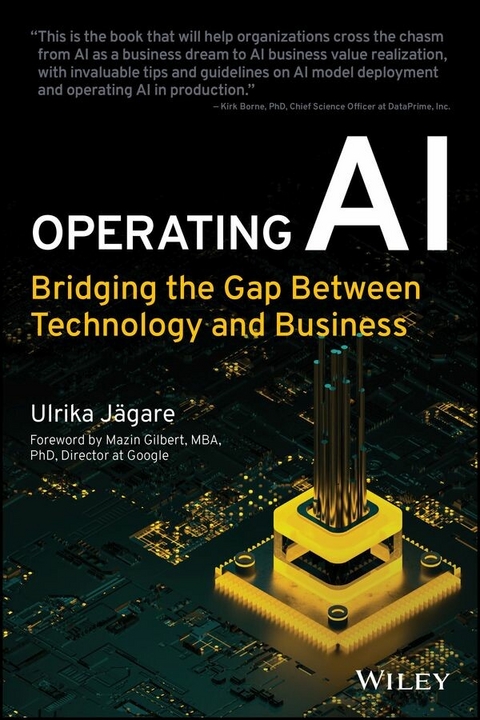
Operating AI (eBook)
John Wiley & Sons (Verlag)
978-1-119-83321-5 (ISBN)
A holistic and real-world approach to operationalizing artificial intelligence in your company
In Operating AI, Director of Technology and Architecture at Ericsson AB, Ulrika Jägare, delivers an eye-opening new discussion of how to introduce your organization to artificial intelligence by balancing data engineering, model development, and AI operations. You'll learn the importance of embracing an AI operational mindset to successfully operate AI and lead AI initiatives through the entire lifecycle, including key aspects of security, privacy, and data rights.
In the book, you'll also discover:
- How to reduce the risk of entering bias in our artificial intelligence solutions
- The importance of efficient and reproduceable data pipelines, including how to manage your company's data
- An operational perspective on the development of AI models using the MLOps (Machine Learning Operations) approach, including how to deploy, run and monitor models and ML pipelines in production, that generates value in the real world
With a strong emphasis on deployment and operations of trustworthy and reliable AI solutions that operate well in the real world-and not just the lab-Operating AI is a must-read for business leaders looking for ways to operationalize an AI business model that actually makes money, from the concept phase to running in a live production environment.
ULRIKA JÄGARE is the MSc. Director of Technology and Architecture at Ericsson AB. She has over 10 years of experience in data, analytics, and machine learning/artificial intelligence and over 20 years' experience in telecommunications.
A holistic and real-world approach to operationalizing artificial intelligence in your company In Operating AI, Director of Technology and Architecture at Ericsson AB, Ulrika J gare, delivers an eye-opening new discussion of how to introduce your organization to artificial intelligence by balancing data engineering, model development, and AI operations. You'll learn the importance of embracing an AI operational mindset to successfully operate AI and lead AI initiatives through the entire lifecycle, including key areas such as; data mesh, data fabric, aspects of security, data privacy, data rights and IPR related to data and AI models. In the book, you ll also discover: How to reduce the risk of entering bias in our artificial intelligence solutions and how to approach explainable AI (XAI) The importance of efficient and reproduceable data pipelines, including how to manage your company's data An operational perspective on the development of AI models using the MLOps (Machine Learning Operations) approach, including how to deploy, run and monitor models and ML pipelines in production using CI/CD/CT techniques, that generates value in the real world Key competences and toolsets in AI development, deployment and operations What to consider when operating different types of AI business models With a strong emphasis on deployment and operations of trustworthy and reliable AI solutions that operate well in the real world and not just the lab Operating AI is a must-read for business leaders looking for ways to operationalize an AI business model that actually makes money, from the concept phase to running in a live production environment.
ULRIKA JÄGARE is the MSc. Director of Technology and Architecture at Ericsson AB. She has over 10 years of experience in data, analytics, and machine learning/artificial intelligence and over 20 years' experience in telecommunications.
Chapter 1: The AI model life cycle
Chapter 2: The importance of efficient Data Engineering
Chapter 3: AI model development from an operational perspective
Chapter 4: Operating AI is different from operating SW
Chapter 5: Resilient and secure AI solutions
Chapter 6: AI is all about Trust
Chapter 7: Making your Business Model Operational
Introduction
Artificial intelligence (AI) plays a critical role in optimizing the value gained from digital transformation. Across different business segments, companies seek to leverage new technologies for increased revenue or lower cost. But AI is much more than an accelerator for taking the digital transformation journey to another level and making it possible for teams to work smarter, do things faster, and turn previously impossible tasks into routine.
Artificial intelligence has started to be seen as a key business enabler across more and more industries. Corporations are starting to view AI as a technology for future-proofing their business way beyond organizational efficiency. It's a revolutionary approach where AI becomes the foundation of the commercial portfolio, whether it's products, services, or some type of “as a service” setup. By embracing the full potential of AI, every company and organization in some sense becomes a technology company, whether or not that is the goal. But are companies in general ready for this massive transformation?
I would argue that most companies are not ready for this massive transformation, but it's important to remember that neither are their customers. Remember that major technology shifts like the one that AI imposes hold a lot of promise but require a fundamental transformation to take place in order to gain the expected return on investment (ROI). This fundamental shift will not happen overnight and will definitely not proceed in a synchronized manner across different markets and business segments, nor across the public sector with all its various service functions.
However, it's worth noting that the COVID-19 pandemic has accelerated the need for, and understanding of, the benefits of a fully digitalized workplace and society. However, keep in mind that just because the digitalization journey is speeding up, that doesn't necessarily mean that adding AI capabilities will be the next natural step to take.
It's not as easy as it may seem to effectively deploy and leverage AI in the enterprise. To be successful, you can't only focus on the technical pieces—you need to also address aspects such as strategy, people, and ways of working as well as how your AI solution is intended to run in production. This is crucial to break down barriers between AI in development and AI in production, and to quickly and seamlessly be able to move AI models and operate increasing numbers of models on a continuous basis in a live setting.
There is no easy fix for this, but by learning how to balance your AI investment while keeping an operational mind-set throughout, you will be more likely to succeed.
This book is centered on the fact that operating AI is not the same as operating software. That is not just a statement, but a principle that has many implications for what it means to embrace AI in your company or organization. By reading this book, you will gain insights on how to approach AI in your enterprise with operations in mind, and by doing so you are much more likely to succeed with your objectives. An operational approach should be taken directly from the start when you build your AI foundation with reproducible model pipelines. In the development phase, consider potential operational factors such as modeling the target environment or the actual use case, and you will be better positioned to build a solution that will meet its objective when it's running in live operations.
Another important aspect in this book involves truly addressing the data perspective as part of your strategic investments in AI. Remember that without the data, your AI solution cannot run. Understanding and caring for your data is vital, as well as making sure you have the data rights needed, which can sometimes be the hardest thing to manage as part of an operational setting. What you don't want to do is find out too late that the data you need isn't accessible or is owned by another party, or perhaps that the data pipeline you have invested in will not scale in production.
This book will also focus on how to successfully deploy your models as well as operate your AI solution in live environments. You will learn how different model target environments can influence aspects through the whole AI life cycle, not only which deployment options you have but which data you need to train your model on, which AI technique you will benefit most from using, how to scale your solution over time, and how and why you need to monitor and maintain your model when it's operating in production.
Finally, it's important to remember that AI is all about trust. In order for a company to rely on the AI solution to take over parts of its operations, make decisions, and let the AI system take action based on identified insights, both management and employees must trust the AI solution enough. To ensure that trust, from the start you need to think about the operational context, legal rights, and transparency and reliability aspects. This is especially valid for commercial usage of AI. In order for your customers to trust your AI-based products and/or services, you must be able to explain how your AI solution works and what is actually going on. The less your customers understand of how an AI-based solution works, the more insecure they will feel about trusting it. Customers hate to buy a black box solution. Although more complex AI techniques like deep learning can be hard to explain even for the data scientists who are building the solutions, there are ways to work with explainable AI (XAI), which will be further explored in this book.
Since the main objective of your AI investment is to realize a business value, internal or commercial, it's fundamental to understand what can be expected from your AI investment. Most companies understand the difficulties involved in reaching their objectives, but they may not fully grasp how to best navigate these challenges given a specific industry or for a specific business model. The book helps you connect these pieces, apply an operational mind-set to the business perspective, and set you on the path to success.
What Does This Book Cover?
This book covers the following topics:
- Chapter 1: Balancing the AI Investment There is no simple answer to how to succeed with your AI investment, but there are some fundamental aspects that should be driving your objectives and realization plans, and that includes a balanced approach to AI. In this chapter you will find out what that means and why it is important for your business. The chapter will start by defining AI and by sorting out what AI is in relation to other related concepts such as machine learning (ML), automation, and robotics, just to name a few. This chapter will also address why you need to put more effort into making your AI model operational than you put into developing your AI model and how to embrace an operational mind-set for AI.
- Chapter 2: Data Engineering Focused on AI Treating data as a valuable business asset should be the main priority in any company, and it's the key to staying on top of what is going on in your company. Leveraging data will help you understand what is not working and why, as well as enable you to see what is coming. This chapter will present a structured way for you to get to know your data and focuses on the importance of working with production. Furthermore, you will learn which data quality metrics are important and how to scale your data to succeed with your AI investment, as well as key competences in data engineering.
- Chapter 3: Embracing MLOps In ML development the problem is seldom to technically develop, train, or implement ML models; instead, the main problem is mostly related to poor communication and lack of efficient cross-functional team collaboration. It might sound like an easy task to correct, but the fact remains that most AI projects do not make it to production due to this communication gap between the data scientists and the business. This chapter will introduce the most successful approach to tackle these problems: MLOps practices. You will learn that shifting the focus from building individual ML models to building ML pipelines is a game-changer. The chapter will also explain the importance of adopting a continuous learning approach. This chapter will also describe how to approach your AI/ML functional technology stack and ensure you have the right competences and toolsets for successful MLOps practices.
- Chapter 4: Deployment with AI Operations in Mind It's important to remember that it's not until you deploy your models in a production setting that the value of AI can fully be realized. However, moving your models from the lab to production is far from an easy task. Successful model deployment is about a lot more than just running your model in another execution environment. When deploying AI models in production, you need to consider various areas spanning from legal rights and data access to managing retraining and redeployment of models in a live production setting. In this chapter you will learn how to handle model serving in practice and the role of the ML inference pipeline in this process. Furthermore, key success factors for industrializing AI will be outlined, as well as why it's equally important to focus attention on the cultural shift that needs to happen.
- Chapter 5: Operating AI Is Different from Operating Software Observing and monitoring AI models in production is often...
| Erscheint lt. Verlag | 19.4.2022 |
|---|---|
| Vorwort | Mazin Gilbert |
| Sprache | englisch |
| Themenwelt | Mathematik / Informatik ► Informatik ► Programmiersprachen / -werkzeuge |
| Mathematik / Informatik ► Informatik ► Theorie / Studium | |
| Schlagworte | AI • AI bias • ai business value • AI ethics • ai in production • ai in the real world • AI investment • ai lifecycle • ai model deployment • ai model rights • ai operational mindset • Ai operations • Artificial Intelligence • artificial intelligence lifecycle • artificial intelligence operations • Computer Science • data engineering • Data Mining & Knowledge Discovery • Data Mining u. Knowledge Discovery • Data rights • Ethics of AI • implementing ai • implementing artificial intelligence • Informatik • KI • Künstliche Intelligenz • machine learning • MLOps • monitoring ai • organizational ai • production ai • Programmierung • Programmierung u. Software-Entwicklung • Programming & Software Development • trustworthy AI |
| ISBN-10 | 1-119-83321-3 / 1119833213 |
| ISBN-13 | 978-1-119-83321-5 / 9781119833215 |
| Informationen gemäß Produktsicherheitsverordnung (GPSR) | |
| Haben Sie eine Frage zum Produkt? |
 EPUB (Adobe DRM)
Kopierschutz: Adobe-DRM
Adobe-DRM ist ein Kopierschutz, der das eBook vor Mißbrauch schützen soll. Dabei wird das eBook bereits beim Download auf Ihre persönliche Adobe-ID autorisiert. Lesen können Sie das eBook dann nur auf den Geräten, welche ebenfalls auf Ihre Adobe-ID registriert sind.
Details zum Adobe-DRM
Dateiformat: EPUB (Electronic Publication)
EPUB ist ein offener Standard für eBooks und eignet sich besonders zur Darstellung von Belletristik und Sachbüchern. Der Fließtext wird dynamisch an die Display- und Schriftgröße angepasst. Auch für mobile Lesegeräte ist EPUB daher gut geeignet.
Systemvoraussetzungen:
PC/Mac: Mit einem PC oder Mac können Sie dieses eBook lesen. Sie benötigen eine
eReader: Dieses eBook kann mit (fast) allen eBook-Readern gelesen werden. Mit dem amazon-Kindle ist es aber nicht kompatibel.
Smartphone/Tablet: Egal ob Apple oder Android, dieses eBook können Sie lesen. Sie benötigen eine
Geräteliste und zusätzliche Hinweise
Buying eBooks from abroad
For tax law reasons we can sell eBooks just within Germany and Switzerland. Regrettably we cannot fulfill eBook-orders from other countries.
aus dem Bereich


