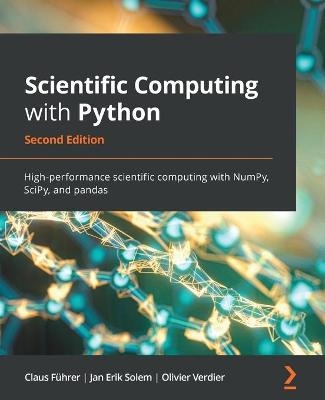
Scientific Computing with Python
Packt Publishing Limited (Verlag)
978-1-83882-232-3 (ISBN)
Leverage this example-packed, comprehensive guide for all your Python computational needs
Key Features
Learn the first steps within Python to highly specialized concepts
Explore examples and code snippets taken from typical programming situations within scientific computing.
Delve into essential computer science concepts like iterating, object-oriented programming, testing, and MPI presented in strong connection to applications within scientific computing.
Book DescriptionPython has tremendous potential within the scientific computing domain. This updated edition of Scientific Computing with Python features new chapters on graphical user interfaces, efficient data processing, and parallel computing to help you perform mathematical and scientific computing efficiently using Python.
This book will help you to explore new Python syntax features and create different models using scientific computing principles. The book presents Python alongside mathematical applications and demonstrates how to apply Python concepts in computing with the help of examples involving Python 3.8. You'll use pandas for basic data analysis to understand the modern needs of scientific computing, and cover data module improvements and built-in features. You'll also explore numerical computation modules such as NumPy and SciPy, which enable fast access to highly efficient numerical algorithms. By learning to use the plotting module Matplotlib, you will be able to represent your computational results in talks and publications. A special chapter is devoted to SymPy, a tool for bridging symbolic and numerical computations.
By the end of this Python book, you'll have gained a solid understanding of task automation and how to implement and test mathematical algorithms within the realm of scientific computing.
What you will learn
Understand the building blocks of computational mathematics, linear algebra, and related Python objects
Use Matplotlib to create high-quality figures and graphics to draw and visualize results
Apply object-oriented programming (OOP) to scientific computing in Python
Discover how to use pandas to enter the world of data processing
Handle exceptions for writing reliable and usable code
Cover manual and automatic aspects of testing for scientific programming
Get to grips with parallel computing to increase computation speed
Who this book is forThis book is for students with a mathematical background, university teachers designing modern courses in programming, data scientists, researchers, developers, and anyone who wants to perform scientific computation in Python.
Claus Fuhrer is a professor of scientific computations at Lund University, Sweden. He has an extensive teaching record that includes intensive programming courses in numerical analysis and engineering mathematics across various levels in many different countries and teaching environments. Claus also develops numerical software in research collaboration with industry and received Lund University's Faculty of Engineering Best Teacher Award in 2016. Jan Erik Solem is a Python enthusiast, former associate professor, and computer vision entrepreneur. He co-founded several computer vision startups, most recently Mapillary, a street imagery computer vision company, and has worked in the tech industry for two decades. Jan Erik is a World Economic Forum technology pioneer and won the Best Nordic Thesis Award 2005-2006 for his dissertation on image analysis and pattern recognition. He is also the author of "Programming Computer Vision with Python" (O'Reilly 2012). Olivier Verdier began using Python for scientific computing back in 2007 and received a PhD in mathematics from Lund University in 2009. He has held post-doctoral positions in Cologne, Trondheim, Bergen, and Ume and is now an associate professor of mathematics at Bergen University College, Norway.
Table of Contents
Getting Started
Variables and Basic Types
Container Types
Linear Algebra – Arrays
Advanced Array Concepts
Plotting
Functions
Classes
Iterating
Series and Dataframes - Working With Pandas
Communication by a Graphical User Interface
Error and Exception Handling
Namespaces, Scopes, and Modules
Input and Output
Testing
Symbolic Computations - SymPy
Interacting with the Operating System
Python for Parallel Computing
Comprehensive Examples
| Erscheinungsdatum | 02.08.2021 |
|---|---|
| Verlagsort | Birmingham |
| Sprache | englisch |
| Maße | 75 x 93 mm |
| Themenwelt | Mathematik / Informatik ► Informatik ► Programmiersprachen / -werkzeuge |
| ISBN-10 | 1-83882-232-1 / 1838822321 |
| ISBN-13 | 978-1-83882-232-3 / 9781838822323 |
| Zustand | Neuware |
| Informationen gemäß Produktsicherheitsverordnung (GPSR) | |
| Haben Sie eine Frage zum Produkt? |
aus dem Bereich