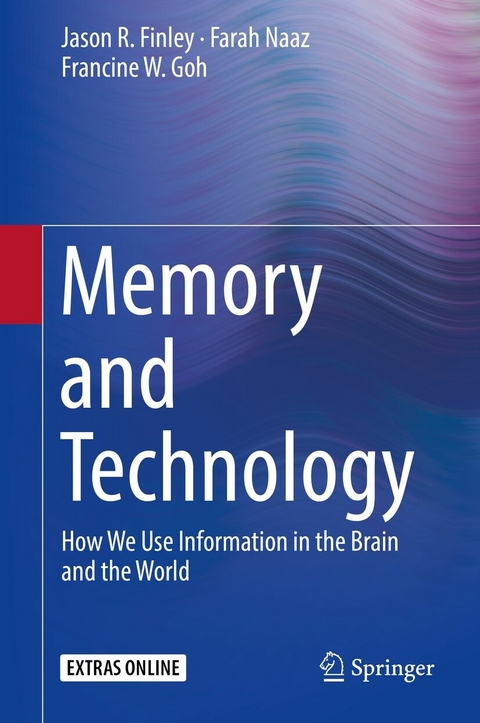
Memory and Technology (eBook)
XVII, 217 Seiten
Springer International Publishing (Verlag)
978-3-319-99169-6 (ISBN)
How is technology changing the way people remember?
This book explores the interplay of memory stored in the brain (internal memory) and outside of the brain (external memory), providing a thorough interdisciplinary review of the current literature, including relevant theoretical frameworks from across a variety of disciplines in the sciences, arts, and humanities. It also presents the findings of a rich and novel empirical data set, based on a comprehensive survey on the shifting interplay of internal and external memory in the 21st century. Results reveal a growing symbiosis between the two forms of memory in our everyday lives.
The book presents a new theoretical framework for understanding the interplay of internal and external memory, and their complementary strengths. It concludes with a guide to important dimensions, questions, and methods for future research.
Memory and Technology will be of interest to researchers, professors, and students across the disciplines of psychology, philosophy, library and information science, human factors, media and cultural studies, anthropology and archaeology, photography, and cognitive rehabilitation, as well as anyone interested in how technology is affecting human memory.
_____
'This is a novel book, with interesting and valuable data on an important, meaningful topic, as well as a gathering of multidisciplinary and interdisciplinary ideas...The research is accurately represented and inclusive. As a teaching tool, I can envision graduate seminars in different disciplines drawing on the material as the basis for teaching and discussions.'
Dr. Linda A. Henkel, Fairfield University
'This book documents the achievements of a vibrant scientific project - you feel the enthusiasm of the authors for their research. The organization of the manuscript introduces the reader into a comparatively new field the same way as pioneering authors have approached it.'
Prof. Dr. Wolfgang Schönpflug, Freie Universität Berlin
Jason R. Finley earned his Ph.D. in psychology from the University of Illinois at Urbana-Champaign and is currently an assistant professor of psychology at Fontbonne University, in St. Louis, MO. His research interests include memory, metacognition, and offloading cognition onto the environment, particularly as the interplay of internal and external memory continues to change with twenty-first century technology. He has published in the Journal of Experimental Psychology (Applied, and Learning, Memory, and Cognition), the American Journal of Psychology, the Journal of Memory and Language, Memory & Cognition, Psychological Inquiry, and Memory.
Farah Naaz is a postdoctoral fellow at the University of Louisville, Department of Psychological and Brain Sciences. She is a cognitive neuroscientist with a background in experimental psychology. Her research interest is in the domain of executive functions, specifically in the process of learning and memory. Her graduate research focused on learning neuroanatomy using 3D graphical visualizations. Her current work explores the process of cognitive control of emotion and memory. She has published in the journals Cerebral Cortex, Brain and Cognition,Psychiatry Research, Advances in Health Sciences Education, Cognition and Instruction, and Anatomical Sciences Education.
Jason R. Finley earned his Ph.D. in psychology from the University of Illinois at Urbana-Champaign and is currently an assistant professor of psychology at Fontbonne University, in St. Louis, MO. His research interests include memory, metacognition, and offloading cognition onto the environment, particularly as the interplay of internal and external memory continues to change with twenty-first century technology. He has published in the Journal of Experimental Psychology (Applied, and Learning, Memory, and Cognition), the American Journal of Psychology, the Journal of Memory and Language, Memory & Cognition, Psychological Inquiry, and Memory.Farah Naaz is a postdoctoral fellow at the University of Louisville, Department of Psychological and Brain Sciences. She is a cognitive neuroscientist with a background in experimental psychology. Her research interest is in the domain of executive functions, specifically in the process of learning and memory. Her graduate research focused on learning neuroanatomy using 3D graphical visualizations. Her current work explores the process of cognitive control of emotion and memory. She has published in the journals Cerebral Cortex, Brain and Cognition,Psychiatry Research, Advances in Health Sciences Education, Cognition and Instruction, and Anatomical Sciences Education.Francine W. Goh is a graduate student at the University of Nebraska-Lincoln, Department of Psychology. She is currently part of the Social and Cognitive Psychology program. She graduated with a B.S. in psychology from Fontbonne University, where her research focused on the effects of stress on decision making in social dilemmas. Her research interests include decision making, both broadly-defined and in social contexts, particularly when individuals decide to engage in prosocial behavior and cooperate with others.
Part I: Empirical Report (The Present).- Chapter 1. Introduction & Method.- Chapter 2. Results: Attitudes and Beliefs about Internal and External Memory.- Chapter 3. Results: Behaviors and Experiences with Internal and External Memory.- Chapter 4. Results: The Interplay Between Internal and External Memory.- Part II: Literature Review (The Past).- Chapter 5. Theoretical Perspectives from Across Psychology.- Chapter 6. Theoretical Perspectives from Other Disciplines.- Part III: Discussion & Guide for Research (The Future).- Chapter 7. A Framework and Methods for Researching the Interplay of Internal and External Memory.- Chapter 8. Important Dimensions and Unanswered Questions.
| Erscheint lt. Verlag | 12.11.2018 |
|---|---|
| Zusatzinfo | XVII, 217 p. 4 illus., 3 illus. in color. |
| Verlagsort | Cham |
| Sprache | englisch |
| Themenwelt | Geisteswissenschaften ► Psychologie |
| Informatik ► Theorie / Studium ► Künstliche Intelligenz / Robotik | |
| Schlagworte | Everyday memory • Extended Mind • external memory • Internal Memory • Offloading • Technology |
| ISBN-10 | 3-319-99169-8 / 3319991698 |
| ISBN-13 | 978-3-319-99169-6 / 9783319991696 |
| Informationen gemäß Produktsicherheitsverordnung (GPSR) | |
| Haben Sie eine Frage zum Produkt? |
 PDF (Wasserzeichen)
DRM: Digitales Wasserzeichen
Dieses eBook enthält ein digitales Wasserzeichen und ist damit für Sie personalisiert. Bei einer missbräuchlichen Weitergabe des eBooks an Dritte ist eine Rückverfolgung an die Quelle möglich.
Dateiformat: PDF (Portable Document Format)
Mit einem festen Seitenlayout eignet sich die PDF besonders für Fachbücher mit Spalten, Tabellen und Abbildungen. Eine PDF kann auf fast allen Geräten angezeigt werden, ist aber für kleine Displays (Smartphone, eReader) nur eingeschränkt geeignet.
Systemvoraussetzungen:
PC/Mac: Mit einem PC oder Mac können Sie dieses eBook lesen. Sie benötigen dafür einen PDF-Viewer - z.B. den Adobe Reader oder Adobe Digital Editions.
eReader: Dieses eBook kann mit (fast) allen eBook-Readern gelesen werden. Mit dem amazon-Kindle ist es aber nicht kompatibel.
Smartphone/Tablet: Egal ob Apple oder Android, dieses eBook können Sie lesen. Sie benötigen dafür einen PDF-Viewer - z.B. die kostenlose Adobe Digital Editions-App.
Buying eBooks from abroad
For tax law reasons we can sell eBooks just within Germany and Switzerland. Regrettably we cannot fulfill eBook-orders from other countries.
aus dem Bereich