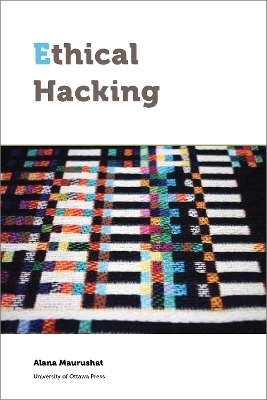
Ethical Hacking
University of Ottawa Press (Verlag)
978-0-7766-2791-5 (ISBN)
- Lieferbar (Termin unbekannt)
- Portofrei ab CHF 40
- Auch auf Rechnung
- Artikel merken
The first part of the 21st century will likely go down in history as the era when ethical hackers opened governments and the line of transparency moved by force. One need only read the motto “we open governments” on the Twitter page for Wikileaks to gain a sense of the sea change that has occurred. Ethical hacking is the non-violent use of a technology in pursuit of a cause—political or otherwise—which is often legally and morally ambiguous.
Hacktivists believe in two general but spirited principles: respect for human rights and fundamental freedoms, including freedom of expression and personal privacy; and the responsibility of government to be open, transparent and fully accountable to the public. How courts and governments will deal with hacking attempts which operate in a grey zone of the law and where different ethical views collide remains to be seen. What is undisputed is that Ethical Hacking presents a fundamental discussion of key societal questions. A fundamental discussion of key societal questions.
Published in English.
Alana Maurushat Maurushat is Professor of Cybersecurity and Behaviour at Western Sydney Univeristy. She is also on the Board of Directors for the cybercrime investigation firm IFW Global.
Chapter I: Why Ethical Hacking?
1.1 You
1.2 Me
1.3 Ethical Hacking
Chapter II: Essential Terms and Concepts
2.1 Types of Ethical Hackers
2.2 Definitions and Typology of Ethical Hacking
2.3 Conventional Computer-Security-Threat Model
2.4 Common Methods Used in Ethical Hacking
2.5 Other Relevant Terms
Chapter III: Methodology and Quantitative Studies of Ethical Hacking: Evidence-Based Decision and Policy-Making
3.1 Report for Public Safety Canada, 2011
3.2 Summary of Findings
3.3 GDELT Analysis Service—Event Data(with Kevin Kim)
3.4 Google’s BigQuery (with Richard Li)
3.5 Dark-Net Analysis of Malware and Cyber-Jihad Forums
3.5.1 Cyber-Jihad Forums (with Adrian Agius)
3.5.2 Hacking Forums (with Richard Li)
3.6 Observations
Chapter IV: Legal Cases Around the World (with Jelena Ardalic)
Chapter V: Select Ethical-Hacking Incidences: Anonymous
Chapter VI: Select Ethical-Hacking Incidences: Chaos Computer Club, CyberBerkut, LulzSec, Iranian Cyber Army, and Others
Chapter VII: Online Civil Disobedience
7.1 Online Civil Disobedience in Context
7.2 Timeline
7.3 Case Studies
7.3.1 Anonymous, Operation Titstorm
7.3.2 German Lufthansa Protest
7.3.3 Twitter #TellVicEverything Campaign
7.4 Observations
Chapter VIII: Hacktivism
8.1 Hacktivism in Context
8.2 Timelines
8.3 Case Studies
8.3.1 Anonymous, Post-Christmas Charity Donations
8.3.2 Neo-Nazi Website
8.3.3 WikiLeaks, Operation Payback
8.4 Observations
Chapter IX: Penetration/Intrusion Testing and Vulnerability Disclosure
9.1 Penetration Testing and Vulnerability Disclosure in Context
9.2 Timeline
9.3 Case Studies
9.3.1 Australian Security Expert Patrick Webster
9.3.2 Cisco Router9.3.3 LulzSec Hacking to Incentivize Sony to Fix Known Software Bugs
9.3.4 Guardians of Peace, North Korea, and the Sony Pictures Hack
9.3.5 Vulnerability Hunter Glenn Mangham
9.3.6 Da Jiang Innovation
9.4 Observations
Chapter X: Counterattack/Hackback
10.1 Counterattack/Hackback in Context
10.2 Case Studies
10.2.1 LulzSec, MasterCard and PayPal, and Barr
10.2.2 Illegal Streaming Link Sites
10.2.3 Automated Counter-DDoS
10.3 The Legalization of Hackback
10.4 Observations
Chapter XI: Security Activism
11.1 Security Activism in Context
11.2 Case Studies
11.2.1 Spamhaus Project
11.2.2 Spam Fighter
11.2.3 Botnet Removal Communities
11.2.4 Cyber-Security Researcher Y
11.3 Observations
Chapter XII: Ethical-Hacking Challenges in Legal Frameworks, Investigation, Prosecution, and Sentencing
12.1 Criminal Landscape: Convention on Cybercrime and the Canadian Criminal Framework
12.2 Attribution
12.3 Jurisdiction
12.4 Evidence
12.5 Integrity, Volatility of Evidence, and the Trojan-Horse Defence
12.6 Damages
12.7 Sentencing and Dealing with Mental Disorders—Addiction and Autism Spectrum (with PhD candidate Hannah Rappaport)
12.8 Observations
Chapter XIII: Ethical Hacking, Whistle-Blowing, and Human Rights and Freedoms
13.1 The Canadian Charter of Human Rights and Freedoms
13.2 Whistle-Blowing and Ethical Hacking
13.3 Observations
Chapter XIV: Toward an Ethical-Hacking Framework
14.1 Ethical Hacking in Context
14.2 Encourage Legitimate Space for Virtual Protests
14.3 Guidelines and Policy
14.4 Code of Conduct for Hackback
14.5 Transparency of Government Engagement with Hackback
14.6 Security Research Exemption and Public-Interest Consideration
14.7 Concluding Remarks
Bibliography
Appendix: Interview Questions
| Erscheinungsdatum | 10.04.2019 |
|---|---|
| Reihe/Serie | Law, Technology, and Media |
| Sprache | englisch |
| Maße | 152 x 229 mm |
| Gewicht | 496 g |
| Themenwelt | Informatik ► Netzwerke ► Sicherheit / Firewall |
| Recht / Steuern ► EU / Internationales Recht | |
| ISBN-10 | 0-7766-2791-0 / 0776627910 |
| ISBN-13 | 978-0-7766-2791-5 / 9780776627915 |
| Zustand | Neuware |
| Informationen gemäß Produktsicherheitsverordnung (GPSR) | |
| Haben Sie eine Frage zum Produkt? |
aus dem Bereich