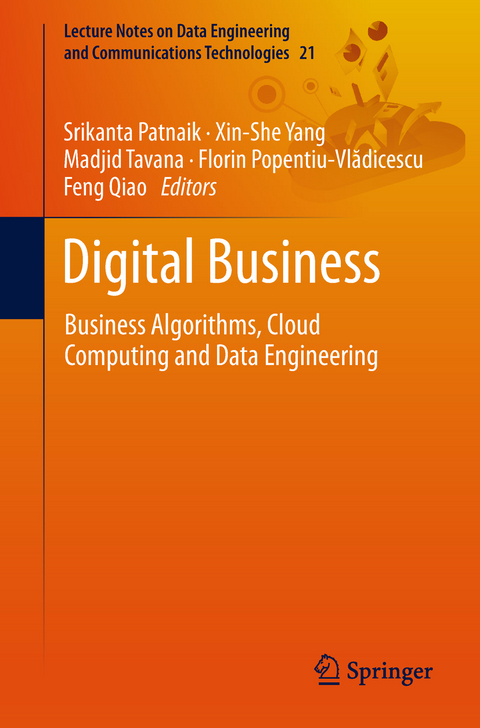
Digital Business (eBook)
480 Seiten
Springer International Publishing (Verlag)
978-3-319-93940-7 (ISBN)
This edited book presents contributions from three different areas: cloud computing, digital mess and business algorithms on a single platform, i.e. Digital Business. The book is divided into four sections: (i) Digital Business Transformation, (ii) Cloud Computing, (iii) IOT & Mobility, and (iv) Information Management & Social Media, which are part of a holistic approach to information management and connecting the value chains of businesses to derive more throughput in the entire business ecosystem. Digital business is a niche area of computer science and business management, and its dimension is vast - it includes technologies such as cloud computing, Internet of Things, mobile platforms, big data applied in areas like ERP, data mining and business intelligence. Digital technologies have also challenged existing business models and will continue to do so. One of the key driving forces is the capacity of innovation and the commercialization of information and communication technologies.
Providing insights into the new paradigm of digital business, the book is a valuable resource for research scholars, academics and professionals.
Preface 6
Editorial 8
Contents 12
About the Editors 14
Digital Business Transformation 17
Towards Algorithmic Business: A Paradigm Shift in Digital Business 18
1 Introduction 19
2 Emergence of Algorithms in Business 21
3 Digital to Algorithmic Transformation 23
4 Deployment Strategies of IoT 24
5 Business Algorithms 27
5.1 Google’s Algorithms 27
5.2 Amazon’s Algorithm 29
5.3 Face Book’s News Feed Algorithm 30
6 Applications 31
6.1 Manufacturing Industries 31
6.2 Health Care Industries 32
6.3 Smart Products 32
6.4 Retail and E-Commerce Industries 32
6.5 Smart Cities 33
6.6 Education Industries 33
6.7 Airline Industry 33
6.8 Human Resources 33
6.9 Transportation 34
6.10 Stock Trading 34
7 Challenges 34
8 Conclusion 35
References 35
A Decentralized Business Ecosystem Model for Complex Products 38
1 Introduction 39
2 Background and Methodology 40
2.1 Business Ecosystems 41
2.2 Methodology 42
3 Overall Objectives 43
3.1 Complex Product Scenarios 43
3.2 Business Goals 46
3.3 Requirements 46
4 Related Work 46
5 Outlining a Decentralized Business Ecosystem for Complex Products 50
5.1 Model and Concept 50
5.2 Ecosystem Structure 52
6 Ecosystem Architecture 55
6.1 High-Level Overview 55
6.2 Peer Application 56
6.3 Decentralized Market Space (DMS) 60
6.4 Inner Workings: Transaction Process for Complex Products 62
6.5 Demonstrator 62
7 Conclusions and Outlook 65
References 66
Compliance Management in Business Processes 68
1 Introduction or Overview 69
2 Compliance Management—Concepts and Terminology 71
3 Case Study 73
4 The Compliance Management Lifecycle 76
4.1 Elicitation 76
4.2 Formalization (Specification) 86
4.3 Implementation 90
4.4 Supervision 93
4.5 Improvement 94
5 Compliance Monitoring Functionalities (CMFs) 96
6 Challenges 98
7 Conclusion 100
References 101
Cloud Computing 107
Sustainable Cloud Computing Realization for Different Applications: A Manifesto 108
1 Introduction 108
2 Sustainable Cloud Computing: Architecture 109
3 State-of-the-Art: Application Management 111
4 Taxonomy of Application Management for Sustainable Cloud Computing 114
4.1 QoS Parameter 114
4.2 Application Parameters 116
4.3 Application Scheduling 118
4.4 Application Category 118
4.5 Application Domain 121
4.6 Resource Administration 121
4.7 Coordination 122
4.8 Application Model 122
5 Gap Analysis and Future Research Directions 123
5.1 Application Modeling 123
5.2 Resource Management 124
5.3 Energy Efficiency 124
5.4 Reliability and Fault Tolerance 124
5.5 Security and Privacy 125
5.6 Scalability 125
5.7 Latency 125
5.8 Data Management 126
5.9 Auditing 126
5.10 New Technological Developments 126
6 Summary and Conclusions 128
References 128
Auction Based Scheme for Resource Allotment in Cloud Computing 131
1 Introduction 132
2 Related Work 132
2.1 A Taxonomy of Market Technical Aspects 134
2.2 Auction Theory 135
3 Market-Based Resource Management Model 139
4 Objective and Design of Proposed Algorithm 141
4.1 Architecture of Cloud 141
4.2 Proposed Resource Allocation Algorithm 146
4.3 Simulation Parameters 146
5 Result and Discussion 149
6 Conclusion 150
Appendix: Flow Chart of the Proposed Auction Algorithm 151
References 151
M-Cloud Computing Based Agriculture Management System 154
1 Introduction 154
2 Problem in Agriculture 156
2.1 Linkage Problems 156
2.2 Weather Information 156
2.3 Transportation and Infrastructure 157
2.4 Agriculture Marketing 157
2.5 Credit Facilities 157
2.6 Storage of Food Grains 157
3 Cloud Computing 157
4 Agriculture with M-Cloud Computing 158
4.1 Crop Disease Identification Management 160
4.2 Smarter Agricultural Practices 160
4.3 Supporting Vegetable and Crop Production 161
5 M-Cloud Computing with Big Data 161
6 Advantages of M-Cloud Computing in Agriculture 163
7 Conclusion 163
References 164
IOT & Mobility
Detection and Analysis of Drowsiness in Human Beings Using Multimodal Signals 166
1 Introduction 166
2 Related Work 167
3 Proposed Work 168
3.1 Databases 169
3.2 Drowsiness Detection 171
3.3 EEG Signal Classification 173
3.4 SVM Classifier 175
3.5 Yawning Detection 176
4 Results and Conclusion 177
4.1 Using EEG Signals 177
4.2 Using Video Signals 177
5 Conclusion 181
References 182
Enhancing Security and Privacy in Enterprises Network by Using Biometrics Technologies 184
1 Introduction 185
2 Inter-entreprises Cooperation 186
3 Interest of Business Networks 186
3.1 Business Networks and Internet Worldwide 187
3.2 Sensitive Business Information 187
4 Information Security and Privacy 188
4.1 Cryptography Process 188
4.2 Biometrics Process 189
4.3 Crypto-Biometric Security System 189
5 Crypto-Biometric Based EN Security 189
6 Proposed Security Solution for Enterprises Information 192
6.1 Preliminary 192
6.2 Encryption and Key Embedded Process 194
6.3 Decryption and Key Retrieval Process 195
7 Experimental Setup 197
8 Security Analysis 200
8.1 Unimodal Biometric Cryptosystem 200
8.2 Multimodal Biometric Cryptosystem 203
9 Conclusion and Further Works 204
References 205
Lightweight Context-Based Web-Service Composition Model for Mobile Devices 207
1 Introduction 208
2 Related Work 209
3 Overview 209
3.1 Parts of Speech (POS) Tagging 209
3.2 Markov Chain Probabilistic Model 215
3.3 Trie Data Structure 216
4 Methodology and Implementation 217
4.1 Get Natural Language Query from the User 218
4.2 Preparing the Corpus 219
4.3 Framing Sample Sentences 219
4.4 Using Markov Chain Probabilistic Model 220
4.5 Identifying Service Names from the Sentence 222
4.6 API’s and Libraries Used in Web Service 222
5 Results and Discussion 227
6 Conclusion and Future Work 228
References 229
On Weighted Extended Cumulative Residual Entropy of k-th Upper Record 231
1 Introduction 231
2 WECREn and Its Dynamic Form 235
3 Characterization Results 241
4 Empirical Approach 245
5 Conclusion and Future Work 248
References 248
Impact of Mobility in IoT Devices for Healthcare 250
1 Introduction 251
1.1 Research Description 251
1.2 Extent amp Objectives of the Research 251
1.3 Significance of the Research 252
1.4 Applications of the Research 253
2 Literature Survey 254
3 Problem Statement for Impacts of Mobility in IoT Devices for Healthcare 255
3.1 Difficulties Which Impact of Mobility in IOT Devices for Healthcare Sector 256
3.2 Existing System Scenarios 257
3.3 Disadvantages of Existing System 257
3.4 Proposed System 258
3.5 Advantages of Proposed System 258
4 System Security Standards 259
5 Security Healthcare Challenges 260
6 Mobility Issues 261
7 System Design 262
8 Performance Analysis 262
9 Disadvantages in Traditional Method 263
10 Conclusion 266
11 Future Work 267
Bibliography 267
Multiple Mobile Elements Based Energy Efficient Data Gathering Technique in Wireless Sensor Networks 269
1 Introduction 270
2 Related Work 271
3 Practical Understanding of Unresolved Issues 273
3.1 Motivation 274
4 Proposed Solution 275
4.1 Overview of the Proposed Work EEDGMME 275
4.2 Detailed Explanation of Inclusive Algorithms 276
5 Simulation Experiments 284
5.1 Simulation Model for EEDG and EEDGMME Techniques 284
5.2 Performance Metrics 284
5.3 Performance Analysis of EEDGMME and EEDG Techniques 285
5.4 Comparative Performance Analysis 287
6 Conclusion and Future Work 289
References 289
Information Management & Social Media
Online Social Communities 293
1 Introduction 294
2 Types of Social Communities 296
3 Evolution of Technology for ONSC 298
4 Online Social Community 299
4.1 Pre-requisite for ONSC 300
4.2 Types of ONSC 306
5 Online Social Community Management 308
5.1 User Acquisition Factor 310
5.2 User Engagement Factor 310
5.3 User Retention Factors 311
5.4 ONSC and User’s Perspective 314
5.5 Recommender Systems from ONSC 319
5.6 ONSC User Engagement Tools 319
6 ONSC Structure Detection 321
6.1 Detection of Communities in Static Networks 322
6.2 Detection of Communities in Dynamic Networks 328
7 Applications 330
8 Conclusion 332
References 337
The ‘Verticals’, ‘Horizontals’, and ‘Diagonals’ in Organisational Communication: Developing Models to Mitigate Communication Barriers Through Social Media Applications 346
1 Introduction 347
2 Review of Literature 348
2.1 History of Communication Skills 349
2.2 New Capitalism: Services Sector and Linguistic Requirements 350
2.3 Rhetorics of Communication and Workplace Demands 351
3 Communication Model and the Channels: A Brief Review 352
3.1 The Model of Communication 352
3.2 Communication Flows 353
3.3 Barriers to Communication 354
4 New Technologies for Communication 357
4.1 Technologisation of Communication 358
4.2 Capitalising Social Tools as an Organisational Discourse 360
5 Social Tools 361
6 Conclusion: Scope, Limitations, and Future Directions 373
References 374
Subjective Interestingness in Association Rule Mining: A Theoretical Analysis 377
1 Introduction 377
2 Knowledge Discovery in Databases 379
2.1 Association Rule Mining 379
3 Interestingness 381
3.1 Objective Interestingness 382
3.2 Subjective Interestingness 383
4 Classification Framework for Subjective Interestingness 385
5 Discussion and Conclusions 387
References 389
Identifying Sentiment of Malayalam Tweets Using Deep Learning 392
1 Introduction 392
2 Related Work 394
3 Materials and Methods 395
3.1 Support Vector Machines 395
3.2 Random Mapping: Random Kitchen Sink Method 395
3.3 Regularized Least Square Method for Classification (RLSC) 397
3.4 Deep Learning Methods—CNN, LSTM 398
4 Experimental Setup 400
4.1 Dataset Description 401
4.2 Preprocessing 401
4.3 Models 402
4.4 Evaluation 403
5 Result and Analysis 404
6 Conclusion 407
References 407
Twitter Based Sentiment Analysis of GST Implementation by Indian Government 410
1 Introduction 410
2 Methodology Followed 411
3 Tweet Collection 412
4 Data Preprocessing 413
5 Training Datasets 414
6 Sentiment Analysis 414
7 Location Based Analysis 416
7.1 Region Wise Analysis 418
7.2 State Wise Analysis 419
8 Possible Reason of Unhappiness Among Various States 421
9 Conclusions 425
References 428
Event Detection Using Twitter Platform 429
1 Introduction 430
2 Types of Online Social Networks 433
3 Event Categories 435
4 Event Detection 438
4.1 Event Detection Techniques 439
4.2 Research Challenges 451
5 Case Study: Twitter Platform 452
5.1 Twitter Platform for Detection of Disaster Events 455
5.2 Twitter Platform for Detection of Emerging Events 457
5.3 Twitter Platform for Public Opinion Events 459
5.4 Twitter Platform for Prediction of Emerging Events 460
6 Existing Tools for Twitter Platform 461
6.1 Data Collection Tools 461
6.2 Event Detection and Analysis Tools 466
7 Conclusion 471
References 472
| Erscheint lt. Verlag | 26.7.2018 |
|---|---|
| Reihe/Serie | Lecture Notes on Data Engineering and Communications Technologies | Lecture Notes on Data Engineering and Communications Technologies |
| Zusatzinfo | XV, 480 p. 111 illus., 77 illus. in color. |
| Verlagsort | Cham |
| Sprache | englisch |
| Themenwelt | Informatik ► Theorie / Studium ► Künstliche Intelligenz / Robotik |
| Technik | |
| Schlagworte | Advanced System Architecture • algorithmic business • Cloud Computing • data engineering • Information of Everything & Platforms • Mesh App and Service Architecture |
| ISBN-10 | 3-319-93940-8 / 3319939408 |
| ISBN-13 | 978-3-319-93940-7 / 9783319939407 |
| Informationen gemäß Produktsicherheitsverordnung (GPSR) | |
| Haben Sie eine Frage zum Produkt? |
 PDF (Wasserzeichen)
DRM: Digitales Wasserzeichen
Dieses eBook enthält ein digitales Wasserzeichen und ist damit für Sie personalisiert. Bei einer missbräuchlichen Weitergabe des eBooks an Dritte ist eine Rückverfolgung an die Quelle möglich.
Dateiformat: PDF (Portable Document Format)
Mit einem festen Seitenlayout eignet sich die PDF besonders für Fachbücher mit Spalten, Tabellen und Abbildungen. Eine PDF kann auf fast allen Geräten angezeigt werden, ist aber für kleine Displays (Smartphone, eReader) nur eingeschränkt geeignet.
Systemvoraussetzungen:
PC/Mac: Mit einem PC oder Mac können Sie dieses eBook lesen. Sie benötigen dafür einen PDF-Viewer - z.B. den Adobe Reader oder Adobe Digital Editions.
eReader: Dieses eBook kann mit (fast) allen eBook-Readern gelesen werden. Mit dem amazon-Kindle ist es aber nicht kompatibel.
Smartphone/Tablet: Egal ob Apple oder Android, dieses eBook können Sie lesen. Sie benötigen dafür einen PDF-Viewer - z.B. die kostenlose Adobe Digital Editions-App.
Buying eBooks from abroad
For tax law reasons we can sell eBooks just within Germany and Switzerland. Regrettably we cannot fulfill eBook-orders from other countries.
aus dem Bereich