


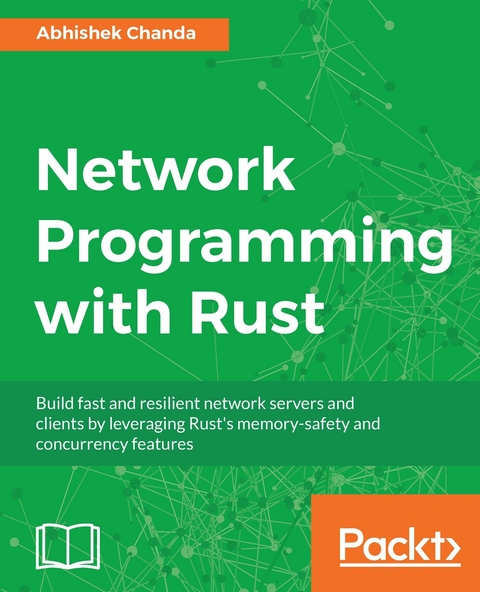
Network Programming with Rust (eBook)
278 Seiten
Packt Publishing (Verlag)
978-1-78862-171-7 (ISBN)
Learn to write servers and network clients using Rust's low-level socket classes with this guide
Key Features
- Build a solid foundation in Rust while also mastering important network programming details
- Leverage the power of a number of available libraries to perform network operations in Rust
- Develop a fully functional web server to gain the skills you need, fast
Book Description
Rust is low-level enough to provide fine-grained control over memory while providing safety through compile-time validation. This makes it uniquely suitable for writing low-level networking applications.
This book is divided into three main parts that will take you on an exciting journey of building a fully functional web server. The book starts with a solid introduction to Rust and essential networking concepts. This will lay a foundation for, and set the tone of, the entire book. In the second part, we will take an in-depth look at using Rust for networking software. From client-server networking using sockets to IPv4/v6, DNS, TCP, UDP, you will also learn about serializing and deserializing data using serde. The book shows how to communicate with REST servers over HTTP. The final part of the book discusses asynchronous network programming using the Tokio stack. Given the importance of security for modern systems, you will see how Rust supports common primitives such as TLS and public-key cryptography.
After reading this book, you will be more than confident enough to use Rust to build effective networking software
What you will learn
- Appreciate why networking is important in implementing distributed systems
- Write a non-asynchronous echo server over TCP that talks to a client over a network
- Parse JSON and binary data using parser combinators such as nom
- Write an HTTP client that talks to the server using reqwest
- Modify an existing Rust HTTTP server and add SSL to it
- Master asynchronous programming support in Rust
- Use external packages in a Rust project
Who this book is for
This book is for software developers who want to write networking software with Rust. A basic familiarity with networking concepts is assumed. Beginner-level knowledge of Rust will help but is not necessary.
Abhishek Chanda studied computer science at IIEST Shibpur in India and electrical engineering at Rutgers University. He has lived and worked in multiple countries, working on distributed systems since 2008 at big companies such as Microsoft as well as a number smaller start-ups. Currently, he is working with DataSine in London, where he is responsible for the scalable deployment of infrastructure powering the backend systems of the DataSine platform. He contributes to a number of open source projects, including Rust.Learn to write servers and network clients using Rust's low-level socket classes with this guideAbout This BookBuild a solid foundation in Rust while also mastering important network programming detailsLeverage the power of a number of available libraries to perform network operations in RustDevelop a fully functional web server to gain the skills you need, fastWho This Book Is ForThis book is for software developers who want to write networking software with Rust. A basic familiarity with networking concepts is assumed. Beginner-level knowledge of Rust will help but is not necessary.What You Will LearnAppreciate why networking is important in implementing distributed systemsWrite a non-asynchronous echo server over TCP that talks to a client over a networkParse JSON and binary data using parser combinators such as nomWrite an HTTP client that talks to the server using reqwestModify an existing Rust HTTTP server and add SSL to itMaster asynchronous programming support in RustUse external packages in a Rust projectIn DetailRust is low-level enough to provide fine-grained control over memory while providing safety through compile-time validation. This makes it uniquely suitable for writing low-level networking applications.This book is divided into three main parts that will take you on an exciting journey of building a fully functional web server. The book starts with a solid introduction to Rust and essential networking concepts. This will lay a foundation for, and set the tone of, the entire book. In the second part, we will take an in-depth look at using Rust for networking software. From client-server networking using sockets to IPv4/v6, DNS, TCP, UDP, you will also learn about serializing and deserializing data using serde. The book shows how to communicate with REST servers over HTTP. The final part of the book discusses asynchronous network programming using the Tokio stack. Given the importance of security for modern systems, you will see how Rust supports common primitives such as TLS and public-key cryptography.After reading this book, you will be more than confident enough to use Rust to build effective networking softwareStyle and approachThis book will get you started with building networking software in Rust by taking you through all the essential concepts.
| Erscheint lt. Verlag | 27.2.2018 |
|---|---|
| Sprache | englisch |
| Themenwelt | Mathematik / Informatik ► Informatik ► Programmiersprachen / -werkzeuge |
| Schlagworte | Data streams • gRPC • IP • network programming • protocols • Rust • Socket • TCP • TLS |
| ISBN-10 | 1-78862-171-9 / 1788621719 |
| ISBN-13 | 978-1-78862-171-7 / 9781788621717 |
| Informationen gemäß Produktsicherheitsverordnung (GPSR) | |
| Haben Sie eine Frage zum Produkt? |
 EPUB (Adobe DRM)
Kopierschutz: Adobe-DRM
Adobe-DRM ist ein Kopierschutz, der das eBook vor Mißbrauch schützen soll. Dabei wird das eBook bereits beim Download auf Ihre persönliche Adobe-ID autorisiert. Lesen können Sie das eBook dann nur auf den Geräten, welche ebenfalls auf Ihre Adobe-ID registriert sind.
Details zum Adobe-DRM
Dateiformat: EPUB (Electronic Publication)
EPUB ist ein offener Standard für eBooks und eignet sich besonders zur Darstellung von Belletristik und Sachbüchern. Der Fließtext wird dynamisch an die Display- und Schriftgröße angepasst. Auch für mobile Lesegeräte ist EPUB daher gut geeignet.
Systemvoraussetzungen:
PC/Mac: Mit einem PC oder Mac können Sie dieses eBook lesen. Sie benötigen eine
eReader: Dieses eBook kann mit (fast) allen eBook-Readern gelesen werden. Mit dem amazon-Kindle ist es aber nicht kompatibel.
Smartphone/Tablet: Egal ob Apple oder Android, dieses eBook können Sie lesen. Sie benötigen eine
Geräteliste und zusätzliche Hinweise
Buying eBooks from abroad
For tax law reasons we can sell eBooks just within Germany and Switzerland. Regrettably we cannot fulfill eBook-orders from other countries.
aus dem Bereich


