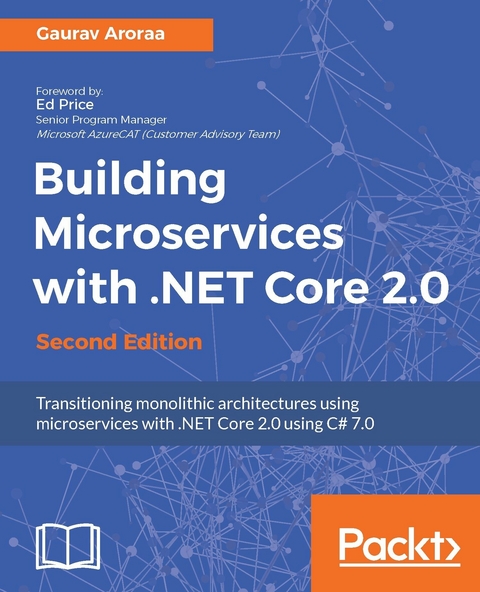
Building Microservices with .NET Core 2.0 - Second Edition (eBook)
300 Seiten
Packt Publishing (Verlag)
978-1-78839-996-8 (ISBN)
Architect your .NET applications by breaking them into really small pieces - microservices -using this practical, example-based guide.
About This Book
- Start your microservices journey and get a broader perspective on microservices development using C# 7.0 with .NET Core 2.0
- Build, deploy, and test microservices using ASP.Net Core, ASP.NET Core API, and Microsoft Azure Cloud
- Get the basics of reactive microservices
Who This Book Is For
This book is for .NET Core developers who want to learn and understand the microservices architecture and implement it in their .NET Core applications. It's ideal for developers who are completely new to microservices or just have a theoretical understanding of this architectural approach and want to gain a practical perspective in order to better manage application complexities.
What You Will Learn
- Get acquainted with Microsoft Azure Service Fabric
- Compare microservices with monolithic applications and SOA
- Learn Docker and Azure API management
- Define a service interface and implement APIs using ASP.NET Core 2.0
- Integrate services using a synchronous approach via RESTful APIs with ASP.NET Core 2.0
- Implement microservices security using Azure Active Directory, OpenID Connect, and OAuth 2.0
- Understand the operation and scaling of microservices in .NET Core 2.0
- Understand the key features of reactive microservices and implement them using reactive extensions
In Detail
The microservices architectural style promotes the development of complex applications as a suite of small services based on business capabilities. This book will help you identify the appropriate service boundaries within your business. We'll start by looking at what microservices are and their main characteristics.
Moving forward, you will be introduced to real-life application scenarios; after assessing the current issues, we will begin the journey of transforming this application by splitting it into a suite of microservices using C# 7.0 with .NET Core 2.0. You will identify service boundaries, split the application into multiple microservices, and define service contracts. You will find out how to configure, deploy, and monitor microservices, and configure scaling to allow the application to quickly adapt to increased demand in the future.
With an introduction to reactive microservices, you'll strategically gain further value to keep your code base simple, focusing on what is more important rather than on messy asynchronous calls.
Style and approach
This guide serves as a stepping stone that helps .NET Core developers in their microservices architecture. This book provides just enough theory to understand the concepts and apply the examples.
Architect your .NET applications by breaking them into really small pieces - microservices -using this practical, example-based guide.About This BookStart your microservices journey and get a broader perspective on microservices development using C# 7.0 with .NET Core 2.0Build, deploy, and test microservices using ASP.Net Core, ASP.NET Core API, and Microsoft Azure CloudGet the basics of reactive microservicesWho This Book Is ForThis book is for .NET Core developers who want to learn and understand the microservices architecture and implement it in their .NET Core applications. It's ideal for developers who are completely new to microservices or just have a theoretical understanding of this architectural approach and want to gain a practical perspective in order to better manage application complexities.What You Will LearnGet acquainted with Microsoft Azure Service FabricCompare microservices with monolithic applications and SOALearn Docker and Azure API managementDefine a service interface and implement APIs using ASP.NET Core 2.0Integrate services using a synchronous approach via RESTful APIs with ASP.NET Core 2.0Implement microservices security using Azure Active Directory, OpenID Connect, and OAuth 2.0Understand the operation and scaling of microservices in .NET Core 2.0Understand the key features of reactive microservices and implement them using reactive extensionsIn DetailThe microservices architectural style promotes the development of complex applications as a suite of small services based on business capabilities. This book will help you identify the appropriate service boundaries within your business. We'll start by looking at what microservices are and their main characteristics. Moving forward, you will be introduced to real-life application scenarios; after assessing the current issues, we will begin the journey of transforming this application by splitting it into a suite of microservices using C# 7.0 with .NET Core 2.0. You will identify service boundaries, split the application into multiple microservices, and define service contracts. You will find out how to configure, deploy, and monitor microservices, and configure scaling to allow the application to quickly adapt to increased demand in the future.With an introduction to reactive microservices, you'll strategically gain further value to keep your code base simple, focusing on what is more important rather than on messy asynchronous calls.Style and approachThis guide serves as a stepping stone that helps .NET Core developers in their microservices architecture. This book provides just enough theory to understand the concepts and apply the examples.
| Erscheint lt. Verlag | 22.12.2017 |
|---|---|
| Sprache | englisch |
| Themenwelt | Mathematik / Informatik ► Informatik |
| ISBN-10 | 1-78839-996-X / 178839996X |
| ISBN-13 | 978-1-78839-996-8 / 9781788399968 |
| Informationen gemäß Produktsicherheitsverordnung (GPSR) | |
| Haben Sie eine Frage zum Produkt? |
 EPUB (Adobe DRM)
Kopierschutz: Adobe-DRM
Adobe-DRM ist ein Kopierschutz, der das eBook vor Mißbrauch schützen soll. Dabei wird das eBook bereits beim Download auf Ihre persönliche Adobe-ID autorisiert. Lesen können Sie das eBook dann nur auf den Geräten, welche ebenfalls auf Ihre Adobe-ID registriert sind.
Details zum Adobe-DRM
Dateiformat: EPUB (Electronic Publication)
EPUB ist ein offener Standard für eBooks und eignet sich besonders zur Darstellung von Belletristik und Sachbüchern. Der Fließtext wird dynamisch an die Display- und Schriftgröße angepasst. Auch für mobile Lesegeräte ist EPUB daher gut geeignet.
Systemvoraussetzungen:
PC/Mac: Mit einem PC oder Mac können Sie dieses eBook lesen. Sie benötigen eine
eReader: Dieses eBook kann mit (fast) allen eBook-Readern gelesen werden. Mit dem amazon-Kindle ist es aber nicht kompatibel.
Smartphone/Tablet: Egal ob Apple oder Android, dieses eBook können Sie lesen. Sie benötigen eine
Geräteliste und zusätzliche Hinweise
Buying eBooks from abroad
For tax law reasons we can sell eBooks just within Germany and Switzerland. Regrettably we cannot fulfill eBook-orders from other countries.
aus dem Bereich