
Rigid Local Systems (eBook)
Princeton University Press (Verlag)
978-1-4008-8259-5 (ISBN)
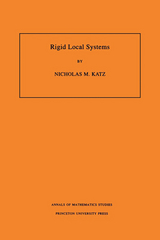
KatzNicholas M.:
Nicholas M Katz is Professor of Mathematics at Princeton University.Nicholas M Katz is Professor of Mathematics at Princeton University.
Riemann introduced the concept of a "e;local system"e; on P1-{a finite set of points} nearly 140 years ago. His idea was to study nth order linear differential equations by studying the rank n local systems (of local holomorphic solutions) to which they gave rise. His first application was to study the classical Gauss hypergeometric function, which he did by studying rank-two local systems on P1- {0,1,infinity}. His investigation was successful, largely because any such (irreducible) local system is rigid in the sense that it is globally determined as soon as one knows separately each of its local monodromies. It became clear that luck played a role in Riemann's success: most local systems are not rigid. Yet many classical functions are solutions of differential equations whose local systems are rigid, including both of the standard nth order generalizations of the hypergeometric function, n F n-1's, and the Pochhammer hypergeometric functions. This book is devoted to constructing all (irreducible) rigid local systems on P1-{a finite set of points} and recognizing which collections of independently given local monodromies arise as the local monodromies of irreducible rigid local systems. Although the problems addressed here go back to Riemann, and seem to be problems in complex analysis, their solutions depend essentially on a great deal of very recent arithmetic algebraic geometry, including Grothendieck's etale cohomology theory, Deligne's proof of his far-reaching generalization of the original Weil Conjectures, the theory of perverse sheaves, and Laumon's work on the l-adic Fourier Transform.
Nicholas M Katz is Professor of Mathematics at Princeton University.
| Erscheint lt. Verlag | 2.3.2016 |
|---|---|
| Reihe/Serie | Annals of Mathematics Studies | Annals of Mathematics Studies |
| Verlagsort | Princeton |
| Sprache | englisch |
| Themenwelt | Mathematik / Informatik ► Mathematik ► Analysis |
| Mathematik / Informatik ► Mathematik ► Geometrie / Topologie | |
| Schlagworte | Additive group • Alexander Grothendieck • Algebraically closed field • algebraic closure • algebraic differential equation • algorithm • analytic continuation • automorphism • Axiom of choice • Bernhard Riemann • Big O notation • Calculation • Carlos Simpson • coefficient • cohomology • commutator • Compactification (mathematics) • comparison theorem • Complex analytic space • Complex conjugate • complex manifold • conjecture • conjugacy class • convolution • corollary • Cube root • cusp form • de Rham cohomology • differential equation • Dimension • Dimensional Analysis • Discrete valuation ring • Disjoint union • Divisor • Duality (mathematics) • Eigenfunction • Eigenvalues and Eigenvectors • Elliptic Curve • Equation • Equivalence of Categories • exact sequence • existential quantification • finite field • Finite set • Fourier transform • functor • fundamental group • Generic point • Ground field • Hodge structure • hypergeometric function • Integer • Invertible matrix • isomorphism class • Jordan normal form • Level of Measurement • linear differential equation • Local System • Mathematical Induction • Mathematics • Matrix (mathematics) • Monodromy • Monomial • Morphism • Natural Filtration • Parameter • Parity (mathematics) • Perfect field • perverse sheaf • polynomial • Prime number • Projective representation • projective space • pullback • Pullback (category theory) • rational function • Regular singular point • Relative dimension • residue field • Ring of integers • Root of unity • Sequence • Sesquilinear form • Set (mathematics) • Sheaf (mathematics) • Six operations • Special case • SUBGROUP • Subobject • Subring • Suggestion • Summation • tensor product • Theorem • theory • Topology • Triangular Matrix • Trivial representation • Vector Space • Zariski topology |
| ISBN-10 | 1-4008-8259-1 / 1400882591 |
| ISBN-13 | 978-1-4008-8259-5 / 9781400882595 |
| Informationen gemäß Produktsicherheitsverordnung (GPSR) | |
| Haben Sie eine Frage zum Produkt? |
 PDF (Wasserzeichen)
Größe: 10,4 MB
DRM: Digitales Wasserzeichen
Dieses eBook enthält ein digitales Wasserzeichen und ist damit für Sie personalisiert. Bei einer missbräuchlichen Weitergabe des eBooks an Dritte ist eine Rückverfolgung an die Quelle möglich.
Dateiformat: PDF (Portable Document Format)
Mit einem festen Seitenlayout eignet sich die PDF besonders für Fachbücher mit Spalten, Tabellen und Abbildungen. Eine PDF kann auf fast allen Geräten angezeigt werden, ist aber für kleine Displays (Smartphone, eReader) nur eingeschränkt geeignet.
Systemvoraussetzungen:
PC/Mac: Mit einem PC oder Mac können Sie dieses eBook lesen. Sie benötigen dafür einen PDF-Viewer - z.B. den Adobe Reader oder Adobe Digital Editions.
eReader: Dieses eBook kann mit (fast) allen eBook-Readern gelesen werden. Mit dem amazon-Kindle ist es aber nicht kompatibel.
Smartphone/Tablet: Egal ob Apple oder Android, dieses eBook können Sie lesen. Sie benötigen dafür einen PDF-Viewer - z.B. die kostenlose Adobe Digital Editions-App.
Buying eBooks from abroad
For tax law reasons we can sell eBooks just within Germany and Switzerland. Regrettably we cannot fulfill eBook-orders from other countries.
PDF (Adobe DRM)Kopierschutz: Adobe-DRM
Adobe-DRM ist ein Kopierschutz, der das eBook vor Mißbrauch schützen soll. Dabei wird das eBook bereits beim Download auf Ihre persönliche Adobe-ID autorisiert. Lesen können Sie das eBook dann nur auf den Geräten, welche ebenfalls auf Ihre Adobe-ID registriert sind.
Details zum Adobe-DRM
Dateiformat: PDF (Portable Document Format)
Mit einem festen Seitenlayout eignet sich die PDF besonders für Fachbücher mit Spalten, Tabellen und Abbildungen. Eine PDF kann auf fast allen Geräten angezeigt werden, ist aber für kleine Displays (Smartphone, eReader) nur eingeschränkt geeignet.
Systemvoraussetzungen:
PC/Mac: Mit einem PC oder Mac können Sie dieses eBook lesen. Sie benötigen eine
eReader: Dieses eBook kann mit (fast) allen eBook-Readern gelesen werden. Mit dem amazon-Kindle ist es aber nicht kompatibel.
Smartphone/Tablet: Egal ob Apple oder Android, dieses eBook können Sie lesen. Sie benötigen eine
Geräteliste und zusätzliche Hinweise
Buying eBooks from abroad
For tax law reasons we can sell eBooks just within Germany and Switzerland. Regrettably we cannot fulfill eBook-orders from other countries.
aus dem Bereich