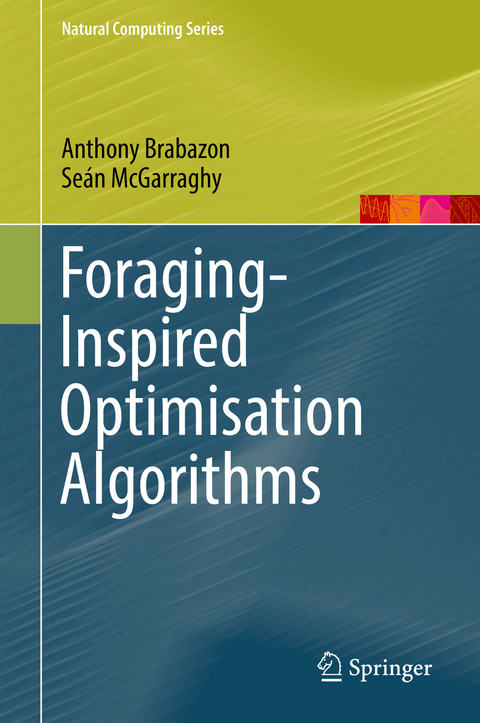
Foraging-Inspired Optimisation Algorithms
Springer International Publishing (Verlag)
978-3-319-59155-1 (ISBN)
This book is an introduction to relevant aspects of the foraging literature for algorithmic design, and an overview of key families of optimization algorithms that stem from a foraging metaphor. The authors first offer perspectives on foraging and foraging-inspired algorithms for optimization, they then explain the techniques inspired by the behaviors of vertebrates, invertebrates, and non-neuronal organisms, and they then discuss algorithms based on formal models of foraging, how to evolve a foraging strategy, and likely future developments.
No prior knowledge of natural computing is assumed. This book will be of particular interest to graduate students, academics and practitioners in computer science, informatics, data science, management science, and other application domains.
Prof. Anthony Brabazon is Associate Dean of the Smurfit Graduate School of Business, University College Dublin (UCD) and Professor of Accountancy; previous positions include Vice-Principal of Research and Innovation for the College of Business and Law, Head of Research for the School of Business, and Programme Director for the Master of Accounting Degree. His primary research interests concern the development of natural computing theory and the application of related algorithms to real-world problems, particularly in the domain of business and finance, and he has pioneered multidisciplinary collaborations with industry in areas such as financial mathematics, financial economics, and computer science. He is cofounder and codirector of the Natural Computing Research and Applications Group at UCD, among the most successful research groups dedicated to this subject. He has a bachelor's degree in commerce and a diploma in accounting, he is a qualified professional accountant, and he has postgraduate qualifications in statistics and operations research. Prof. Brabazon coauthored the Springer books 'Natural Computing Algorithms' and 'Biologically Inspired Algorithms for Financial Modelling'.Dr. Seán McGarraghy is the Director of the UCD Smurfit Graduate School of Business M.Sc. in Business Analytics. He has qualifications in electronics, mathematics and management, and his teaching and academic publications cover many aspects of business analytics and operations research. Particular topics of interests include combinatorial enumeration and optimization, network algorithms, supply chain management, quadratic forms, and K-theory.
Introduction.- Formal Models of Foraging.- Sensor Modalities.- Individual and Social Learning.- Introduction to Foraging Algorithms.- Mammals.- Bird Foraging Algorithms.- Fish Algorithms.- Ant Foraging Algorithms.- Honeybee Inspired Algorithms.- Bioluminescence Algorithms.- Spider Algorithms.- Worm Algorithm.- Bacteria Inspired Algorithms.- Slime Mould Foraging.- Plant Foraging Algorithms.- Group Search and Predatory Search.- Evolving Foraging Algorithms.- Conclusions.
| Erscheinungsdatum | 08.10.2018 |
|---|---|
| Reihe/Serie | Natural Computing Series |
| Zusatzinfo | XVIII, 478 p. |
| Verlagsort | Cham |
| Sprache | englisch |
| Maße | 155 x 235 mm |
| Gewicht | 901 g |
| Themenwelt | Mathematik / Informatik ► Informatik ► Theorie / Studium |
| Schlagworte | animal behavior • Ant Foraging Algorithm • Artificial Intelligence • artificial intelligence (incl. robotics) • Bacteria Inspired Algorithms • Bioluminescence Algorithms • Chemotaxis • Computational Intelligence • Computer Science • Evolutionary Computing • foraging • Foraging Algorithms • genetic programming • Group Search • Heuristics • honeybees • learning • management & management techniques • Management Decision Making • Management & management techniques • Mathematical theory of computation • Natural Computing • Operational Research • Operations Research/Decision Theory • Operations Research, Management Science • Optimization • Plant Foraging • Predatory Search • Robotics • Search • slime mould • social learning • Theory of Computation |
| ISBN-10 | 3-319-59155-X / 331959155X |
| ISBN-13 | 978-3-319-59155-1 / 9783319591551 |
| Zustand | Neuware |
| Informationen gemäß Produktsicherheitsverordnung (GPSR) | |
| Haben Sie eine Frage zum Produkt? |
aus dem Bereich