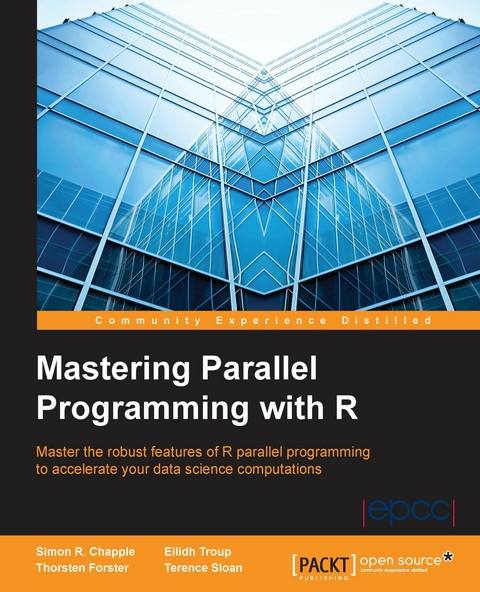
Mastering Parallel Programming with R (eBook)
244 Seiten
Packt Publishing (Verlag)
978-1-78439-462-2 (ISBN)
Master the robust features of R parallel programming to accelerate your data science computations
About This Book
- Create R programs that exploit the computational capability of your cloud platforms and computers to the fullest
- Become an expert in writing the most efficient and highest performance parallel algorithms in R
- Get to grips with the concept of parallelism to accelerate your existing R programs
Who This Book Is For
This book is for R programmers who want to step beyond its inherent single-threaded and restricted memory limitations and learn how to implement highly accelerated and scalable algorithms that are a necessity for the performant processing of Big Data. No previous knowledge of parallelism is required. This book also provides for the more advanced technical programmer seeking to go beyond high level parallel frameworks.
What You Will Learn
- Create and structure efficient load-balanced parallel computation in R, using R's built-in parallel package
- Deploy and utilize cloud-based parallel infrastructure from R, including launching a distributed computation on Hadoop running on Amazon Web Services (AWS)
- Get accustomed to parallel efficiency, and apply simple techniques to benchmark, measure speed and target improvement in your own code
- Develop complex parallel processing algorithms with the standard Message Passing Interface (MPI) using RMPI, pbdMPI, and SPRINT packages
- Build and extend a parallel R package (SPRINT) with your own MPI-based routines
- Implement accelerated numerical functions in R utilizing the vector processing capability of your Graphics Processing Unit (GPU) with OpenCL
- Understand parallel programming pitfalls, such as deadlock and numerical instability, and the approaches to handle and avoid them
- Build a task farm master-worker, spatial grid, and hybrid parallel R programs
In Detail
R is one of the most popular programming languages used in data science. Applying R to big data and complex analytic tasks requires the harnessing of scalable compute resources.
Mastering Parallel Programming with R presents a comprehensive and practical treatise on how to build highly scalable and efficient algorithms in R. It will teach you a variety of parallelization techniques, from simple use of R's built-in parallel package versions of lapply(), to high-level AWS cloud-based Hadoop and Apache Spark frameworks. It will also teach you low level scalable parallel programming using RMPI and pbdMPI for message passing, applicable to clusters and supercomputers, and how to exploit thousand-fold simple processor GPUs through ROpenCL. By the end of the book, you will understand the factors that influence parallel efficiency, including assessing code performance and implementing load balancing; pitfalls to avoid, including deadlock and numerical instability issues; how to structure your code and data for the most appropriate type of parallelism for your problem domain; and how to extract the maximum performance from your R code running on a variety of computer systems.
Style and approach
This book leads you chapter by chapter from the easy to more complex forms of parallelism. The author's insights are presented through clear practical examples applied to a range of different problems, with comprehensive reference information for each of the R packages employed. The book can be read from start to finish, or by dipping in chapter by chapter, as each chapter describes a specific parallel approach and technology, so can be read as a standalone.
Master the robust features of R parallel programming to accelerate your data science computationsAbout This BookCreate R programs that exploit the computational capability of your cloud platforms and computers to the fullestBecome an expert in writing the most efficient and highest performance parallel algorithms in RGet to grips with the concept of parallelism to accelerate your existing R programsWho This Book Is ForThis book is for R programmers who want to step beyond its inherent single-threaded and restricted memory limitations and learn how to implement highly accelerated and scalable algorithms that are a necessity for the performant processing of Big Data. No previous knowledge of parallelism is required. This book also provides for the more advanced technical programmer seeking to go beyond high level parallel frameworks.What You Will LearnCreate and structure efficient load-balanced parallel computation in R, using R's built-in parallel packageDeploy and utilize cloud-based parallel infrastructure from R, including launching a distributed computation on Hadoop running on Amazon Web Services (AWS)Get accustomed to parallel efficiency, and apply simple techniques to benchmark, measure speed and target improvement in your own codeDevelop complex parallel processing algorithms with the standard Message Passing Interface (MPI) using RMPI, pbdMPI, and SPRINT packagesBuild and extend a parallel R package (SPRINT) with your own MPI-based routinesImplement accelerated numerical functions in R utilizing the vector processing capability of your Graphics Processing Unit (GPU) with OpenCLUnderstand parallel programming pitfalls, such as deadlock and numerical instability, and the approaches to handle and avoid themBuild a task farm master-worker, spatial grid, and hybrid parallel R programsIn DetailR is one of the most popular programming languages used in data science. Applying R to big data and complex analytic tasks requires the harnessing of scalable compute resources.Mastering Parallel Programming with R presents a comprehensive and practical treatise on how to build highly scalable and efficient algorithms in R. It will teach you a variety of parallelization techniques, from simple use of R's built-in parallel package versions of lapply(), to high-level AWS cloud-based Hadoop and Apache Spark frameworks. It will also teach you low level scalable parallel programming using RMPI and pbdMPI for message passing, applicable to clusters and supercomputers, and how to exploit thousand-fold simple processor GPUs through ROpenCL. By the end of the book, you will understand the factors that influence parallel efficiency, including assessing code performance and implementing load balancing; pitfalls to avoid, including deadlock and numerical instability issues; how to structure your code and data for the most appropriate type of parallelism for your problem domain; and how to extract the maximum performance from your R code running on a variety of computer systems.Style and approachThis book leads you chapter by chapter from the easy to more complex forms of parallelism. The author's insights are presented through clear practical examples applied to a range of different problems, with comprehensive reference information for each of the R packages employed. The book can be read from start to finish, or by dipping in chapter by chapter, as each chapter describes a specific parallel approach and technology, so can be read as a standalone.
| Erscheint lt. Verlag | 31.5.2016 |
|---|---|
| Sprache | englisch |
| Themenwelt | Mathematik / Informatik ► Informatik |
| ISBN-10 | 1-78439-462-9 / 1784394629 |
| ISBN-13 | 978-1-78439-462-2 / 9781784394622 |
| Informationen gemäß Produktsicherheitsverordnung (GPSR) | |
| Haben Sie eine Frage zum Produkt? |
 EPUB (Adobe DRM)
Kopierschutz: Adobe-DRM
Adobe-DRM ist ein Kopierschutz, der das eBook vor Mißbrauch schützen soll. Dabei wird das eBook bereits beim Download auf Ihre persönliche Adobe-ID autorisiert. Lesen können Sie das eBook dann nur auf den Geräten, welche ebenfalls auf Ihre Adobe-ID registriert sind.
Details zum Adobe-DRM
Dateiformat: EPUB (Electronic Publication)
EPUB ist ein offener Standard für eBooks und eignet sich besonders zur Darstellung von Belletristik und Sachbüchern. Der Fließtext wird dynamisch an die Display- und Schriftgröße angepasst. Auch für mobile Lesegeräte ist EPUB daher gut geeignet.
Systemvoraussetzungen:
PC/Mac: Mit einem PC oder Mac können Sie dieses eBook lesen. Sie benötigen eine
eReader: Dieses eBook kann mit (fast) allen eBook-Readern gelesen werden. Mit dem amazon-Kindle ist es aber nicht kompatibel.
Smartphone/Tablet: Egal ob Apple oder Android, dieses eBook können Sie lesen. Sie benötigen eine
Geräteliste und zusätzliche Hinweise
Buying eBooks from abroad
For tax law reasons we can sell eBooks just within Germany and Switzerland. Regrettably we cannot fulfill eBook-orders from other countries.
aus dem Bereich