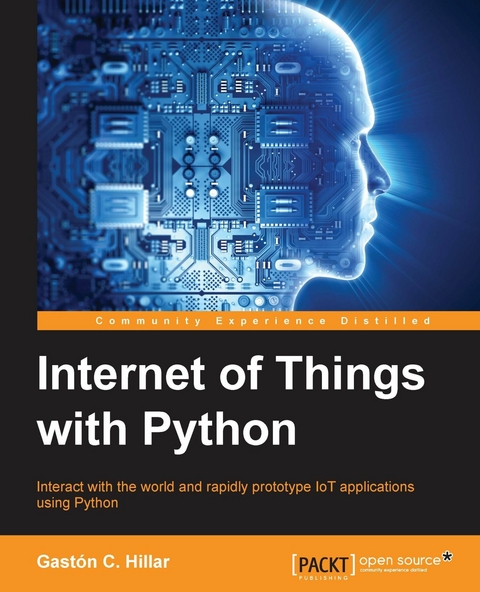
Internet of Things with Python (eBook)
388 Seiten
Packt Publishing (Verlag)
978-1-78588-531-0 (ISBN)
Interact with the world and rapidly prototype IoT applications using Python
About This Book
- Rapidly prototype even complex IoT applications with Python and put them to practical use
- Enhance your IoT skills with the most up-to-date applicability in the field of wearable tech, smart environments, and home automation
- Interact with hardware, sensors, and actuators and control your DIY IoT projects through Python
Who This Book Is For
The book is ideal for Python developers who want to explore the tools in the Python ecosystem in order to build their own IoT applications and work on IoT-related projects. It is also a very useful resource for developers with experience in other programming languages that want to easily prototype IoT applications with the Intel Galileo Gen 2 board.
What You Will Learn
- Prototype and develop IoT solutions from scratch with Python as the programming language
- Develop IoT projects with Intel Galileo Gen 2 board along with Python
- Work with the different components included in the boards using Python and the MRAA library
- Interact with sensors, actuators, and shields
- Work with UART and local storage
- Interact with any electronic device that supports the I2C bus
- Allow mobile devices to interact with the board
- Work with real-time IoT and cloud services
- Understand Big Data and IoT analytics
In Detail
Internet of Things (IoT) is revolutionizing the way devices/things interact with each other. And when you have IoT with Python on your side, you'll be able to build interactive objects and design them.
This book lets you stay at the forefront of cutting-edge research on IoT. We'll open up the possibilities using tools that enable you to interact with the world, such as Intel Galileo Gen 2, sensors, and other hardware. You will learn how to read, write, and convert digital values to generate analog output by programming Pulse Width Modulation (PWM) in Python. You will get familiar with the complex communication system included in the board, so you can interact with any shield, actuator, or sensor.
Later on, you will not only see how to work with data received from the sensors, but also perform actions by sending them to a specific shield. You'll be able to connect your IoT device to the entire world, by integrating WiFi, Bluetooth, and Internet settings. With everything ready, you will see how to work in real time on your IoT device using the MQTT protocol in python.
By the end of the book, you will be able to develop IoT prototypes with Python, libraries, and tools.
Style and approach
This book takes a tutorial-like approach with mission critical chapters. The initial chapters are introductions that set the premise for useful examples covered in later chapters.
Interact with the world and rapidly prototype IoT applications using PythonAbout This BookRapidly prototype even complex IoT applications with Python and put them to practical useEnhance your IoT skills with the most up-to-date applicability in the field of wearable tech, smart environments, and home automationInteract with hardware, sensors, and actuators and control your DIY IoT projects through PythonWho This Book Is ForThe book is ideal for Python developers who want to explore the tools in the Python ecosystem in order to build their own IoT applications and work on IoT-related projects. It is also a very useful resource for developers with experience in other programming languages that want to easily prototype IoT applications with the Intel Galileo Gen 2 board.What You Will LearnPrototype and develop IoT solutions from scratch with Python as the programming languageDevelop IoT projects with Intel Galileo Gen 2 board along with PythonWork with the different components included in the boards using Python and the MRAA libraryInteract with sensors, actuators, and shieldsWork with UART and local storageInteract with any electronic device that supports the I2C busAllow mobile devices to interact with the boardWork with real-time IoT and cloud servicesUnderstand Big Data and IoT analyticsIn DetailInternet of Things (IoT) is revolutionizing the way devices/things interact with each other. And when you have IoT with Python on your side, you'll be able to build interactive objects and design them.This book lets you stay at the forefront of cutting-edge research on IoT. We'll open up the possibilities using tools that enable you to interact with the world, such as Intel Galileo Gen 2, sensors, and other hardware. You will learn how to read, write, and convert digital values to generate analog output by programming Pulse Width Modulation (PWM) in Python. You will get familiar with the complex communication system included in the board, so you can interact with any shield, actuator, or sensor.Later on, you will not only see how to work with data received from the sensors, but also perform actions by sending them to a specific shield. You'll be able to connect your IoT device to the entire world, by integrating WiFi, Bluetooth, and Internet settings. With everything ready, you will see how to work in real time on your IoT device using the MQTT protocol in python.By the end of the book, you will be able to develop IoT prototypes with Python, libraries, and tools.Style and approach This book takes a tutorial-like approach with mission critical chapters. The initial chapters are introductions that set the premise for useful examples covered in later chapters.
| Erscheint lt. Verlag | 20.5.2016 |
|---|---|
| Sprache | englisch |
| Themenwelt | Mathematik / Informatik ► Informatik |
| ISBN-10 | 1-78588-531-6 / 1785885316 |
| ISBN-13 | 978-1-78588-531-0 / 9781785885310 |
| Informationen gemäß Produktsicherheitsverordnung (GPSR) | |
| Haben Sie eine Frage zum Produkt? |
 EPUB (Adobe DRM)
Kopierschutz: Adobe-DRM
Adobe-DRM ist ein Kopierschutz, der das eBook vor Mißbrauch schützen soll. Dabei wird das eBook bereits beim Download auf Ihre persönliche Adobe-ID autorisiert. Lesen können Sie das eBook dann nur auf den Geräten, welche ebenfalls auf Ihre Adobe-ID registriert sind.
Details zum Adobe-DRM
Dateiformat: EPUB (Electronic Publication)
EPUB ist ein offener Standard für eBooks und eignet sich besonders zur Darstellung von Belletristik und Sachbüchern. Der Fließtext wird dynamisch an die Display- und Schriftgröße angepasst. Auch für mobile Lesegeräte ist EPUB daher gut geeignet.
Systemvoraussetzungen:
PC/Mac: Mit einem PC oder Mac können Sie dieses eBook lesen. Sie benötigen eine
eReader: Dieses eBook kann mit (fast) allen eBook-Readern gelesen werden. Mit dem amazon-Kindle ist es aber nicht kompatibel.
Smartphone/Tablet: Egal ob Apple oder Android, dieses eBook können Sie lesen. Sie benötigen eine
Geräteliste und zusätzliche Hinweise
Buying eBooks from abroad
For tax law reasons we can sell eBooks just within Germany and Switzerland. Regrettably we cannot fulfill eBook-orders from other countries.
aus dem Bereich