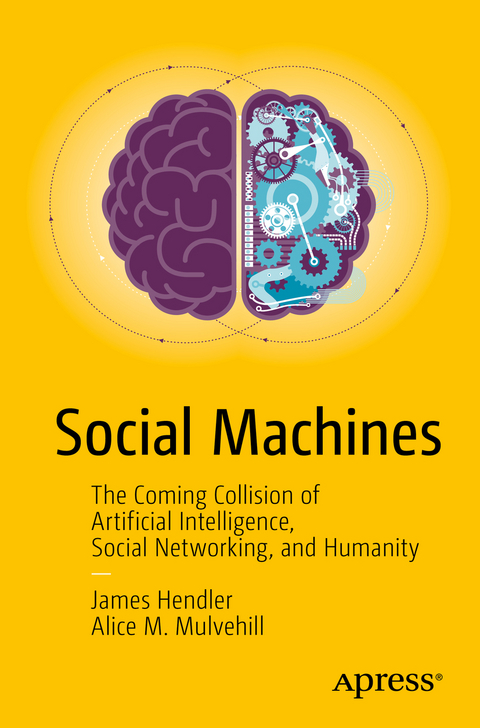
Social Machines (eBook)
XVI, 174 Seiten
Apress (Verlag)
978-1-4842-1156-4 (ISBN)
- What the concept of a social machine is and how the activities of non-programmers are contributing to machine intelligence
- How modern artificial intelligence technologies, such as Watson, are evolving and how they process knowledge from both carefully produced information (such as Wikipedia and journal articles) and from big data collections
- The fundamentals of neuromorphic computing, knowledge graph search, and linked data, as well as the basic technology concepts that underlie networking applications such as Facebook and Twitter
- How the change in attitudes towards cooperative work on the Web, especially in the younger demographic, is critical to the future of Web applications
James Hendler is the Director of the Institute for Data Exploration and Applications and the Tetherless World Professor of Computer, Web and Cognitive Sciences at RPI. He also serves as a Director of the UK's charitable Web Science Trust. Hendler has authored over 250 technical papers in the areas of Semantic Web, artificial intelligence, agent-based computing and high performance processing. One of the originators of the Semantic Web, Hendler was the recipient of a 1995 Fulbright Foundation Fellowship, is a former member of the US Air Force Science Advisory Board, and is a Fellow of the American Association for Artificial Intelligence, the British Computer Society, the IEEE and the AAAS. He is also the former Chief Scientist of the Information Systems Office at the US Defense Advanced Research Projects Agency (DARPA) and was awarded a US Air Force Exceptional Civilian Service Medal in 2002. He is also the first computer scientist to serve on the Board of Reviewing editors for Science. In 2010, Hendler was named one of the 20 most innovative professors in America by Playboy magazine and was selected as an Internet Web Expert by the US government. In 2012, he was one of the inaugural recipients of the Strata Conference Big Data awards for his work on large-scale open government data, and he is a columnist and associate editor of the Big Data journal. In 2013, he was appointed by the governor as the Open Data Advisor to New York State and in 2014, he won a prestigious IBM faculty award for his work on cognitive computing and artificial intelligence.
Will your next doctor be a human being-or a machine? Will you have a choice? If you do, what should you know before making it?This book introduces the reader to the pitfalls and promises of artificial intelligence (AI) in its modern incarnation and the growing trend of systems to "e;reach off the Web"e; into the real world. The convergence of AI, social networking, and modern computing is creating an historic inflection point in the partnership between human beings and machines with potentially profound impacts on the future not only of computing but of our world and species.AI experts and researchers James Hendler-co-originator of the Semantic Web (Web 3.0)-and Alice Mulvehill-developer of AI-based operational systems for DARPA, the Air Force, and NASA-explore the social implications of AI systems in the context of a close examination of the technologies that make them possible. The authors critically evaluate the utopian claims and dystopian counterclaimsof AI prognosticators. Social Machines: The Coming Collision of Artificial Intelligence, Social Networking, and Humanity is your richly illustrated field guide to the future of your machine-mediated relationships with other human beings and with increasingly intelligent machines.What Readers Will LearnWhat the concept of a social machine is and how the activities of non-programmers are contributing to machine intelligenceHow modern artificial intelligence technologies, such as Watson, are evolving and how they process knowledge from both carefully produced information (such as Wikipedia and journal articles) and from big data collectionsThe fundamentals of neuromorphic computing, knowledge graph search, and linked data, as well as the basic technology concepts that underlie networking applications such as Facebook and TwitterHow the change in attitudes towards cooperative work on the Web, especially in the younger demographic, is critical to the future of Web applicationsWho This Book Is ForGeneral readers and technically engaged developers, entrepreneurs, and technologists interested in the threats and promises of the accelerating convergence of artificial intelligence with social networks and mobile web technologies.
James Hendler is the Director of the Institute for Data Exploration and Applications and the Tetherless World Professor of Computer, Web and Cognitive Sciences at RPI. He also serves as a Director of the UK's charitable Web Science Trust. Hendler has authored over 250 technical papers in the areas of Semantic Web, artificial intelligence, agent-based computing and high performance processing. One of the originators of the Semantic Web, Hendler was the recipient of a 1995 Fulbright Foundation Fellowship, is a former member of the US Air Force Science Advisory Board, and is a Fellow of the American Association for Artificial Intelligence, the British Computer Society, the IEEE and the AAAS. He is also the former Chief Scientist of the Information Systems Office at the US Defense Advanced Research Projects Agency (DARPA) and was awarded a US Air Force Exceptional Civilian Service Medal in 2002. He is also the first computer scientist to serve on the Board of Reviewing editors for Science. In 2010, Hendler was named one of the 20 most innovative professors in America by Playboy magazine and was selected as an Internet Web Expert by the US government. In 2012, he was one of the inaugural recipients of the Strata Conference Big Data awards for his work on large-scale open government data, and he is a columnist and associate editor of the Big Data journal. In 2013, he was appointed by the governor as the Open Data Advisor to New York State and in 2014, he won a prestigious IBM faculty award for his work on cognitive computing and artificial intelligence.Alice M. Mulvehill is a research scientist and provides consulting through her company, Memory Based Research, LLC. She was previously a lead scientist at Raytheon/BBN Technologies where she led the development of several advanced decision support systems for the Air Force and DARPA. Prior to joining BBN she worked for the MITRE Corporation as a researcher, specializing in knowledge acquisition, knowledge representation, case-based reasoning, and planning. While at MITRE she was part of early research teams that explored the use of Artificial Intelligence techniques for the development of planning and scheduling systems. She was a participant in the DARPA/Rome Lab Planning Initiative and participated in the development of operationally-oriented AI-based systems for DARPA, the Air Force, and NASA. She has authored or co-authored numerous technical papers in the areas of knowledge acquisition and representation, model development and adaptation; case-based reasoning; semantic web technology; and applications of these technologies to support logistics, planning and prediction. She is a senior member of the Association for Artificial Intelligence and a member of IEEE and ACM. She currently provides consulting services to support the research and development of advanced information system technology and has an adjunct position at the University of Pittsburgh’s School of Nursing, where she provides guest lectures on technology. Mulvehill took her PhD in Information Science from the University of Pittsburgh.
Contents at a Glance 5
Contents 6
About the Authors 9
About the Technical Reviewer 11
Acknowledgments 12
Chapter 1: Introduction: Why This Book? 15
Who Are the Authors? 16
Why Read This Book? 17
A Brief History of AI 19
Social Machines 21
Risks and Challenges 22
What Lies Ahead for the Reader 23
What This Book Is Not About 25
Chapter 2: Who Will Be Your Next Doctor? 27
Going to the Doctor 27
Could an Intelligent Computer Be Your Next Doctor? 29
The Situation Today 29
The Not Too Distant Future 29
Cognitive Computing Technology 30
From Individual to Network 33
Other AI Systems in Healthcare 34
Social Media and Trend Analytics 35
Web-Based (Healthcare) Applications 37
Personalized (Healthcare) Applications 38
So Who Will Be Your Next Doctor? 39
Chapter 3: The Games We Play 42
Obvious Differences? 42
Computers Play Chess 45
Starting Simple: Tic-tac-toe 47
From Tic-Tac-Toe to Chess 52
Why Computers Are Good at Chess 56
Go, the Current Challenge 59
Other Games 61
How Do Humans Play Games? 65
Beyond Games 68
Chapter 4: The Limits of Humans 70
Problem Solving 70
Memory and Aging 73
Emotion and Stress 75
Socialization and Mobility 78
Humans and Tools 79
Can Machines Augment Human Limits? 80
Chapter 5: What Computers Can’t Do–Yet 84
Getting Machines to Understand the Way People Use Language 85
Ambiguity in Language 88
Understanding the World We Live In 92
Encoding World Knowledge 93
Knowledge and Memory 96
Understanding What They Perceive 98
The Problem of Context 100
Procedural Systems 101
Declarative Systems 101
Learning Systems 103
What About Creativity? 107
Chapter 6: Augmenting Human Capabilities with AI 109
Human Enhancements: Now and the Near Future 109
Enhanced Problem Solving 110
Fatigue and Stress 111
Individualized Support Technology 113
Building User Interfaces 115
Human Enhancements: Near Future and Beyond 117
Personal Assistants 118
Enhancing Memory 120
Beyond the Individual 121
Chapter 7: Social Machines: Embracing the Blur 124
Human Computation 127
Games with a Purpose and Citizen Science 130
Wikipedia: The People’s Encyclopedia 135
Artificial Intelligence Needs Social Machines 140
Watson and Wikipedia 140
Deep Learning and Labeled Data 142
Social Machines Need AI 144
Chapter 8: Social Challenges for the Social Machine 148
The Technology Development Cycle 149
Technology for the Individual 150
AI Technology and Warfare 155
Managing Cognitive Support Technology 162
Extending and Maintaining Cognitive Computing Technology 165
The Limits of Learning 167
The Wisdom of the Crowd or the Madness of the Mob 170
Chapter 9: Conclusion: Social Machines and the New Future 173
Index 177
| Erscheint lt. Verlag | 20.9.2016 |
|---|---|
| Zusatzinfo | XVI, 174 p. 51 illus., 46 illus. in color. |
| Verlagsort | Berkeley |
| Sprache | englisch |
| Themenwelt | Mathematik / Informatik ► Informatik ► Software Entwicklung |
| Informatik ► Theorie / Studium ► Künstliche Intelligenz / Robotik | |
| Schlagworte | AI • Amazon Turk • crowd problem-solving • dark Web • HFSE • human networking • knowledge graph search • linked data • machine learning • Memex program • neuromorphic computing • policy-aware computing |
| ISBN-10 | 1-4842-1156-1 / 1484211561 |
| ISBN-13 | 978-1-4842-1156-4 / 9781484211564 |
| Informationen gemäß Produktsicherheitsverordnung (GPSR) | |
| Haben Sie eine Frage zum Produkt? |
 PDF (Wasserzeichen)
DRM: Digitales Wasserzeichen
Dieses eBook enthält ein digitales Wasserzeichen und ist damit für Sie personalisiert. Bei einer missbräuchlichen Weitergabe des eBooks an Dritte ist eine Rückverfolgung an die Quelle möglich.
Dateiformat: PDF (Portable Document Format)
Mit einem festen Seitenlayout eignet sich die PDF besonders für Fachbücher mit Spalten, Tabellen und Abbildungen. Eine PDF kann auf fast allen Geräten angezeigt werden, ist aber für kleine Displays (Smartphone, eReader) nur eingeschränkt geeignet.
Systemvoraussetzungen:
PC/Mac: Mit einem PC oder Mac können Sie dieses eBook lesen. Sie benötigen dafür einen PDF-Viewer - z.B. den Adobe Reader oder Adobe Digital Editions.
eReader: Dieses eBook kann mit (fast) allen eBook-Readern gelesen werden. Mit dem amazon-Kindle ist es aber nicht kompatibel.
Smartphone/Tablet: Egal ob Apple oder Android, dieses eBook können Sie lesen. Sie benötigen dafür einen PDF-Viewer - z.B. die kostenlose Adobe Digital Editions-App.
Buying eBooks from abroad
For tax law reasons we can sell eBooks just within Germany and Switzerland. Regrettably we cannot fulfill eBook-orders from other countries.
aus dem Bereich