Zum Hauptinhalt springen
Nicht aus der Schweiz? Besuchen Sie lehmanns.de
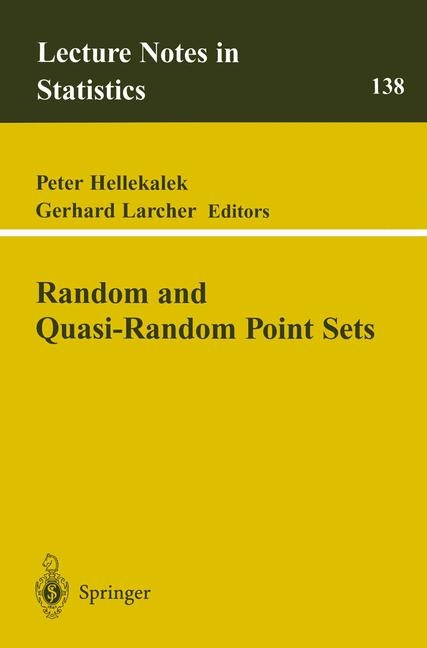
Random and Quasi-Random Point Sets -

Random and Quasi-Random Point Sets (eBook)

eBook Download: PDF
2012
Springer New York (Verlag)
978-1-4612-1702-2 (ISBN)
Systemvoraussetzungen
108,78 inkl. MwSt
(CHF 106,25)
Der eBook-Verkauf erfolgt durch die Lehmanns Media GmbH (Berlin) zum Preis in Euro inkl. MwSt.
  • Download sofort lieferbar
  • Zahlungsarten anzeigen
This volume is a collection of survey papers on recent developments in the fields of quasi-Monte Carlo methods and uniform random number generation. We will cover a broad spectrum of questions, from advanced metric number theory to pricing financial derivatives. The Monte Carlo method is one of the most important tools of system modeling. Deterministic algorithms, so-called uniform random number gen- erators, are used to produce the input for the model systems on computers. Such generators are assessed by theoretical ("e;a priori"e;) and by empirical tests. In the a priori analysis, we study figures of merit that measure the uniformity of certain high-dimensional "e;random"e; point sets. The degree of uniformity is strongly related to the degree of correlations within the random numbers. The quasi-Monte Carlo approach aims at improving the rate of conver- gence in the Monte Carlo method by number-theoretic techniques. It yields deterministic bounds for the approximation error. The main mathematical tool here are so-called low-discrepancy sequences. These "e;quasi-random"e; points are produced by deterministic algorithms and should be as "e;super"e;- uniformly distributed as possible. Hence, both in uniform random number generation and in quasi-Monte Carlo methods, we study the uniformity of deterministically generated point sets in high dimensions. By a (common) abuse oflanguage, one speaks of random and quasi-random point sets. The central questions treated in this book are (i) how to generate, (ii) how to analyze, and (iii) how to apply such high-dimensional point sets.
Erscheint lt. Verlag 6.12.2012
Co-Autor J. Beck, P. Hellekalek, P. Hickernell, P. L'Ecuyer, G. Larcher, H. Niederreiter, S. Tezuka, C. Xing
Sprache englisch
Themenwelt Mathematik / Informatik Mathematik Wahrscheinlichkeit / Kombinatorik
ISBN-10 1-4612-1702-4 / 1461217024
ISBN-13 978-1-4612-1702-2 / 9781461217022
Informationen gemäß Produktsicherheitsverordnung (GPSR)
Haben Sie eine Frage zum Produkt?
PDFPDF (Adobe DRM)

Kopierschutz: Adobe-DRM
Adobe-DRM ist ein Kopierschutz, der das eBook vor Mißbrauch schützen soll. Dabei wird das eBook bereits beim Download auf Ihre persönliche Adobe-ID autorisiert. Lesen können Sie das eBook dann nur auf den Geräten, welche ebenfalls auf Ihre Adobe-ID registriert sind.
Details zum Adobe-DRM

Dateiformat: PDF (Portable Document Format)
Mit einem festen Seiten­layout eignet sich die PDF besonders für Fach­bücher mit Spalten, Tabellen und Abbild­ungen. Eine PDF kann auf fast allen Geräten ange­zeigt werden, ist aber für kleine Displays (Smart­phone, eReader) nur einge­schränkt geeignet.

Systemvoraussetzungen:
PC/Mac: Mit einem PC oder Mac können Sie dieses eBook lesen. Sie benötigen eine Adobe-ID und die Software Adobe Digital Editions (kostenlos). Von der Benutzung der OverDrive Media Console raten wir Ihnen ab. Erfahrungsgemäß treten hier gehäuft Probleme mit dem Adobe DRM auf.
eReader: Dieses eBook kann mit (fast) allen eBook-Readern gelesen werden. Mit dem amazon-Kindle ist es aber nicht kompatibel.
Smartphone/Tablet: Egal ob Apple oder Android, dieses eBook können Sie lesen. Sie benötigen eine Adobe-ID sowie eine kostenlose App.
Geräteliste und zusätzliche Hinweise

Buying eBooks from abroad
For tax law reasons we can sell eBooks just within Germany and Switzerland. Regrettably we cannot fulfill eBook-orders from other countries.

Mehr entdecken
aus dem Bereich
Quellen der Erkenntnis oder digitale Orakel?

von Bernd Simeon

eBook Download (2023)
Springer Berlin Heidelberg (Verlag)
CHF 19,50