Fundamentals of Statistical Experimental Design and Analysis (eBook)
John Wiley & Sons (Verlag)
978-1-118-95464-5 (ISBN)
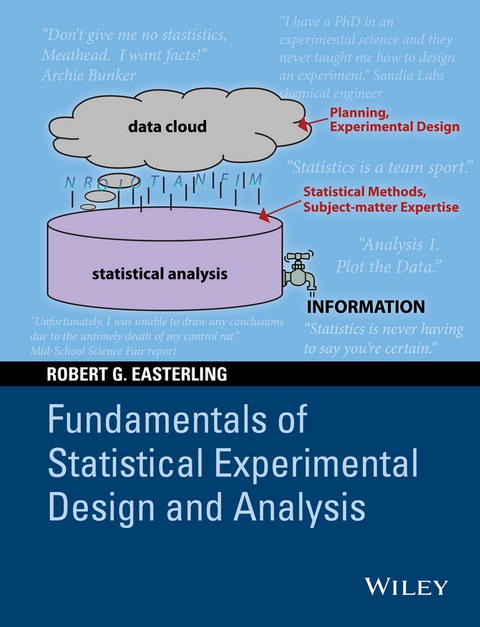
Professionals in all areas - business; government; the physical, life, and social sciences; engineering; medicine, etc. - benefit from using statistical experimental design to better understand their worlds and then use that understanding to improve the products, processes, and programs they are responsible for. This book aims to provide the practitioners of tomorrow with a memorable, easy to read, engaging guide to statistics and experimental design.
This book uses examples, drawn from a variety of established texts, and embeds them in a business or scientific context, seasoned with a dash of humor, to emphasize the issues and ideas that led to the experiment and the what-do-we-do-next? steps after the experiment. Graphical data displays are emphasized as means of discovery and communication and formulas are minimized, with a focus on interpreting the results that software produce. The role of subject-matter knowledge, and passion, is also illustrated. The examples do not require specialized knowledge, and the lessons they contain are transferrable to other contexts.
Fundamentals of Statistical Experimental Design and Analysis introduces the basic elements of an experimental design, and the basic concepts underlying statistical analyses. Subsequent chapters address the following families of experimental designs:
- Completely Randomized designs, with single or multiple treatment factors, quantitative or qualitative
- Randomized Block designs
- Latin Square designs
- Split-Unit designs
- Repeated Measures designs
- Robust designs
- Optimal designs
Written in an accessible, student-friendly style, this book is suitable for a general audience and particularly for those professionals seeking to improve and apply their understanding of experimental design.
Robert G. Easterling. Dr. Easterling is retired from Sandia National Laboratories where he was a statistical consultant, manager, and senior scientist. He is a Fellow of the American Statistical Association, a former Editor of Technometrics, and a recipient of the American Society for Quality's Brumbaugh Award. He holds a Ph.D. in statistics from Oklahoma State University.
Robert G. Easterling. Dr. Easterling is retired from Sandia National Laboratories where he was a statistical consultant, manager, and senior scientist. He is a Fellow of the American Statistical Association, a former Editor of Technometrics, and a recipient of the American Society for Quality's Brumbaugh Award. He holds a Ph.D. in statistics from Oklahoma State University.
Preface
Acknowledgments
Chapter 1 Introduction
Chapter 2 Fundamentals of Experimental Design
Chapter 3 Fundamentals of Statistical Analysis
Chapter 4 Completely Randomized Design
Chapter 5 Completely Randomized Design with Multiple Treatment Factors
Chapter 6 Randomized Complete Block Design
Chapter 7 Other Experimental Designs
"This is an interesting and very useful book that explains the basic concepts and fundamentals of statistical experimental design and analysis to its readers in an easy-to-understand and accessible style"......" Rather than presenting the statistical design of experiments as a cut-and-dried subject, the author spices up this book with a sense of humour and fun"....." Students, professionals, and researchers will find it interesting. It is a welcome addition to the statistics market" D. V. Chopra, MathSciNet, Aug 2017
"Easterling sets out to provide a textbook for an undergraduate course in applied experimental design for a mixed group of students. He succeeds admirably. Although many excellent texts on experimental design exist for statistics students, most are too technical for mixed disciplines. This book covers only basic designs but with extensive discussion of matters other textbooks elide or ignore. Examples from respected textbooks are elaborated to show the reasoning underpinning experimentation and the need to combine statistical and subject-area knowledge ... this is a book that can be enjoyed by students being taught how and why to work with a statistician, and by statisticians who want to work more productively in teams with other disciplines." Significance, 14:6 (2017)
Preface
I have a dream: that professionals in all areas—business; government; the physical, life, and social sciences; engineering; medicine; and others—will increasingly use statistical experimental design to better understand their worlds and to use that understanding to improve the products, processes, and programs they are responsible for. To this end, these professionals need to be inspired and taught, early, to conduct well-conceived and well-executed experiments and then properly extract, communicate, and act on information generated by the experiment. This learning can and should happen at the undergraduate level—in a way that carries over into a student’s eventual career. This text is aimed at fulfilling that goal.
Many excellent statistical texts on experimental design and analysis have been written by statisticians, primarily for students in statistics. These texts are generally more technical and more comprehensive than is appropriate for a mixed-discipline undergraduate audience and a one-semester course, the audience and scope this text addresses. Such texts tend to focus heavily on statistical analysis, for a catalog of designs. In practice, however, finding and implementing an experimental design capable of answering questions of importance are often where the battle is won. The data from a well-designed experiment may almost analyze themselves—often graphically. Rising generations of statisticians and the professionals with whom they will collaborate need more training on the design process than may be provided in graduate-level statistical texts.
Additionally, there are many experimental design texts, typically used in research methods courses in individual disciplines, that focus on one area of application. This book is aimed at a more heterogeneous collection of students who may not yet have chosen a particular career path. The examples have been chosen to be understandable without any specialized knowledge, while the basic ideas are transferable to particular situations and applications a student will subsequently encounter.
Successful experiments require subject-matter knowledge and passion and the statistical tools to translate that knowledge and passion into useful information. Archie Bunker, in the TV series, All in the Family, once told his son-in-law (approximately and with typical inadvertent profundity), “Don’t give me no stastistics (sic), Meathead. I want facts!” Statistical texts naturally focus on “stastistics”: here’s how to calculate a regression line, a confidence interval, an analysis of variance table, etc. For the professional in fields other than statistics, those methods are only a means to an end: revealing and understanding new facts pertinent to his or her area of interest. This text strives to make the connection between facts and statistics. Students should see from the beginning the connection between the statistics and the wider business or scientific context served by those statistics.
To achieve this goal, I tell stories about experiments, and bring in appropriate analyses, graphical and mathematical, as needed to move the stories along. I try to describe the situation that led to the experiment, what was learned, and what might happen after the experiment: “Fire the quality manager! Give the worthy statistician a bonus!” Experimental results need to be communicated in clear and convincing ways, so I emphasize graphical displays more than is often done in experimental design texts.
My stories are built around examples in statistical texts on experimental design, especially examples found in the classic text, Statistics for Experimenters, by Box, Hunter, and Hunter (1978, 2005). This “BHH” text has been on my desk since the first edition came out. I have taught several university classes based on it and have incorporated some of its material into my introductory statistics classes. Most of the examples are simple at first glance, but I have found it useful to (shamelessly) expand the stories in ways that address more of the design issues and more of the what-do-we-do-next issues. I try to make the stories provocative and entertaining because real-life experimentation is provocative and entertaining. I want the issues and concepts to be discussable by an interdisciplinary group of students and the lessons to be transferable to a student’s particular interests, with enough staying power to affect the student’s subsequent career. An underlying theme is that it is subject-matter enthusiasms that give rise to experiments, shape their design, and guide actions based on the findings. Statistical experimental design and data analysis methods facilitate and enhance the whole process. In short, statistics is a team sport. This text tries to demonstrate that.
In 1974, I taught at the University of Wisconsin and had the opportunity to attend the renowned Monday night “beer seminars” in the basement of the late Professor George Box’s home. He would invite researchers in to discuss their work, and the evening would turn into a grand consulting session among George, the researcher, and the students and faculty in attendance. The late Bill Hunter, also a professor in the Statistics Department and an innovative teacher of experimental design, was often a participant. I learned a lot in those sessions and hope that the atmosphere of those Monday night consulting sessions is reflected in the stories I have created here. The other H in BHH is J. Stuart Hunter, also an innovator in the teaching of experimental design; his presentations and articles have influenced me greatly, and his support for this book is especially valued. He puts humor into statistics that nobody would believe exists. I attended several Gordon Research Conferences at which B, H, and H all generated a lot of fun. Statistics can be fun. I have fun being a statistician and I have tried to spice this book with a sense of fun. (Please note that this book’s title begins with fun.)
In this book, mathematical detail takes a backseat to the stories and the pictures. Experimental design is not just for the mathematically inclined. I rely on software to do the analyses, and I focus on the story, not formulas. Once you understand the structure of a basic analysis of variance, I believe you can rely on software (and maybe a friendly, local statistician) to calculate an ANOVA table of the sort considered in this text. Thus, I do not give formulas for sums of squares for every design considered. Ample references are just a quick Google or Wikipedia search away for the mathematically intrigued students or instructors so inclined. I give formulas for standard errors and confidence intervals where needed. I would be pleased if class discussions and questions, and alternate stories, led to displays and analyses not covered in my stories.
To offset my expanded stories, I limit the scope of this text’s topics to what I think is appropriate for an introductory course. I indicate and reference possible extensions beyond the text’s coverage. Individual instructors can tailor their excursions into such areas in ways that fit their students. This text can best be used by instructors with experience in designing experiments, analyzing the resulting data, and working with collaborators or clients to develop next steps. They can usefully supplement my stories with theirs.
Chapter-end assignments emphasize the experimental design process, not computational exercises. I want students to pursue their passions and design experiments that could illuminate issues of interest to them. I want them to think about the displays and analyses they would use more than I want them to practice turning the crank on somebody else’s data. Ideally, I would like for these exercises to be worked by two- or three-person teams, as in the real-world environment a student will encounter after college. (My ideal class makeup would be half statistics-leaning majors and half majors from a variety of other fields, and I would pair a stat major with a nonstat major to do assignments and projects.)
Existing texts contain an ample supply of analysis exercises that an instructor can choose from and assign, if desired. Some are listed at the end of this Preface. Individual instructors may or should have their own favorite texts and exercises. I would suggest only that each selected analysis exercise should be augmented by Analysis 1: Plot the data. These exercise resources are also useful windows on aspects of experimental design and analysis beyond the scope of this book that a student might want to pursue later in his studies or her career.
Software packages such as Minitab® also provide exercises. Teaching analysis methods in conjunction with software is also left to the individual instructor and campus resources. I use Minitab in most of my graphical displays and quantitative analyses, just because it suits my needs. Microsoft Excel® can also be used for many of the analyses and displays in this book. JMP® software covers basic analyses and provides more advanced capabilities that could be used and taught. Individual instructors should choose the software appropriate for their classrooms and campuses.
Projects provide another opportunity to experience and develop the ability to conceive, design, conduct, analyze, and communicate the results of experiments that...
| Erscheint lt. Verlag | 3.8.2015 |
|---|---|
| Sprache | englisch |
| Themenwelt | Mathematik / Informatik ► Mathematik ► Angewandte Mathematik |
| Mathematik / Informatik ► Mathematik ► Statistik | |
| Mathematik / Informatik ► Mathematik ► Wahrscheinlichkeit / Kombinatorik | |
| Technik | |
| Schlagworte | completely randomized design • Engineering statistics • Experimental Design • Fundamentals of Statistical Experimental Design and Analysis • Randomized block design • Robert G. Easterling • Statistics • Statistics - Text & Reference • Statistik • Statistik in den Ingenieurwissenschaften • Statistik / Lehr- u. Nachschlagewerke • Versuchsplanung |
| ISBN-10 | 1-118-95464-5 / 1118954645 |
| ISBN-13 | 978-1-118-95464-5 / 9781118954645 |
| Informationen gemäß Produktsicherheitsverordnung (GPSR) | |
| Haben Sie eine Frage zum Produkt? |
 EPUB (Adobe DRM)
Kopierschutz: Adobe-DRM
Adobe-DRM ist ein Kopierschutz, der das eBook vor Mißbrauch schützen soll. Dabei wird das eBook bereits beim Download auf Ihre persönliche Adobe-ID autorisiert. Lesen können Sie das eBook dann nur auf den Geräten, welche ebenfalls auf Ihre Adobe-ID registriert sind.
Details zum Adobe-DRM
Dateiformat: EPUB (Electronic Publication)
EPUB ist ein offener Standard für eBooks und eignet sich besonders zur Darstellung von Belletristik und Sachbüchern. Der Fließtext wird dynamisch an die Display- und Schriftgröße angepasst. Auch für mobile Lesegeräte ist EPUB daher gut geeignet.
Systemvoraussetzungen:
PC/Mac: Mit einem PC oder Mac können Sie dieses eBook lesen. Sie benötigen eine
eReader: Dieses eBook kann mit (fast) allen eBook-Readern gelesen werden. Mit dem amazon-Kindle ist es aber nicht kompatibel.
Smartphone/Tablet: Egal ob Apple oder Android, dieses eBook können Sie lesen. Sie benötigen eine
Geräteliste und zusätzliche Hinweise
Buying eBooks from abroad
For tax law reasons we can sell eBooks just within Germany and Switzerland. Regrettably we cannot fulfill eBook-orders from other countries.
aus dem Bereich