


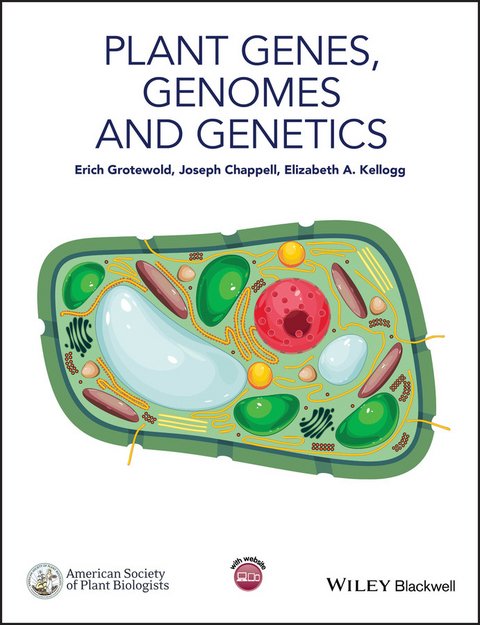
Plant Genes, Genomes and Genetics (eBook)
John Wiley & Sons (Verlag)
978-1-118-53936-1 (ISBN)
Plant Genes, Genomes and Genetics provides a comprehensive treatment of all aspects of plant gene expression. Unique in explaining the subject from a plant perspective, it highlights the importance of key processes, many first discovered in plants, that impact how plants develop and interact with the environment. This text covers topics ranging from plant genome structure and the key control points in how genes are expressed, to the mechanisms by which proteins are generated and how their activities are controlled and altered by posttranslational modifications.
Written by a highly respected team of specialists in plant biology with extensive experience in teaching at undergraduate and graduate level, this textbook will be invaluable for students and instructors alike. Plant Genes, Genomes and Genetics also includes:
- specific examples that highlight when and how plants operate differently from other organisms
- special sections that provide in-depth discussions of particular issues
- end-of-chapter problems to help students recapitulate the main concepts
- rich, full-colour illustrations and diagrams clearly showing important processes in plant gene expression
- a companion website with PowerPoint slides, downloadable figures, and answers to the questions posed in the book
Aimed at upper level undergraduates and graduate students in plant biology, this text is equally suited for advanced agronomy and crop science students inclined to understand molecular aspects of organismal phenomena. It is also an invaluable starting point for professionals entering the field of plant biology.
Dr Erich Grotewold is currently a professor in the Department of Molecular Genetics (College of Arts & Sciences) as well as in the Department of Horticulture & Crop Sciences (College of Food, Agriculture & Environmental Sciences) at The Ohio State University. His research focuses on plant systems biology.
Dr Joseph Chappell joined the faculty at the University of Kentucky in 1985, where he has developed an internationally recognized research program pioneering the molecular genetics and biochemistry of natural products in plants.
Dr Elizabeth A. Kellogg was formerly the E. Desmond Lee and Family Professor of Botanical Studies at the University of Missouri-St. Louis, and is currently a Member of the Donald Danforth Plant Science Center in St. Louis. Her work focuses on the evolution of plant genes, genomes and development, particularly in the cereal crops and their wild relatives.
Plant Genes, Genomes and Genetics provides a comprehensive treatment of all aspects of plant gene expression. Unique in explaining the subject from a plant perspective, it highlights the importance of key processes, many first discovered in plants, that impact how plants develop and interact with the environment. This text covers topics ranging from plant genome structure and the key control points in how genes are expressed, to the mechanisms by which proteins are generated and how their activities are controlled and altered by posttranslational modifications. Written by a highly respected team of specialists in plant biology with extensive experience in teaching at undergraduate and graduate level, this textbook will be invaluable for students and instructors alike. Plant Genes, Genomes and Genetics also includes: specific examples that highlight when and how plants operate differently from other organisms special sections that provide in-depth discussions of particular issues end-of-chapter problems to help students recapitulate the main concepts rich, full-colour illustrations and diagrams clearly showing important processes in plant gene expression a companion website with PowerPoint slides, downloadable figures, and answers to the questions posed in the book Aimed at upper level undergraduates and graduate students in plant biology, this text is equally suited for advanced agronomy and crop science students inclined to understand molecular aspects of organismal phenomena. It is also an invaluable starting point for professionals entering the field of plant biology.
Dr Erich Grotewold is currently a professor in the Department of Molecular Genetics (College of Arts & Sciences) as well as in the Department of Horticulture & Crop Sciences (College of Food, Agriculture & Environmental Sciences) at The Ohio State University. His research focuses on plant systems biology. Dr Joseph Chappell joined the faculty at the University of Kentucky in 1985, where he has developed an internationally recognized research program pioneering the molecular genetics and biochemistry of natural products in plants. Dr Elizabeth A. Kellogg was formerly the E. Desmond Lee and Family Professor of Botanical Studies at the University of Missouri-St. Louis, and is currently a Member of the Donald Danforth Plant Science Center in St. Louis. Her work focuses on the evolution of plant genes, genomes and development, particularly in the cereal crops and their wild relatives.
Acknowledgements xi
Introduction xiii
About the Companion Website xix
PART I: PLANT GENOMES AND GENES
Chapter 1 Plant genetic material 3
1.1 DNA is the genetic material of all living organisms, including plants 3
1.2 The plant cell contains three independent genomes 8
1.3 A gene is a complete set of instructions for building an RNA molecule 10
1.4 Genes include coding sequences and regulatory sequences 11
1.5 Nuclear genome size in plants is variable but the numbers of protein-coding, non-transposable element genes are roughly the same 12
1.6 Genomic DNA is packaged in chromosomes 15
1.7 Summary 15
1.8 Problems 15
References 16
Chapter 2 The shifting genomic landscape 17
2.1 The genomes of individual plants can differ in many ways 17
2.2 Differences in sequences between plants provide clues about gene function 20
2.3 SNPs and lengthmutations in simple sequence repeats are useful tools for genome mapping and marker assisted selection 22
2.4 Genome size and chromosome number are variable 28
2.5 Segments of DNA are often duplicated and can recombine 30
2.6 Some genes are copied nearby in the genome 31
2.7 Whole genome duplications are common in plants 34
2.8 Whole genome duplication has many effects on the genome and on gene function 37
2.9 Summary 41
2.10 Problems 42
Further reading 42
References 42
Chapter 3 Transposable elements 45
3.1 Transposable elements are common in genomes of all organisms 45
3.2 Retrotransposons are mainly responsible for increases in genome size 46
3.3 DNA transposons create small mutations when they insert and excise 52
3.4 Transposable elements move genes and change their regulation 57
3.5 How are transposable elements controlled? 60
3.6 Summary 60
3.7 Problems 61
References 61
Chapter 4 Chromatin, centromeres and telomeres 63
4.1 Chromosomes are made up of chromatin, a complex of DNA and protein 63
4.2 Telomeres make up the ends of chromosomes 66
4.3 The chromosome middles-centromeres 71
4.4 Summary 77
4.5 Problems 77
Further reading 77
References 77
Chapter 5 Genomes of organelles 79
5.1 Plastids and mitochondria are descendants of free-living bacteria 79
5.2 Organellar genes have been transferred to the nuclear genome 80
5.3 Organellar genes sometimes include introns 82
5.4 Organellar mRNA is often edited 82
5.5 Mitochondrial genomes contain fewer genes than chloroplasts 84
5.6 Plant mitochondrial genomes are large and undergo frequent recombination 87
5.7 All plastid genomes in a cell are identical 91
5.8 Plastid genomes are similar among land plants but contain some structural rearrangements 93
5.9 Summary 95
5.10 Problems 95
Further reading 95
References 95
PART II: TRANSCRIBING PLANT GENES
Chapter 6 RNA 99
6.1 RNA links components of the Central Dogma 99
6.2 Structure provides RNA with unique properties 102
6.3 RNA has multiple regulatory activities 105
6.4 Summary 108
6.5 Problems 108
References 109
Chapter 7 The plant RNA polymerases 111
7.1 Transcription makes RNA from DNA 111
7.2 Varying numbers of RNA polymerases in the different kingdoms 112
7.3 RNA polymerase I transcribes rRNAs 114
7.4 RNA polymerase III recruitment to upstream and internal promoters 116
7.5 Plant-specific RNP-IV and RNP-V participate in transcriptional gene silencing 117
7.6 Organelles have their own set of RNA polymerases 117
7.7 Summary 118
7.8 Problems 118
References 118
Chapter 8 Making mRNAs - Control of transcription by RNA polymerase II 121
8.1 RNA polymerase II transcribes protein-coding genes 121
8.2 The structure of RNA polymerase II reveals how it functions 121
8.3 The core promoter 123
8.4 Initiation of transcription 125
8.5 The mediator complex 127
8.6 Transcription elongation: the role of RNP-II phosphorylation 128
8.7 RNP-II pausing and termination 129
8.8 Transcription re-initiation 130
8.9 Summary 130
8.10 Problems 130
References 130
Chapter 9 Transcription factors interpret cis-regulatory information 133
9.1 Information on when, where and how much a gene is expressed is codified by the gene's regulatory regions 133
9.2 Identifying regulatory regions requires the use of reporter genes 134
9.3 Gene regulatory regions have a modular structure 135
9.4 Enhancers: Cis-regulatory elements or modules that function at a distance 137
9.5 Transcription factors interpret the gene regulatory code 138
9.6 Transcription factors can be classified in families 138
9.7 How transcription factors bind DNA 139
9.8 Modular structure of transcription factors 143
9.9 Organization of transcription factors into gene regulatory grids and networks 146
9.10 Summary 146
9.11 Problems 146
More challenging problems 147
References 147
Chapter 10 Control of transcription factor activity 149
10.1 Transcription factor phosphorylation 149
10.2 Protein-protein interactions 151
10.3 Preventing transcription factors from access to the nucleus 155
10.4 Movement of transcription factors between cells 156
10.5 Summary 158
10.6 Problems 158
References 158
Chapter 11 Small RNAs 161
11.1 The phenomenon of cosuppression or gene silencing 161
11.2 Discovery of small RNAs 162
11.3 Pathways for miRNA formation and function 163
11.4 Plant siRNAs originate from different types of double-stranded RNAs 166
11.5 Intercellular and systemic movement of small RNAs 168
11.6 Role of miRNAs in plant physiology and development 170
11.7 Summary 171
11.8 Problems 171
References 172
Chapter 12 Chromatin and gene expression 173
12.1 Packing long DNA molecules in a small space: the function of chromatin 173
12.2 Heterochromatin and euchromatin 173
12.3 Histone modifications 174
12.4 Histone modifications affect gene expression 175
12.5 Introducing and removing histone marks: writers and erasers 175
12.6 'Readers' recognize histone modifications 177
12.7 Nucleosome positioning 177
12.8 DNA methylation 178
12.9 RNA-directed DNA methylation 179
12.10 Control of flowering by histone modifications 180
12.11 Summary 181
12.12 Problems 181
References 181
PART III: FROM RNA TO PROTEINS
Chapter 13 RNA processing and transport 185
13.1 RNA processing can be thought of as steps 185
13.2 RNA capping provides a distinctive 5' end to mRNAs 185
13.3 Transcription termination consists of mRNA 3'-end formation and polyadenylation 189
13.4 RNA splicing is another major source of genetic variation 192
13.5 Export of mRNA from the nucleus is a gateway for regulating which mRNAs actually get translated 194
13.6 Summary 196
13.7 Problems 196
References 196
Chapter 14 Fate of RNA 199
14.1 Regulation of RNA continues upon export from nucleus 199
14.2 Mechanisms for RNA turnover 199
14.3 RNA surveillance mechanisms 201
14.4 RNA sorting 202
14.5 RNA movement 203
14.6 Summary 204
14.7 Problems 204
Further reading 205
References 205
Chapter 15 Translation of RNA 207
15.1 Translation: a key aspect of gene expression 207
15.2 Initiation 209
15.3 Elongation 209
15.4 Termination 210
15.5 Tools for studying the regulation of translation 211
15.6 Specific translational control mechanisms 211
15.7 Summary 213
15.8 Problems 214
Further reading 214
References 214
Chapter 16 Protein folding and transport 215
16.1 The pathway to a protein's function is a complicated matter 215
16.2 Protein folding and assembly 215
16.3 Protein targeting 218
16.4 Co-translational targeting 218
16.5 Post-translational targeting 219
16.6 Post-translational modifications regulating function 220
16.7 Summary 222
16.8 Problems 223
Further reading 223
References 224
Chapter 17 Protein degradation 225
17.1 Two sides of gene expression-synthesis and degradation 225
17.2 Autophagy, senescence and programmed cell death 225
17.3 Protein-tagging mechanisms 226
17.4 The ubiquitin proteasome system rivals gene transcription 228
17.5 Summary 231
17.6 Problems 231
Further reading 231
Reference 231
Index 233
Introduction
The word “plant” has many meanings
One goal of this book is to highlight the aspects of molecular biology that are unique to plants, and that represent mechanisms that cannot be understood simply by studying animals, yeast or bacteria. We therefore need to spend some time discussing what we mean by the word “plant”, which, perhaps surprisingly, does not have a simple or universally accepted definition.
When most people think of a plant, they generally immediately come up with an image of a tomato plant, or a petunia, or corn. A scientist might think of Arabidopsis thaliana, the tiny weed that has been domesticated by molecular biologists. All these are examples of flowering plants (angiosperms), which are the dominant forms of land plants on Earth today. The flowering plants represent a large group that originated in the early Cretaceous (∼140 million years ago, although the exact date is subject to much current debate); the group has subsequently diversified to produce most trees, shrubs, and herbs. The flowering plants include more than 300 000 species; only a few thousand are cultivated, and surprisingly, only a few of these – fewer than twenty – produce the vast majority of the food for all of humanity.
The term “plant” is often used to mean “land plant”, a much larger group that includes the flowering plants, but also the gymnosperms, ferns, lycophytes, mosses, hornworts and liverworts. This large group is monophyletic, a term that refers to all being descendants of a common ancestor, and is often called the Embryophytes because all members produce embryos retained on the parent plant. A phylogeny of the Embryophyta is presented in Figure 1, which is assembled on the basis of the main characteristics that define the major groups of plants. Clades (or groups) within the land plants include the seed plants (flowering plants plus gymnosperms, distinguished by how they bear their seeds) and other vascular plants [ferns (pteridophytes) and lycophytes], in which the diploid sporophyte forms on the independent gametophyte, and dispersal occurs via spores. In contrast, the non-vascular plants (hornworts and liverworts) are distinguished not only by the absence of phloem and xylem vessels, but by having a dominant gametophytic (haploid) stage of life and only a short lived sporophytic (diploid) stage.
Figure 1 Phylogeny of organisms that originated with the primary endosymbiosis, in which a eukaryote acquired a symbiotic cyanobacterium. Superimposed on the phylogeny is a Venn diagram of major groups. While the green plants (Viridiplantae) and streptophytes are sometimes called “plants”, in this book we will use the term “plant” to refer to the land plants, the group shaded in green. Subgroups within the land plants are also indicated.
Another possible definition of “plant” is the group known as the Streptophytes, which includes the land plants plus their immediate relatives, Chara and Coleochaete (both formerly considered green algae). The Streptophytes all share a peculiar method of cell division, the phragmoplast, and a unique structure of proteins to make cellulose (the sugar polymer that is the primary component of plant cell walls), the cellulose rosettes.
A third definition of “plant” corresponds to organisms that have chloroplasts and make chlorophyll a and b. These are known as the Viridiplantae (Latin for green plants). This group includes the Streptophytes (i.e., land plants plus Coleochaete and Chara) plus all the green algae. The latter group includes the well-studied single cell organism Chlamydomonas.
Finally, a fourth (and uncommon) definition of “plant” includes all organisms with chloroplasts that are the result of a primary endosymbiosis, that is organisms that acquired their chloroplasts by directly aquiring a cyanobacterium (see Chapter 5). Members of this group are Viridiplantae, the red algae (Rhodophyta) and the glaucophytes. Some data suggest that the primary endosymbiosis occurred only once, in the common ancestor of the Viridiplantae, red algae and glaucophytes. Evidence is accumulating to suggest that indeed Viridiplantae, red algae and glaucophytes are all part of a monophyletic group, which is sometimes called the Archaeplastida. However, each primary endosymbiotic event could be independent, with the capture of a cyanobacterium occurring independently several times. In either case, origin of plastids from cyanobacteria has been extremely rare in the history of life.
The plastid bearing organisms diverged from other eukaryote lineages, including animals plus fungi, at least 1 billion years ago (Knoll, 2003). Given this enormously long period of evolution, it is remarkable that there are any similarities at all in the cellular apparatus between animals (i.e., you), fungi (i.e., yeast), and any plants. There are many similarities of course, but we suggest here that they need to be demonstrated, not assumed. In other words, the fact that the transcriptional machinery is similar between animals and yeast, does not necessarily mean that it will also be similar in plants. In addition, the term similarity does not mean identity. Processes in common could have arisen because of convergent forces, and really the metric for similarity has become conservation in the DNA encoding these functions.
In the past, the term “plant” was sometimes applied to all photosynthetic organisms. However, such a broad use of the term is now rejected. Many organisms that are able to undergo photosynthesis have gained that ability by acquiring a red alga along with its plastid. In other words, the plastid is a symbiont in the red alga and the red alga is the symbiont in another (previously non-photosynthetic) organism. Such symbioses are known as secondary endosymbioses to distinguish them from the primary endosymbioses of the Archaeplastida. In organisms with a secondary endosymbiont, the structure of the membranes around the symbiont shows that it was once a separate organism that was picked up by its host. Organisms with secondary endosymbioses include the Stramenopiles, the group that includes the brown algae (e.g., Fucus, a common seaweed) and golden brown algae (which occur mostly in freshwater), the dinoflagellates, and the kinetoplastids (e.g., Euglena, trypanosomes, and the apicomplexans, which include the organisms that cause malaria). Each of these groups is as different from plants as animals are, and as different from animals as plants are. In these organisms in particular one might expect to find novel genes, proteins and cellular mechanisms. If the term “plant” were applied to all photosynthetic organisms, the ones with the secondary endosymbioses are so diverse and so totally unrelated (other than all being eukaryotes) that the term would be effectively meaningless.
In summary, the term plant is used to apply to many sets of organisms, the smallest of which is the land plants and the largest is all photosynthetic organisms. Most commonly, however, “plant” refers either to the entire green plant lineage (Viridiplantae), or to the land plants. In common parlance its use is even more restricted to refer informally to flowering plants. In this textbook we will use the term to refer to land plants. Most of the data we present come from flowering plants, so in most cases, the reader can assume that we are extrapolating, generally without evidence, from the flowering plants to the gymnosperms, ferns, lycophytes, mosses, liverworts and hornworts. If we have data from species outside the land plants, we will cite that explicitly.
The basic structure of a plant is deceptively simple
The processes described in this book can in theory occur in any cell in the plant. However, some familiarity with basic plant morphology is assumed. Plant growth occurs from dedicated sets of stem cells, known as meristems. These are active throughout the life of the plant, so that development is continuous and modular. This is quite different from the situation in animals, in which the entire organism develops in a coordinated fashion and then ceases development entirely at maturity. If a human were to grow like a plant, the fingers, toes and the top of the head might keep growing throughout the life of the human.
Meristems are organized during embryonic development. In the seed plants these initially consist of two clusters of cells, the shoot apical meristem and the root apical meristem, at opposite ends of the plant. These are the basis of the bipolar embryo, which is only found in the seed plants. Meristems in non-seed bearing vascular plants (ferns, lycophytes) consist of only a few cells, and the root apical meristem in particular develops late and on one side of the embryonic axis.
A flowering plant has an obvious above ground component, the shoot, and a below-ground component, generally the root (Figure 2). The apical meristem of the shoot produces leaves on its flanks. In the axil of each leaf, another meristem forms, the axillary meristem; this meristem is often dormant for a while but may grow out to form a branch. The root apical meristem forms the primary root. Lateral roots are not formed from the apical meristem, but rather are formed from meristems that arise de novo just outside the vascular tissue. In most eudicots, the primary root...
| Erscheint lt. Verlag | 27.4.2015 |
|---|---|
| Sprache | englisch |
| Themenwelt | Informatik ► Weitere Themen ► Bioinformatik |
| Naturwissenschaften ► Biologie ► Botanik | |
| Naturwissenschaften ► Biologie ► Genetik / Molekularbiologie | |
| Technik | |
| Schlagworte | Agriculture • Agriculture Special Topics • Biowissenschaften • Botanik • Botanik / Zellbiologie • Chloroplast • Degradation • Genome • Landwirtschaft • Life Sciences • Pflanzengenetik • plant cell biology • Plant genetics • Polymerase • Post-translational regulation • RNA and protein degradation • RNA Interference • Spezialthemen Landwirtschaft • transcription • Translation • Transposon • Zellbiologie |
| ISBN-10 | 1-118-53936-2 / 1118539362 |
| ISBN-13 | 978-1-118-53936-1 / 9781118539361 |
| Informationen gemäß Produktsicherheitsverordnung (GPSR) | |
| Haben Sie eine Frage zum Produkt? |
 EPUB (Adobe DRM)
Kopierschutz: Adobe-DRM
Adobe-DRM ist ein Kopierschutz, der das eBook vor Mißbrauch schützen soll. Dabei wird das eBook bereits beim Download auf Ihre persönliche Adobe-ID autorisiert. Lesen können Sie das eBook dann nur auf den Geräten, welche ebenfalls auf Ihre Adobe-ID registriert sind.
Details zum Adobe-DRM
Dateiformat: EPUB (Electronic Publication)
EPUB ist ein offener Standard für eBooks und eignet sich besonders zur Darstellung von Belletristik und Sachbüchern. Der Fließtext wird dynamisch an die Display- und Schriftgröße angepasst. Auch für mobile Lesegeräte ist EPUB daher gut geeignet.
Systemvoraussetzungen:
PC/Mac: Mit einem PC oder Mac können Sie dieses eBook lesen. Sie benötigen eine
eReader: Dieses eBook kann mit (fast) allen eBook-Readern gelesen werden. Mit dem amazon-Kindle ist es aber nicht kompatibel.
Smartphone/Tablet: Egal ob Apple oder Android, dieses eBook können Sie lesen. Sie benötigen eine
Geräteliste und zusätzliche Hinweise
Buying eBooks from abroad
For tax law reasons we can sell eBooks just within Germany and Switzerland. Regrettably we cannot fulfill eBook-orders from other countries.


