


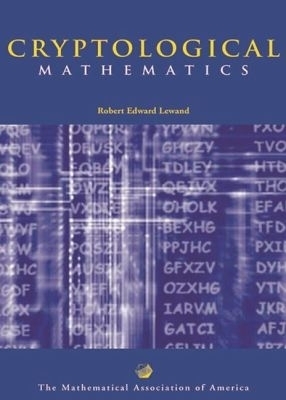
Cryptological Mathematics
Seiten
2000
Mathematical Association of America (Verlag)
978-0-88385-719-9 (ISBN)
Mathematical Association of America (Verlag)
978-0-88385-719-9 (ISBN)
Provides an introduction to the mathematics involved in the field of cryptology, the science of writing and reading secret messages. The basic branches of mathematics required, including number theory, abstract algebra and probability, are used to show how to encipher and decipher messages, and why this works, giving a practical as well as theoretical basis to the subject.
This is an introduction to the mathematics involved in the intriguing field of cryptology, the science of writing and reading secret messages which are designed to be read only by their intended recipients. It is written at an elementary level, suitable for beginning undergraduates, with careful explanations of all the concepts used. The basic branches of mathematics required, including number theory, abstract algebra and probability, are used to show how to encipher and decipher messages, and why this works, giving a practical as well as theoretical basis to the subject. Challenging computer programming exercises are also included. The book is written in an engaging style which will appeal to all, and also includes historical background on some of the founders of the subject. It will be of interest both to students wishing to learn cryptology per se, and also to those searching for practical applications of seemingly abstract mathematics.
This is an introduction to the mathematics involved in the intriguing field of cryptology, the science of writing and reading secret messages which are designed to be read only by their intended recipients. It is written at an elementary level, suitable for beginning undergraduates, with careful explanations of all the concepts used. The basic branches of mathematics required, including number theory, abstract algebra and probability, are used to show how to encipher and decipher messages, and why this works, giving a practical as well as theoretical basis to the subject. Challenging computer programming exercises are also included. The book is written in an engaging style which will appeal to all, and also includes historical background on some of the founders of the subject. It will be of interest both to students wishing to learn cryptology per se, and also to those searching for practical applications of seemingly abstract mathematics.
Preface
1. Monoalphabetic Substitution Ciphers
2. Polyalphabetic Substitution Ciphers
3. Polygraphic Substitution Ciphers
4. Public Key Cryptography
Appendix A: ASCII Code
Appendix B: Taxonomy of Cryptology
Appendix C: Answers to Even-Numbered Problems
| Erscheint lt. Verlag | 30.12.2000 |
|---|---|
| Reihe/Serie | Classroom Resource Materials |
| Sprache | englisch |
| Maße | 179 x 254 mm |
| Gewicht | 389 g |
| Themenwelt | Mathematik / Informatik ► Mathematik ► Allgemeines / Lexika |
| Mathematik / Informatik ► Mathematik ► Algebra | |
| ISBN-10 | 0-88385-719-7 / 0883857197 |
| ISBN-13 | 978-0-88385-719-9 / 9780883857199 |
| Zustand | Neuware |
| Informationen gemäß Produktsicherheitsverordnung (GPSR) | |
| Haben Sie eine Frage zum Produkt? |
Mehr entdecken
aus dem Bereich


aus dem Bereich
ein Übungsbuch für Fachhochschulen
Buch | Hardcover (2023)
Carl Hanser (Verlag)
CHF 23,75


