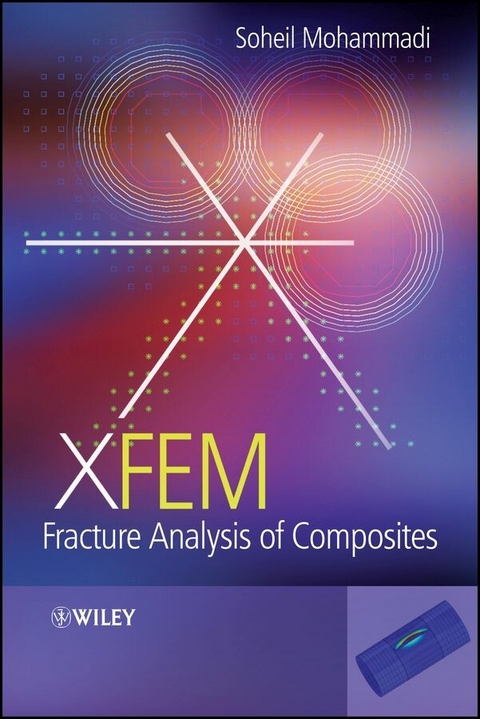
XFEM Fracture Analysis of Composites (eBook)
John Wiley & Sons (Verlag)
978-1-118-44338-5 (ISBN)
This book describes the basics and developments of the new XFEM approach to fracture analysis of composite structures and materials. It provides state of the art techniques and algorithms for fracture analysis of structures including numeric examples at the end of each chapter as well as an accompanying website which will include MATLAB resources, executables, data files, and simulation procedures of XFEM.
- The first reference text for the extended finite element method (XFEM) for fracture analysis of structures and materials
- Includes theory and applications, with worked numerical problems and solutions, and MATLAB examples on an accompanying website with further XFEM resources
- Provides a comprehensive overview of this new area of research, including a review of Fracture Mechanics, basic through to advanced XFEM theory, as well as current problems and applications
- Includes a chapter on the future developments in the field, new research areas and possible future applications of the method
Soheil Mohammadi, Associate Professor, School of Civil Engineering, University of Tehran, Tehran, IRAN
Soheil Mohammdi studied for his PhD at the University of Wales Swansea and is now a lecturer at the University of Tehran where his academic career began. He teaches PhD courses in contact mechanics, mesh generation and adaptivity, meshless methods, and impact and explosive loadings on structures. He research interests are based in computational mechanics and finite element analysis, and XFEM. He has published many papers in these areas as well as a book on discontinuum mechanics in 2003.
This book describes the basics and developments of the new XFEM approach to fracture analysis of composite structures and materials. It provides state of the art techniques and algorithms for fracture analysis of structures including numeric examples at the end of each chapter as well as an accompanying website which will include MATLAB resources, executables, data files, and simulation procedures of XFEM. The first reference text for the extended finite element method (XFEM) for fracture analysis of structures and materials Includes theory and applications, with worked numerical problems and solutions, and MATLAB examples on an accompanying website with further XFEM resources Provides a comprehensive overview of this new area of research, including a review of Fracture Mechanics, basic through to advanced XFEM theory, as well as current problems and applications Includes a chapter on the future developments in the field, new research areas and possible future applications of the method
Soheil Mohammadi, Associate Professor, School of Civil Engineering, University of Tehran, Tehran, IRAN Soheil Mohammdi studied for his PhD at the University of Wales Swansea and is now a lecturer at the University of Tehran where his academic career began. He teaches PhD courses in contact mechanics, mesh generation and adaptivity, meshless methods, and impact and explosive loadings on structures. He research interests are based in computational mechanics and finite element analysis, and XFEM. He has published many papers in these areas as well as a book on discontinuum mechanics in 2003.
Chapter 1 Introduction.
1.1 Composite structures.
1.2 Failure of composites.
1.3 Crack analysis.
1.4 Analytical solutions for composites.
1.5 Numerical techniques.
1.6 Scope of the book.
Chapter 2 Fracture Mechanics, a Review.
2.1 Introduction.
2.2 Basics of elasticity.
2.3 Basics of LEFM.
2.4 stress intensity factor.
2.5 Classical solution procedures for K and G.
2.6 Quarter point singular elements.
2.7 J integral.
2.8 Elastoplastic fracture mechanics (EPFM).
Chapter 3 Extended Finite Element Method.
3.1 Introduction.
3.2 Historic development of XFEM.
3.3 Enriched approximations.
3.4 XFEM formulation.
3.5 XFEM strong discontinuity enrichments.
3.6 XFEM weak discontinuity enrichments.
3.7 XFEM crack tip enrichments.
3.8 Transition from standard to enriched approximation.
3.9 Tracking moving boundaries.
3.10 Numerical simulations.
Chapter 4 Static Fracture Analysis of Composites.
4.1 Introduction.
4.2 Anisotropic elasticity.
4.3 Analytical solutions for near crack tip.
4.4 Orthotropic mixed mode fracture.
4.5 Anisotropic XFEM.
4.6 Numerical simulations.
Chapter 5 Dynamic Fracture Analysis of Composites.
5.1 Introduction.
5.2 Analytical solutions for near crack tips in dynamic states.
5.3 Dynamic stress intensity factors.
5.4 Dynamic XFEM.
5.5 Numerical simulations.
Chapter 6 Fracture Analysis of Functionally Graded Materials.
6.1 Introduction.
6.2 Analytical solution for near crack tip.
6.3 Stress intensity factor.
6.4 Crack propagation in FGM composites.
6.5 Inhomogeneous XFEM.
6.6 Numerical examples.
Chapter 7 Delamination/Interlaminar Crack Analysis.
7.1 Introduction.
7.2 Fracture mechanics for bimaterial interface cracks.
7.3 Stress intensity factors for interlaminar cracks.
7.4 Delamination propagation.
7.5 Bimaterial XFEM.
7.6 Numerical examples.
Chapter 8 New Orthotropic Frontiers.
8.1 Introduction.
8.2 Orthotropic XIGA.
8.3 Orthotropic dislocation dynamics.
8.4 Other anisotropic applications.
References.
Index.
Nomenclature
Parameters not shown in this nomenclature are temporary variables or known constants, defined immediately when cited in the text.
| α | Curvilinear coordinate |
| α | First Dundurs parameter |
| α, β | Newmark parameters |
| α, β, γ | FGM constants |
| Curvilinear coordinate α of an ellipse |
| Components of coordinate transformation tensor |
| β | Curvilinear coordinate |
| β | Second Dundurs parameter |
| Curvilinear coordinate β of an ellipse |
| , | Dilatational and shear wave functions |
| γ | Wedge angle |
| Surface energy density |
| , | Dilatational and shear wave functions |
| Engineering shear strain |
| δ | Plastic crack tip zone |
| δ | Variation of a function |
| Dirac delta function |
| Kronecker delta function |
| , | Local displacements of crack edges |
| Strain tensor |
| ε | Oscillation index |
| , | Strain components |
| Dimensionless angular geometric function |
| Auxiliary strain components |
| Applied displacement loading |
| Yield strain |
| ξ | Local curvilinear (mapping) coordinate system |
| Knot i |
| Crack-tip position |
| Distance function |
| Gauss point position along the contour J |
| η | Local curvilinear (mapping) coordinate system |
| η | Equivalent inelastic strain |
| θ | Crack propagation angle with respect to initial crack |
| θ | Angular polar coordinate |
| Crack angle |
| , | Orthotropic angular functions |
| , | Dynamic distance functions |
| κ, | Material parameters |
| Effective material parameter |
| λ | Lame modulus |
| λ | Power of radial enrichment |
| λ | Ratio of orthotropic Young modules E2/E1 |
| λ, | Roots of the characteristic equation |
| μ, | Isotropic and orthotropic shear modulus |
| ν, | Isotropic and orthotropic Poisson's ratios |
| Average orthotropic Poisson's ratios |
| ρ | Radius of curvature |
| ρ | Density |
| Stress tensor |
| Applied normal traction |
| Critical stress for cracking |
| von Mises effective stress |
| , | Stress components |
| Dimensionless angular geometric function |
| Auxiliary stress components |
| Yield stress |
| Hoop stress |
| Applied tangential traction |
| Decohesive shear stress |
| Level set function |
| Complex stress function |
| Angle of orthotropic axes |
| Crack angle |
| Ramp function for transition domain |
| Electric potential |
| Enrichment function for weak discontinuities |
| Complex stress function |
| ψ | Friction coefficient |
| ψ | Phase angle |
| Enrichment function |
| Level set function |
| Complex stress function |
| Boundary |
| Infinitesimally small internal contour |
| Crack boundary |
| Traction (natural) boundary |
| Displacement (essential) boundary |
| Finite variation of a function |
| Time-step |
| Crack length increment |
| Time interval shape functions |
| Knot vector |
| Π | Potential energy |
| Φ | Airy stress function |
| MLS shape functions |
| Complex functions |
| Ω | Domain |
| , | Non-overlapping subdomains |
| Domain associated with the partition of unity |
| Dislocation glide enrichment |
| (1, 2) | Material axes |
| a | Crack length/half length |
| a | Semi-major axis of ellipse |
| Effective crack length |
| a(x) | Vector of unknown coefficients |
| a, ah | Heaviside enrichment degrees of freedom |
| ai, ak | Enrichment degrees of freedom |
| aenr | Enrichment degrees of freedom |
| a | Area associated with the domain J integral |
| A1 | Area inside the infinitesimally small internal contour |
| A+, A− | Area of the influence domain above and below the crack |
| Ai, Aij | Coefficients |
| b | Width of a plate |
| b | Semi-minor axis of ellipse |
| bk, blk | Crack tip enrichment degrees of freedom |
| Burgers vector for dislocation α |
| Magnitude of the Burgers vector for dislocation α |
| bn | Series coefficients |
| B | Matrix of derivatives of shape functions |
| B12, B66 | Coefficients of characteristic equation |
| B-spline basis function of order p |
| Bh | Matrix of derivatives of final shape functions |
| Bri | Strain-displacement matrix (derivatives of shape functions) |
| Bui | Matrix of derivatives of classical FE shape... |
| Erscheint lt. Verlag | 27.8.2012 |
|---|---|
| Sprache | englisch |
| Themenwelt | Mathematik / Informatik ► Mathematik ► Angewandte Mathematik |
| Naturwissenschaften ► Physik / Astronomie | |
| Technik ► Maschinenbau | |
| Schlagworte | acceptable • Aeronautic & Aerospace Engineering • Bruchmechanik • civil • Classical • Computational • Concepts • Conventional • costs • Electrical & Electronics Engineering • Elektrotechnik u. Elektronik • Element • extension • FEM • Festkörpermechanik • Festkörpermechanik • Finite • Implications • Level • Luft- u. Raumfahrttechnik • Maschinenbau • mechanical engineering • Mesh • Method • method xfem • Numerical Methods & Algorithms • Numerische Methoden u. Algorithmen • Partition • Performance • Problems • propagation • solid mechanics • specifically • XFEM |
| ISBN-10 | 1-118-44338-1 / 1118443381 |
| ISBN-13 | 978-1-118-44338-5 / 9781118443385 |
| Informationen gemäß Produktsicherheitsverordnung (GPSR) | |
| Haben Sie eine Frage zum Produkt? |
 EPUB (Adobe DRM)
Kopierschutz: Adobe-DRM
Adobe-DRM ist ein Kopierschutz, der das eBook vor Mißbrauch schützen soll. Dabei wird das eBook bereits beim Download auf Ihre persönliche Adobe-ID autorisiert. Lesen können Sie das eBook dann nur auf den Geräten, welche ebenfalls auf Ihre Adobe-ID registriert sind.
Details zum Adobe-DRM
Dateiformat: EPUB (Electronic Publication)
EPUB ist ein offener Standard für eBooks und eignet sich besonders zur Darstellung von Belletristik und Sachbüchern. Der Fließtext wird dynamisch an die Display- und Schriftgröße angepasst. Auch für mobile Lesegeräte ist EPUB daher gut geeignet.
Systemvoraussetzungen:
PC/Mac: Mit einem PC oder Mac können Sie dieses eBook lesen. Sie benötigen eine
eReader: Dieses eBook kann mit (fast) allen eBook-Readern gelesen werden. Mit dem amazon-Kindle ist es aber nicht kompatibel.
Smartphone/Tablet: Egal ob Apple oder Android, dieses eBook können Sie lesen. Sie benötigen eine
Geräteliste und zusätzliche Hinweise
Buying eBooks from abroad
For tax law reasons we can sell eBooks just within Germany and Switzerland. Regrettably we cannot fulfill eBook-orders from other countries.
aus dem Bereich