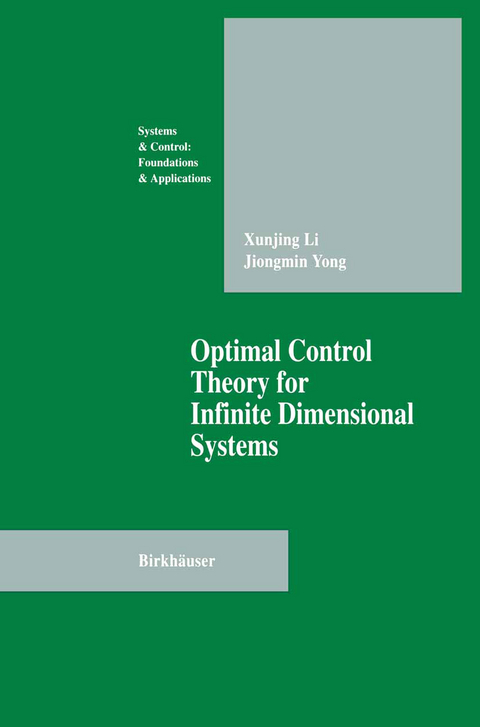
Optimal Control Theory for Infinite Dimensional Systems
Springer-Verlag New York Inc.
978-1-4612-8712-4 (ISBN)
1. Control Problems in Infinite Dimensions.- §1. Diffusion Problems.- §2. Vibration Problems.- §3. Population Dynamics.- §4. Fluid Dynamics.- §5. Free Boundary Problems.- Remarks.- 2. Mathematical Preliminaries.- §1. Elements in Functional Analysis.- §1.1. Spaces.- §1.2. Linear operators.- §1.3. Linear functional and dual spaces.- §1.4. Adjoint operators.- §1.5. Spectral theory.- §1.6. Compact operators.- §2. Some Geometric Aspects of Banach Spaces.- §2.1. Convex sets.- §2.2. Convexity of Banach spaces.- §3. Banach Space Valued Functions.- §3.1. Measurability and integrability.- §3.2. Continuity and differentiability.- §4. Theory of Co Semigroups.- §4.1. Unbounded operators.- §4.2. Co semigroups.- §4.3. Special types of Co semigroups.- §4.4. Examples.- §5. Evolution Equations.- §5.1. Solutions.- §5.2. Semilinear equations.- §5.3. Variation of constants formula.- §6. Elliptic Partial Differential Equations.- §6.1. Sobolev spaces.- §6.2. Linear elliptic equations.- §6.3. Semilinear elliptic equations.- Remarks.- 3. Existence Theory of Optimal Controls.- §1. Souslin Space.- §1.1. Polish space.- §1.2. Souslin space.- §1.3. Capacity and capacitability.- §2. Multifunctions and Selection Theorems.- §2.1. Continuity.- §2.2. Measurability.- §2.3. Measurable selection theorems.- §3. Evolution Systems with Compact Semigroups.- §4. Existence of Feasible Pairs and Optimal Pairs.- §4.1. Cesari property.- §4.2. Existence theorems.- §5. Second Order Evolution Systems.- §5.1. Formulation of the problem.- §5.2. Existence of optimal controls.- §6. Elliptic Partial Differential Equations and Variational Inequalities.- Remarks.- 4. Necessary Conditions for Optimal Controls — Abstract Evolution Equations.- §1. Formulation of the Problem.-§2. Ekeland Variational Principle.- §3. Other Preliminary Results.- §3.1. Finite codimensionality.- §3.2. Preliminaries for spike perturbation.- §3.3. The distance function.- §4. Proof of the Maximum Principle.- §5. Applications.- Remarks.- 5. Necessary Conditions for Optimal Controls — Elliptic Partial Differential Equations.- §1. Semilinear Elliptic Equations.- §1.1. Optimal control problem and the maximum principle.- §1.2. The state coastraints.- §2. Variation along Feasible Pairs.- §3. Proof of the Maximum Principle.- §4. Variational Inequalities.- §4.1. Stability of the optimal cost.- §4.2. Approximate control problems.- §4.3. Maximum principle and its proof.- §5. Quasilinear Equations.- §5.1. The state equation and the optimal control problem.- §5.2. The maximum principle.- §6. Minimax Control Problem.- §6.1. Statement of the problem.- §6.2. Regularization of the cost functional.- §6.3. Necessary conditions for optimal controls.- §7. Bounary Control Problems.- §7.1. Formulation of the problem.- §7.2. Strong stability and the qualified maximum principle.- §7.3. Neumann problem with measure data.- §7.4. Exact penalization and a proof of the maximum principle.- Remarks.- 6. Dynamic Programming Method for Evolution Systems.- §1. Optimality Principle and Hamilton-Jacobi-Bellman Equations.- §2. Properties of the Value Functions.- §2.1. Continuity.- §2.2. B-continuity.- §2.3. Semi-concavity.- §3. Viscosity Solutions.- §4. Uniqueness of Viscosity Solutions.- §4.1. A perturbed optimization lemma.- §4.2. The Hilbert space X?.- §4.3. A uniqueness theorem.- §5. Relation to Maximum Principle and Optimal Synthesis.- §6. Infinite Horizon Problems.- Remarks.- 7. Controllability and Time Optimal Control.- §1. Definitions ofControllability.- §2. Controllability for linear systems.- §2.1. Approximate controllability.- §2.2. Exact controllability.- §3. Approximate controllability for semilinear systems.- §4. Time Optimal Control — Semilinear Systems.- §4.1. Necessary conditions for time optimal pairs.- §4.2. The minimum time function.- §5. Time Optimal Control — Linear Systems.- §5.1. Convexity of the reachable set.- §5.2. Encounter of moving sets.- §5.3. Time optimal control.- Remarks.- 8. Optimal Switching and Impulse Controls.- §1. Switching and Impulse Controls.- §2. Preliminary Results.- §3. Properties of the Value Function.- §4. Optimality Principle and the HJB Equation.- §5. Construction of an Optimal Control.- §6. Approximation of the Control Problem.- §7. Viscosity Solutions.- §8. Problem in Finite Horizon.- Remarks.- 9. Linear Quadratic Optimal Control Problems.- §1. Formulation of the Problem.- §1.1. Examples of unbounded control problems.- §1.2. The LQ problem.- §2. Well-posedness and Solvability.- §3. State Feedback Control.- §3.1. Two-point boundary value problem.- §3.2. The Problem (LQ)t.- §3.3. A Fredholm integral equation.- §3.4. State feedback representation of optimal controls.- §4. Riccati Integral Equation.- §5. Problem in Infinite Horizon.- §5.1. Reduction of the problem.- §5.2. Well-posedness and solvability.- §5.3. Algebraic Riccati equation.- §5.4. The positive real lemma.- §5.5. Feedback stabilization.- §5.6. Fredholm integral equation and Riccati integral equation.- Remarks.- References.
| Reihe/Serie | Systems & Control: Foundations & Applications |
|---|---|
| Zusatzinfo | XII, 450 p. |
| Verlagsort | New York |
| Sprache | englisch |
| Maße | 155 x 235 mm |
| Themenwelt | Mathematik / Informatik ► Informatik ► Theorie / Studium |
| Mathematik / Informatik ► Mathematik ► Angewandte Mathematik | |
| ISBN-10 | 1-4612-8712-X / 146128712X |
| ISBN-13 | 978-1-4612-8712-4 / 9781461287124 |
| Zustand | Neuware |
| Informationen gemäß Produktsicherheitsverordnung (GPSR) | |
| Haben Sie eine Frage zum Produkt? |
aus dem Bereich