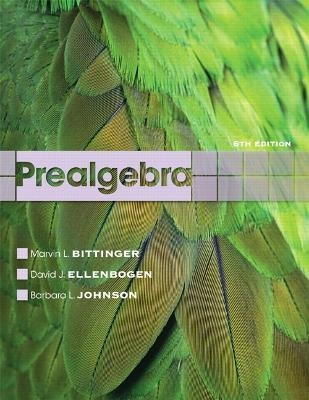
Prealgebra plus MyMathLab/MyStatLab -- Access Card Package
Pearson
978-0-321-76009-8 (ISBN)
- Titel ist leider vergriffen;
keine Neuauflage - Artikel merken
Packages
Access codes for Pearson's MyLab & Mastering products may not be included when purchasing or renting from companies other than Pearson; check with the seller before completing your purchase.
Used or rental books
If you rent or purchase a used book with an access code, the access code may have been redeemed previously and you may have to purchase a new access code.
Access codes
Access codes that are purchased from sellers other than Pearson carry a higher risk of being either the wrong ISBN or a previously redeemed code. Check with the seller prior to purchase.
-- The Bittinger Worktext Series changed the face of developmental education with the introduction of objective-based worktexts that presented math one concept at a time. This approach allowed students to understand the rationale behind each concept before practicing the associated skills and then moving on to the next topic. With this revision, Marv Bittinger continues to focus on building success through conceptual understanding, while also supporting students with quality applications, exercises, and new review and study materials to help them apply and retain their knowledge.
Marvin Bittinger has been teaching math at the university level for more than thirty-eight years. Since 1968, he has been employed at Indiana University Purdue University Indianapolis, and is now professor emeritus of mathematics education. Professor Bittinger has authored over 190 publications on topics ranging from basic mathematics to algebra and trigonometry to applied calculus. He received his BA in mathematics from Manchester College and his PhD in mathematics education from Purdue University. Special honors include Distinguished Visiting Professor at the United States Air Force Academy and his election to the Manchester College Board of Trustees from 1992 to 1999. Professor Bittinger has also had the privilege of speaking at many mathematics conventions, most recently giving a lecture entitled "Baseball and Mathematics." His hobbies include hiking in Utah, baseball, golf, and bowling. In addition, he also has an interest in philosophy and theology, in particular, apologetics. Professor Bittinger currently lives in Carmel, Indiana with his wife Elaine. He has two grown and married sons, Lowell and Chris, and four granddaughters.
1. Whole Numbers
1.1 Standard Notation
1.2 Addition
1.3 Subtraction
1.4 Multiplication
1.5 Division
1.6 Rounding and Estimating; Order
1.7 Solving Equations
1.8 Applications and Problem Solving
1.9 Exponential Notation and Order of Operations
2. Introduction to Integers and Algebraic Expressions
2.1 Integers and the Number Line
2.2 Addition of Integers
2.3 Subtraction of Integers
2.4 Multiplication of Integers
2.5 Division of Integers and Order of Operations
2.6 Introduction to Algebra and Expressions
2.7 Like Terms and Perimeter
2.8 Solving Equations
3. Fraction Notation: Multiplication and Division
3.1 Multiples and Divisibility
3.2 Factorizations
3.3 Fractions and Fraction Notation
3.4 Multiplication and Applications
3.5 Simplifying
3.6 Multiplying, Simplifying, and More with Area
3.7 Reciprocals and Division
3.8 Solving Equations: The Multiplication Principle
4. Fraction Notation: Addition, Subtraction, and Mixed Numerals
4.1 Least Common Multiples
4.2 Addition, Order, and Applications
4.3 Subtraction, Equations, and Applications
4.4 Solving Equations: Using the Principles Together
4.5 Mixed Numerals
4.6 Addition and Subtraction of Mixed Numerals; Applications
4.7 Multiplication and Division of Mixed Numerals; Applications
4.8 Order of Operations and Complex Fractions
5. Decimal Notation
5.1 Decimal Notation, Order, and Rounding
5.2 Addition and Subtraction of Decimals
5.3 Multiplication of Decimals
5.4 Division of Decimals
5.5 Using Fraction Notation with Decimal Notation
5.6 Estimating
5.7 Solving Equations
5.8 Applications and Problem Solving
6. Introduction to Graphing and Statistics
6.1 Tables and Pictographs
6.2 Bar Graphs and Line Graphs
6.3 Ordered Pairs and Equations in Two Variables
6.4 Graphing Linear Equations
6.5 Means, Medians, and Modes
6.6 Predictions and Probability
7. Ratio and Proportion
7.1 Introduction to Ratios
7.2 Rates and Unit Prices
7.3 Proportions
7.4 Applications of Proportions
7.5 Geometric Applications
8. Percent Notation
8.1 Percent Notation
8.2 Solving Percent Problems Using Percent Equations
8.3 Solving Percent Problems Using Proportions
8.4 Applications of Percent
8.5 Percent of Increase or Decrease
8.6 Sales Tax, Commission, and Discount
8.7 Simple Interest and Compound Interest; Credit Cards
9. Geometry and Measurement
9.1 Systems of Linear Measurement
9.2 Converting Units of Area
9.3 More with Perimeter and Area
9.4 Volume and Capacity
9.5 Angles and Triangles
9.6 Square Roots and the Pythagorean Theorem
9.7 Weight, Mass, and Temperature
9.8 Medical Applications
10. Exponents and Polynomials
10.1 Integers as Exponents
10.2 Working with Exponents
10.3 Scientific Notation
10.4 Addition and Subtraction of Polynomials
10.5 Introduction to Multiplying and Factoring Polynomials
Appendices: Developmental Units
A. Addition
S. Subtraction
M. Multiplication
D. Division
| Erscheint lt. Verlag | 28.10.2012 |
|---|---|
| Sprache | englisch |
| Maße | 216 x 274 mm |
| Gewicht | 1474 g |
| Themenwelt | Mathematik / Informatik ► Mathematik ► Algebra |
| ISBN-10 | 0-321-76009-3 / 0321760093 |
| ISBN-13 | 978-0-321-76009-8 / 9780321760098 |
| Zustand | Neuware |
| Informationen gemäß Produktsicherheitsverordnung (GPSR) | |
| Haben Sie eine Frage zum Produkt? |
aus dem Bereich