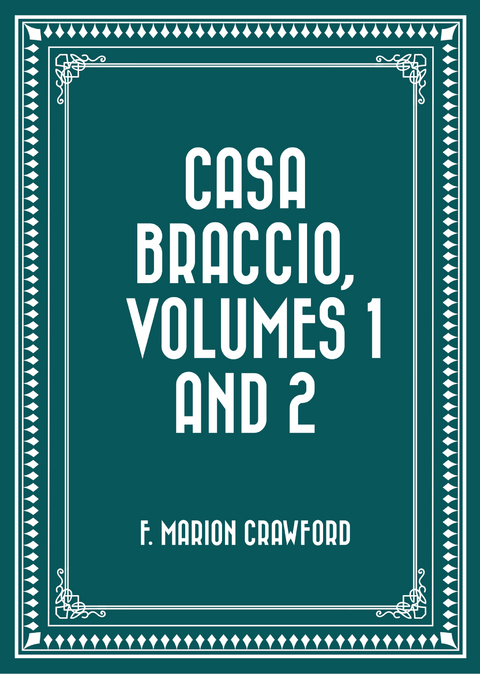
Casa Braccio, Volumes 1 and 2 (eBook)
598 Seiten
Krill Press (Verlag)
978-1-5183-7289-6 (ISBN)
F. Marion Crawford was a prolific American author. He is well known for his many mysterious and weird fiction novels.
CHAPTER II.
Maria Addolorata.—Vol. I., p. 25.
SISTER MARIA ADDOLORATA SAT BY the open door of her cell, looking across the stone parapet of her little balcony, and watching the changing richness of the western sky, as the sun went down far out of sight behind the mountains. Though the month was October, the afternoon was warm; it was very still, and the air had been close in the choir during the Benediction service, which was just over. She leaned back in her chair, and her lips parted as she breathed, with a perceptible desire for refreshment in the breath. She held a piece of needlework in her heavy white hands; the needle had been thrust through the linen, but the stitch had remained unfinished, and one pointed finger pressed the doubled edge against the other, lest the material should slip before she made up her mind to draw the needle through. Deep in the garden under the balcony the late flowers were taking strangely vivid colours out of the bright sky above, and some bits of broken glass, stuck in the mortar on the top of the opposite wall as a protection against thieving boys, glowed like a line of rough rubies against the misty distance. Even the white walls of the bare cell and the coarse grey blanket lying across the foot of the small bed drank in a little of the colour, and looked less grey and less grim.
From the eaves, high above the open door, the swallows shot down into the golden light, striking great circles and reflecting the red gold of the sky from their breasts as they wheeled just beyond the wall, with steady wings wide-stretched, up and down; and each one, turning at full speed, struck upwards again and was out of sight in an instant, above the lintel. The nun watched them, her eyes trying to follow each of them in turn and to recognize them separately as they flashed into sight again and again.
Her lips were parted, and as she sat there she began to sing very softly and quite unconsciously. She could not have told what the song was. The words were strange and oddly divided, and there was a deadly sadness in a certain interval that came back almost with every stave. But the voice itself was beautiful beyond all comparison with ordinary voices, full of deep and touching vibrations and far harmonics, though she sang so softly, all to herself. Notes like hers haunt the ears—and sometimes the heart—when she who sang them has been long dead, and many would give much to hear but a breath of them again.
It was hard for Maria Addolorata not to sing sometimes, when she was all alone in her cell, though it was so strictly forbidden. Singing is a gift of expression, when it is a really natural gift, as much as speech and gesture and the smile on the lips, with the one difference that it is a keener pleasure to him or her that sings than gesture or speech can possibly be. Music, and especially singing, are a physical as well as an intellectual expression, a pleasure of the body as well as a ‘delectation’ of the soul. To sing naturally and spontaneously is most generally an endowment of natures physically strong and rich by the senses, independently of the mind, though melody may sometimes be the audible translation of a silent thought as well as the unconscious speech of wordless passion.
And in Maria’s song there was a strain of that something unknown and fatal, which the nuns sometimes saw in her face and which was in her eyes now, as she sang; for they no longer followed the circling of the swallows, but grew fixed and dark, with fiery reflexions from the sunset sky, and the regular features grew white and straight and square against the deepening shadows within the narrow room. The deep voice trembled a little, and the shoulders had a short, shivering movement under the heavy folds of the dark veil, as the sensation of a presence ran through her and made her shudder. But the voice did not break, and she sang on, louder, now, than she realized, the full notes swelling in her throat, and vibrating between the narrow walls, and floating out through the open door to join the flight of the swallows.
The door of the cell opened gently, but she did not hear, and sang on, leaning back in her chair and gazing still at the pink clouds above the mountains.
“Death is my love, dark-eyed death—”
she sang.
“Maria!”
The abbess was standing in the doorway and speaking to her, but she did not hear.
“His hands are sweetly cold and gentle—
“Maria!” cried the abbess, impatiently. “What follies are you singing? I could hear you in my room!”
Maria Addolorata started and rose from her seat, still holding her needlework, and turning half round towards her superior, with suddenly downcast eyes. The elder lady came forward with slow dignity and walked as far as the door of the balcony, where she stood still for a moment, gazing at the beautiful sky. She was not a stately woman, for she was too short and stout, but she had that calm air of assured superiority which takes the place of stateliness, and which seems to belong especially to those who occupy important positions in the Church. Her large features, though too heavy, were imposing in their excessive pallor, while the broad, dark brown shadows all around and beneath the large black eyes gave the face a depth of expression which did not, perhaps, wholly correspond with the original character. It was a striking face, and considering the wide interval between the ages of the abbess and her niece, and the natural difference of colouring, there was a strong family resemblance in the two women.
The abbess sat down upon the only chair, and Maria remained standing before her, her sewing in her hands.
“I have often told you that you must not sing in your cell,” said the abbess, in a coldly severe tone.
Maria’s shoulders shook her veil a little, but she still looked at the floor.
“I cannot help it,” she answered in a constrained voice. “I did not know that I was singing—”
“That is ridiculous! How can one sing, and not know it? You are not deaf. At least, you do not sing as though you were. I will not have it. I could hear you as far away as my own room—a love-song, too!”
“The love of death,” suggested Maria.
“It makes no difference,” answered the elder lady. “You disturb the peace of the sisters with your singing. You know the rule, and you must obey it, like the rest. If you must sing, then sing in church.”
“I do.”
“Very well, that ought to be enough. Must you sing all the time? Suppose that the Cardinal had been visiting me, as was quite possible, what impression would he have had of our discipline?”
“Oh, Uncle Cardinal has often heard me sing.”
“You must not call him ‘Uncle Cardinal.’ It is like the common people who say ‘Uncle Priest.’ I have told you that a hundred times at least. And if the Cardinal has heard you singing, so much the worse.”
“He once told me that I had a good voice,” observed Maria, still standing before her aunt.
“A good voice is a gift of God and to be used in church, but not in such a way as to attract attention or admiration. The devil is everywhere, my daughter, and makes use of our best gifts as a means of temptation. The Cardinal certainly did not hear you singing that witch’s love-song which I heard just now. He would have rebuked you as I do.”
“It was not a love-song. It is about death—and Saint John’s eve.”
“Well, then it is about witches. Do not argue with me. There is a rule, and you must not break it.”
Maria Addolorata said nothing, but moved a step and leaned against the door-post, looking out into the evening light. The stout abbess sat motionless in her straight chair, looking past her niece at the distant hills. She had evidently said all she meant to say about the singing, and it did not occur to her to talk of anything else. A long silence followed. Maria was not timid, but she had been accustomed from her childhood to look upon her aunt as an immensely superior person, moving in a higher sphere, and five years spent in the convent as novice and nun had rather increased than diminished the feeling of awe which the abbess inspired in the young girl. There was, indeed, no other sister in the community who would have dared to answer the abbess’s rebuke at all, and Maria’s very humble protest really represented an extraordinary degree of individuality and courage. Conventual institutions can only exist on a basis of absolute submission.
The abbess was neither harsh nor unkind, and was certainly not a very terrifying figure, but she possessed undeniable force of character, strengthened by the inborn sense of hereditary right and power, and her kindness was as imposing as her displeasure was lofty and solemn. She had very little sympathy for any weakness in others, but she was always ready to dispense the mercy of Heaven, vicariously, so to say, and with a certain royally suppressed surprise that Heaven should be merciful. On the whole, considering the circumstances, she admitted that Maria Addolorata had accepted the veil with sufficient outward grace, though without any vocation, and she took it for granted that with such opportunities the girl must slowly develop into an abbess not unlike her predecessors. She prayed regularly, of course, and...
| Erscheint lt. Verlag | 17.1.2016 |
|---|---|
| Sprache | englisch |
| Themenwelt | Literatur ► Anthologien |
| Literatur ► Klassiker / Moderne Klassiker | |
| Literatur ► Romane / Erzählungen | |
| Schlagworte | Austen • Bronte • classics • Dickens • Hawthorne • Prejudice • Sense |
| ISBN-10 | 1-5183-7289-9 / 1518372899 |
| ISBN-13 | 978-1-5183-7289-6 / 9781518372896 |
| Informationen gemäß Produktsicherheitsverordnung (GPSR) | |
| Haben Sie eine Frage zum Produkt? |
 EPUB (Adobe DRM)
Größe: 868 KB
Kopierschutz: Adobe-DRM
Adobe-DRM ist ein Kopierschutz, der das eBook vor Mißbrauch schützen soll. Dabei wird das eBook bereits beim Download auf Ihre persönliche Adobe-ID autorisiert. Lesen können Sie das eBook dann nur auf den Geräten, welche ebenfalls auf Ihre Adobe-ID registriert sind.
Details zum Adobe-DRM
Dateiformat: EPUB (Electronic Publication)
EPUB ist ein offener Standard für eBooks und eignet sich besonders zur Darstellung von Belletristik und Sachbüchern. Der Fließtext wird dynamisch an die Display- und Schriftgröße angepasst. Auch für mobile Lesegeräte ist EPUB daher gut geeignet.
Systemvoraussetzungen:
PC/Mac: Mit einem PC oder Mac können Sie dieses eBook lesen. Sie benötigen eine
eReader: Dieses eBook kann mit (fast) allen eBook-Readern gelesen werden. Mit dem amazon-Kindle ist es aber nicht kompatibel.
Smartphone/Tablet: Egal ob Apple oder Android, dieses eBook können Sie lesen. Sie benötigen eine
Geräteliste und zusätzliche Hinweise
Buying eBooks from abroad
For tax law reasons we can sell eBooks just within Germany and Switzerland. Regrettably we cannot fulfill eBook-orders from other countries.
aus dem Bereich