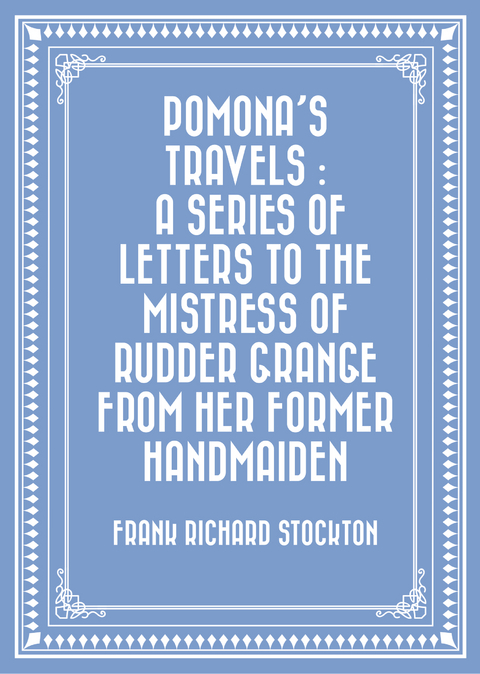
Pomona's Travels : A Series of Letters to the Mistress of Rudder Grange from her Former Handmaiden (eBook)
234 Seiten
Krill Press (Verlag)
978-1-5183-6576-8 (ISBN)
Frank Richard Stockton was a popular 19th century American author who remains best known for writing a series of acclaimed children's fairy tales. His books are still read across the world today.
LETTER NUMBER ONE
T
LONDON
he first thing Jone said to me when I told him I was going to write about what I saw and heard was that I must be careful of two things. In the first place, I must not write a lot of stuff that everybody ought to be expected to know, especially people who have travelled themselves; and in the second place, I must not send you my green opinions, but must wait until they were seasoned, so that I can see what they are good for before I send them.
“But if I do that,” said I, “I will get tired of them long before they are seasoned, and they will be like a bundle of old sticks that I wouldn’t offer to anybody.” Jone laughed at that, and said I might as well send them along green, for, after all, I wasn’t the kind of a person to keep things until they were seasoned, to see if I liked them. “That’s true,” said I, “there’s a great many things, such as husbands and apples, that I like a good deal better fresh than dry. Is that all the advice you’ve got to give?”
“For the present,” said he; “but I dare say I shall have a good deal more as we go along.”
“All right,” said I, “but be careful you don’t give me any of it green. Advice is like gooseberries, that’s got to be soft and ripe, or else well cooked and sugared, before they’re fit to take into anybody’s stomach.”
Jone was standing at the window of our sitting-room when I said this, looking out into the street. As soon as we got to London we took lodgings in a little street running out of the Strand, for we both want to be in the middle of things as long as we are in this conglomerate town, as Jone calls it. He says, and I think he is about right, that it is made up of half a dozen large cities, ten or twelve towns, at least fifty villages, more than a hundred little settlements, or hamlets, as they call them here, and about a thousand country houses scattered along around the edges; and over and above all these are the inhabitants of a large province, which, there being no province to put them into, are crammed into all the cracks and crevices so as to fill up the town and pack it solid.
When we was in London before, with you and your husband, madam, and we lost my baby in Kensington Gardens, we lived, you know, in a peaceful, quiet street by a square or crescent, where about half the inhabitants were pervaded with the solemnities of the past and the other half bowed down by the dolefulness of the present, and no way of getting anywhere except by descending into a movable tomb, which is what I always think of when we go anywhere in the underground railway. But here we can walk to lots of things we want to see, and if there was nothing else to keep us lively the fear of being run over would do it, you may be sure.
But, after all, Jone and me didn’t come here to London just to see the town. We have ideas far ahead of that. When we was in London before I saw pretty nearly all the sights, for when I’ve got work like that to do I don’t let the grass grow under my feet, and what we want to do on this trip is to see the country part of England and Scotland. And in order to see English country life just as it is, we both agreed that the best thing to do was to take a little house in the country and live there a while; and I’ll say here that this is the only plan of the whole journey that Jone gets real enthusiastic about, for he is a domestic man, as you well know, and if anything swells his veins with fervent rapture it is the idea of living in some one place continuous, even if it is only for a month.
As we wanted a house in the country we came to London to get it, for London is the place to get everything. Our landlady advised us, when we told her what we wanted, to try and get a vicarage in some little village, because, she said, there are always lots of vicars who want to go away for a month in the summer, and they can’t do it unless they rent their houses while they are gone. And in fact, some of them, she said, got so little salary for the whole year, and so much rent for their vicarages while they are gone, that they often can’t afford to stay in places unless they go away.
So we answered some advertisements, and there was no lack of them in the papers, and three agents came to see us, but we did not seem to have any luck. Each of them had a house to let which ought to have suited us, according to their descriptions, and although we found the prices a good deal higher than we expected, Jone said he wasn’t going to be stopped by that, because it was only for a little while and for the sake of experience—and experience, as all the poets, and a good many of the prose writers besides, tell us, is always dear. But after the agents went away, saying they would communicate with us in the morning, we never heard anything more from them, and we had to begin all over again. There was something the matter, Jone and I both agreed on that, but we didn’t know what it was. But I waked up in the night and thought about this thing for a whole hour, and in the morning I had an idea.
“Jone,” said I, when we was eating breakfast, “it’s as plain as A B C that those agents don’t want us for tenants, and it isn’t because they think we are not to be trusted, for we’d have to pay in advance, and so their money’s safe; it is something else, and I think I know what it is. These London men are very sharp, and used to sizing and sorting all kinds of people as if they was potatoes being got ready for market, and they have seen that we are not what they call over here gentlefolks.”
“No lordly airs, eh?” said Jone.
“Oh, I don’t mean that,” I answered him back; “lordly airs don’t go into parsonages, and I don’t mean either that they see from our looks or manners that you used to drive horses and milk cows and work in the garden, and that I used to cook and scrub and was maid-of-all-work on a canal-boat; but they do see that we are not the kind of people who are in the habit, in this country, at least, of spending their evenings in the best parlors of vicarages.”
“Do you suppose,” said Jone, “that they think a vicar’s kitchen would suit us better?”
“No,” said I, “they wouldn’t put us in a vicarage at all; there wouldn’t be no place there that would not be either too high or too low for us. It’s my opinion that what they think we belong in is a lordly house, where you’d shine most as head butler or a steward, while I’d be the housekeeper or a leading lady’s maid.”
“By George!” said Jone, getting up from the table, “if any of those fellows would favor me with an opinion like that I’d break his head.”
“You’d have a lot of heads to break,” said I, “if you went through this country asking for opinions on the subject. It’s all very well for us to remember that we’ve got a house of our own as good as most rectors have over here, and money enough to hire a minor canon, if we needed one in the house; but the people over here don’t know that, and it wouldn’t make much difference if they did, for it wouldn’t matter how nice we lived or what we had so long as they knew we was retired servants.”
At this Jone just blazed up and rammed his hands into his pockets and spread his feet wide upon the floor. “Pomona,” said he, “I don’t mind it in you, but if anybody else was to call me a retired servant I’d—”
“Hold up, Jone,” said I, “don’t waste good, wholesome anger.” Now, I tell you, madam, it really did me good to see Jone blaze up and get red in the face, and I am sure that if he’d get his blood boiling oftener it would be a good thing for his dyspeptic tendencies and what little malaria may be left in his system. “It won’t do any good to flare up here,” I went on to say to him; “fact’s fact, and we was servants, and good ones, too, though I say it myself, and the trouble is we haven’t got into the way of altogether forgetting it, or, at least, acting as if we had forgotten it.”
Jone sat down on a chair. “It might help matters a little,” he said, “if I knew what you was driving at.”
“I mean just this,” said I, “as long as we are as anxious not to give trouble, or as careful of people’s feelings, as good-mannered to servants, and as polite and good-natured to everybody we have anything to do with, as we both have been since we came here, and as it is our nature to be, I am proud to say, we’re bound to be set down, at least by the general run of people over here, as belonging to the pick of the nobility and gentry, or as well-bred servants. It’s only those two classes that act as we do, and anybody can see we are not special nobles and gents. Now, if we want to be reckoned anywhere in between these two we’ve got to change our manners.”
“Will you kindly mention just how?” said Jone.
“Yes,” said I, “I will. In the first place, we’ve got to act as if we had always been waited on and had never been satisfied with the way it was done; we’ve got to let people think...
| Erscheint lt. Verlag | 10.1.2016 |
|---|---|
| Sprache | englisch |
| Themenwelt | Literatur ► Anthologien |
| Literatur ► Klassiker / Moderne Klassiker | |
| Literatur ► Romane / Erzählungen | |
| Schlagworte | Austen • Bronte • classics • Dickens • Hawthorne • Prejudice • Sense |
| ISBN-10 | 1-5183-6576-0 / 1518365760 |
| ISBN-13 | 978-1-5183-6576-8 / 9781518365768 |
| Informationen gemäß Produktsicherheitsverordnung (GPSR) | |
| Haben Sie eine Frage zum Produkt? |
 EPUB (Adobe DRM)
Größe: 656 KB
Kopierschutz: Adobe-DRM
Adobe-DRM ist ein Kopierschutz, der das eBook vor Mißbrauch schützen soll. Dabei wird das eBook bereits beim Download auf Ihre persönliche Adobe-ID autorisiert. Lesen können Sie das eBook dann nur auf den Geräten, welche ebenfalls auf Ihre Adobe-ID registriert sind.
Details zum Adobe-DRM
Dateiformat: EPUB (Electronic Publication)
EPUB ist ein offener Standard für eBooks und eignet sich besonders zur Darstellung von Belletristik und Sachbüchern. Der Fließtext wird dynamisch an die Display- und Schriftgröße angepasst. Auch für mobile Lesegeräte ist EPUB daher gut geeignet.
Systemvoraussetzungen:
PC/Mac: Mit einem PC oder Mac können Sie dieses eBook lesen. Sie benötigen eine
eReader: Dieses eBook kann mit (fast) allen eBook-Readern gelesen werden. Mit dem amazon-Kindle ist es aber nicht kompatibel.
Smartphone/Tablet: Egal ob Apple oder Android, dieses eBook können Sie lesen. Sie benötigen eine
Geräteliste und zusätzliche Hinweise
Buying eBooks from abroad
For tax law reasons we can sell eBooks just within Germany and Switzerland. Regrettably we cannot fulfill eBook-orders from other countries.
EPUB (Ohne DRM)Digital Rights Management: ohne DRM
Dieses eBook enthält kein DRM oder Kopierschutz. Eine Weitergabe an Dritte ist jedoch rechtlich nicht zulässig, weil Sie beim Kauf nur die Rechte an der persönlichen Nutzung erwerben.
Dateiformat: EPUB (Electronic Publication)
EPUB ist ein offener Standard für eBooks und eignet sich besonders zur Darstellung von Belletristik und Sachbüchern. Der Fließtext wird dynamisch an die Display- und Schriftgröße angepasst. Auch für mobile Lesegeräte ist EPUB daher gut geeignet.
Systemvoraussetzungen:
PC/Mac: Mit einem PC oder Mac können Sie dieses eBook lesen. Sie benötigen dafür die kostenlose Software Adobe Digital Editions.
eReader: Dieses eBook kann mit (fast) allen eBook-Readern gelesen werden. Mit dem amazon-Kindle ist es aber nicht kompatibel.
Smartphone/Tablet: Egal ob Apple oder Android, dieses eBook können Sie lesen. Sie benötigen dafür eine kostenlose App.
Geräteliste und zusätzliche Hinweise
Buying eBooks from abroad
For tax law reasons we can sell eBooks just within Germany and Switzerland. Regrettably we cannot fulfill eBook-orders from other countries.
aus dem Bereich