UNDER
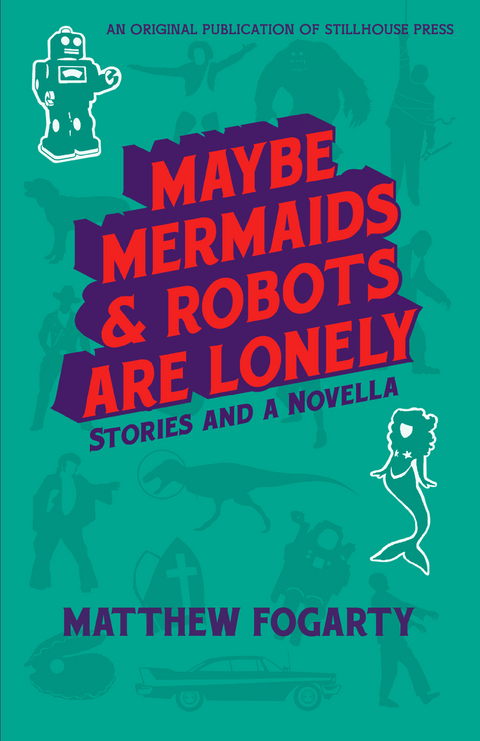
Maybe Mermaids & Robots are Lonely
1
And just because his skin is steel doesn’t mean he feels nothing. Maybe they’re at a beach and she’s in with the tide. Or maybe they’re at the tops of skyscrapers, a city between them, and all they can see is each other: her with the curls that fall in a tangle over her shoulders and the dress that drapes her fins, him with the earnestness of a logic board. Wherever it is they find each other, he has to believe in the possibility, because if this isn’t possible, what is?
Maybe they have coffee or a drink. She’s intelligent, passionate about the sea. He’s funny. She touches his arm and there’s a spark. Later, they’re at his factory, afterhours. In the breakroom, he finds salt and a jug of water. They lay under his favorite socket. He’s barrel-chested, cylinder limbs heated drunk with her coursing energy. She’s an electrical drug; her lips tap his circuit veins. He says, “I’d rust for you.” She says, “You leave me breathless.” Her grip is firm. His alloys green her clamshell breasts.
2
Maybe it’s morning then and they’re still at the factory when the first shift comes in.
Or maybe they woke early. They’re already at the shore among schools of surfers. There’s sand in his hinges; he feels unplugged. She says she has to go back. She says, “I wish you would come.”
And maybe that’s it. He lets her leave. Maybe his heart is a heat sink, a dull organ that shields his mainframe from her glow.
Or maybe it’s clockwork, his heart, and maybe there’s a screw that’s twisted, a gear that slows. His LED eyes fade. There’s an electric tear. He says, “I wish I could go.”
A wave flows in. She ebbs out with it.
3
At the factory, he ratchets parts on the line, his hard drive looping that last image—her arms extended, hair trailing behind, the flip of a fin as she dives under, her wake shimmying the surface. Maybe that’s when his memory loads an image of a surfer shedding a wetsuit.
In the closet, there are sheets of silicone rubber, bottles of glue and sealant, spools of thread. He lays them over a worktable, looms it all into the shape of him, his metal hands mechanical, methodical. If he could sweat, he’d wipe his brow. The moon sets in the high factory window.
4
At the beach, his pincers clamp at the sleeves, fit the wetsuit over his tin-can body. He goes awkwardly into the water, his feet softly sinking into the wet sand and the wet sand sucking thick against his step, against the pull and fall of his metal limbs. The water rises to his articulated joints and rises further. A broken wave washes against his mechanical chest, splashes the gloved whole of him, and recedes to the warm of the air. It splashes again, higher, and recedes again, the cool of it fogging the plastic mask he’s sewn in to see. He loses his axis. The sea bottom descends. The sea floor gives way to water. He’s surrounded by it. He’s in it. His metal body buoys, and for a moment he floats, free—feels the surface as archived memory—before realizing it’s a feeling he was never meant to have felt. He flails for it and from his flailing he floats down and he flails more and he goes deeper, floats further underwater, airless, deep and dumb.
He wonders whether robots can drown. He wonders whether she’s forgotten him, or whether maybe he’s in the wrong ocean, or if it’s all just a cruel glitch. She’s a failure of programming; she doesn’t exist. Maybe this is what happens in the night, when the factory is closed and it’s dark—idle robots dream of love and mermaids.
Or maybe that’s when she catches him, thrashing for life, fishhooks her arms under his. He says, “I’m sorry. I’m not programmed to swim.” And she smiles, takes his hand, says, “Then don’t let go.”
River to Shanghai
Then, we lived next to a river and my brother spent a summer building a raft out of a fallen pine he claimed would float him down the river and out into the ocean and all the way to Shanghai. “May take a while,” he’d say, “but I’ll get there eventually.” He told me all the things he expected to see on the way—tropical islands and whales and pirates and giant sea kelp and monsters—and described Shanghai as though it were paradise.
In our room one night, after we were supposed to have gone to sleep, he told me about some of the dreams he’d had, his adventures living there, this exotic land, having a whole house to himself. He said, “A young person like me can really make it in Shanghai. I can have any kind of family I want.” This was the way he talked, like he was older than he really was and like there was a life that he wanted to live that was different from his own. He dreamed of being carried away from our real life, of new people and places. Even though I was younger than him, I understood what he meant. This was all during the time our parents were divorcing, when it seemed like home wasn’t ours anymore.
When one day that fall he disappeared on his way home from school, I figured he’d done it—barged off down the grassy slope onto his pine raft, out into the open sea. Maybe he thought it would fix things, like he was the axe felling our family and that the family could only survive without him.
And for a time it was magic. Our parents were worried and the worrying together gave them something to talk about without fighting. Each night they drove through the neighborhood together, called all the shelters and hospitals, talked to all his friends. I told them about the raft and the trip around the world. They hugged me and said I was sweet but that the story wasn’t possible. Our backyard river was just a creek, they said, and beautiful as it is, it wouldn’t have gotten him very far. Later that night they took me with them to search, Mom and me in the car, Dad in his waders kicking at the creek bottom.
Eventually, they each started to blame the other and they both blamed him. I started to miss him more than I was amazed by him. What he’d called adventure seemed more like escape—or even worse. And it wasn’t long before we were back where we started. Except, across the dinner table now, instead of my living breathing brother, there was just a chair made of blonde wood and carved slats and blank space that seemed to bend light from the kitchen and collapse us toward it, our shoulders and our arms leaned toward nothing.
Plain Burial
Bentley died somewhere in the middle of Nebraska. He was in the backseat and I didn’t see him right away. I’d been giving him tranquilizers to help keep him calm on the trip out west, and when he laid down, I figured it was just the tranqs working too well. He wobbled a bit, looked woozy, and he did that low growl he does—more of a soft moan—when he wants something and doesn’t know how to ask and I told him to shut up and I turned up the radio.
We’d been on the road since early in the morning when I snuck him out of the Holiday Inn. They had a no-pets policy and we skipped the free breakfast because of it. There wasn’t any way we would’ve gotten out without them seeing him and so I took us both out the back door near where all the semis park. He dug a couple of holes and sniffed around and then stopped and got up on his haunches to shit and I said, “We gotta go, B,” and yanked him out of it. I pulled over to the shoulder a few miles up and clipped on the leash and he ran around the ditch by the side of the highway for a couple minutes before finding his spot. He was always so regal, even in doing that; sometimes I’d offer him a newspaper to read. Still, I felt bad for the indignity of it, of having to do that basic living act with people speeding by. This time, he looked full of life, that big smile he’d get, like he was ready to run the rest of the way to San Francisco. And then some asshole in a Land Rover slowed and blew his horn and whooped at us. My awesome dog didn’t hesitate: he barked and turned and shook his ass at the guy.
It wasn’t until the truck stop outside of North Platte that I realized he’d stopped breathing. It was a Love’s and there was a McDonalds inside and I lowered the windows a little and went in to get something to eat. I thought I’d seen his tail wag as I got out of the car. But he’d been quiet for much of the last hundred miles, and the longer I was in line, the more worried I got. I ordered him a breakfast sandwich and ran back to the parking lot. He was in the same position as when I left, his body stretched on its belly on the back seat, his head resting between his front paws, his eyes closed. I said his name a dozen times and leaned my head next to his, put my hand near his mouth and his nose. There was nothing.
It was not something I’d planned for. Yeah, he was getting old and he and I had been through a lot. I’d had him since he was two or three—those Lab eyes in the corner of the shelter were all I’d needed to see. Looking back on it, before we left Detroit, I had a feeling something bad might happen. It’s like...


 EPUB (Adobe DRM)


