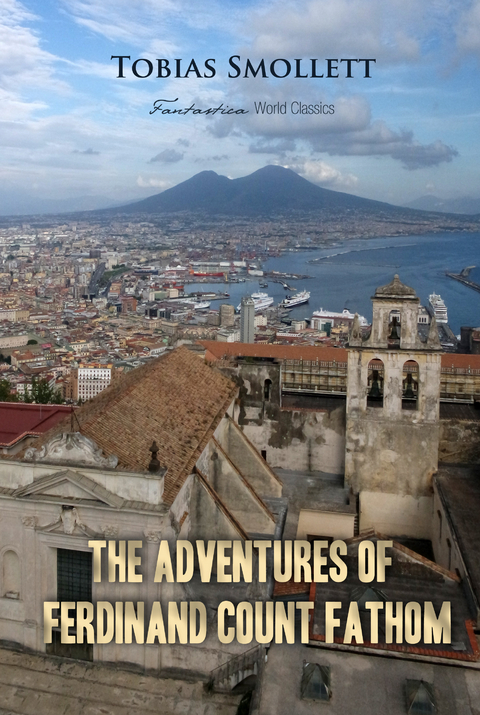
Adventures of Ferdinand Count Fathom (eBook)
412 Seiten
Max Bollinger (Verlag)
978-1-911535-01-0 (ISBN)
The Adventures of Ferdinand Count Fathom follows the sinister rise and scheming exploits of its villainous protagonist, a cold-hearted and manipulative rogue determined to climb the social ladder by any means necessary. Unlike Smollett's more sympathetic rogues, Ferdinand is driven not by wit or survival but by calculated malice, deceit, and ambition. Posing as a nobleman, he insinuates himself into aristocratic circles across Europe, preying on the gullible and exploiting their trust for personal gain. Though his schemes often backfire in darkly comic fashion, the novel offers a chilling exploration of human greed and moral corruption. Written with Smollett's signature irony and satirical edge, Count Fathom stands apart in his canon for its focus on vice rather than virtue.
INTRODUCTION
The Adventures of Ferdinand Count Fathom, Smollett’s third novel, was given to the world in 1753. Lady Mary Wortley Montagu, writing to her daughter, the Countess of Bute, over a year later [January 1st, 1755], remarked that “my friend Smollett . . . has certainly a talent for invention, though I think it flags a little in his last work.” Lady Mary was both right and wrong. The inventive power which we commonly think of as Smollett’s was the ability to work over his own experience into realistic fiction. Of this, Ferdinand Count Fathom shows comparatively little. It shows relatively little, too, of Smollett’s vigorous personality, which in his earlier works was present to give life and interest to almost every chapter, were it to describe a street brawl, a ludicrous situation, a whimsical character, or with venomous prejudice to gibbet some enemy. This individuality—the peculiar spirit of the author which can be felt rather than described—is present in the dedication of Fathom to Doctor ———, who is no other than Smollett himself, and a candid revelation of his character, by the way, this dedication contains. It is present, too, in the opening chapters, which show, likewise, in the picture of Fathom’s mother, something of the author’s peculiar “talent for invention.” Subsequently, however, there is no denying that the Smollett invention and the Smollett spirit both flag. And yet, in a way, Fathom displays more invention than any of the author’s novels; it is based far less than any other on personal experience. Unfortunately such thorough-going invention was not suited to Smollett’s genius. The result is, that while uninteresting as a novel of contemporary manners, Fathom has an interest of its own in that it reveals a new side of its author. We think of Smollett, generally, as a rambling storyteller, a rational, unromantic man of the world, who fills his pages with his own oddly-metamorphosed acquaintances and experiences. The Smollett of Count Fathom, on the contrary, is rather a forerunner of the romantic school, who has created a tolerably organic tale of adventure out of his own brain. Though this is notably less readable than the author’s earlier works, still the wonder is that when the man is so far “off his beat,” he should yet know so well how to meet the strange conditions which confront him. To one whose idea of Smollett’s genius is formed entirely by Random and Pickle and Humphry Clinker, Ferdinand Count Fathom will offer many surprises.
The first of these is the comparative lifelessness of the book. True, here again are action and incident galore, but generally unaccompanied by that rough Georgian hurly-burly, common in Smollett, which is so interesting to contemplate from a comfortable distance, and which goes so far towards making his fiction seem real. Nor are the characters, for the most part, life-like enough to be interesting. There is an apparent exception, to be sure, in the hero’s mother, already mentioned, the hardened camp-follower, whom we confidently expect to become vitalised after the savage fashion of Smollett’s characters. But, alas! we have no chance to learn the lady’s style of conversation, for the few words that come from her lips are but partially characteristic; we have only too little chance to learn her manners and customs. In the fourth chapter, while she is making sure with her dagger that all those on the field of battle whom she wishes to rifle are really dead, an officer of the hussars, who has been watching her lucrative progress, unfeelingly puts a brace of bullets into the lady’s brain, just as she raises her hand to smite him to the heart. Perhaps it is as well that she is thus removed before our disappointment at the non-fulfilment of her promise becomes poignant. So far as we may judge from the other personages of Count Fathom, even this interesting Amazon would sooner or later have turned into a wooden figure, with a label giving the necessary information as to her character.
Such certainly is her son, Fathom, the hero of the book. Because he is placarded, “Shrewd villain of monstrous inhumanity,” we are fain to accept him for what his creator intended; but seldom in word or deed is he a convincingly real villain. His friend and foil, the noble young Count de Melvil, is no more alive than he; and equally wooden are Joshua, the high-minded, saint-like Jew, and that tedious, foolish Don Diego. Neither is the heroine alive, the peerless Monimia, but then, in her case, want of vitality is not surprising; the presence of it would amaze us. If she were a woman throbbing with life, she would be different from Smollett’s other heroines. The “second lady” of the melodrama, Mademoiselle de Melvil, though by no means vivified, is yet more real than her sister-in-law.
The fact that they are mostly inanimate figures is not the only surprise given us by the personages of Count Fathom. It is a surprise to find few of them strikingly whimsical; it is a surprise to find them in some cases far more distinctly conceived than any of the people in Roderick Random or Peregrine Pickle. In the second of these, we saw Smollett beginning to understand the use of incident to indicate consistent development of character. In Count Fathom, he seems fully to understand this principle of art, though he has not learned to apply it successfully. And so, in spite of an excellent conception, Fathom, as I have said, is unreal. After all his villainies, which he perpetrates without any apparent qualms of conscience, it is incredible that he should honestly repent of his crimes. We are much inclined to doubt when we read that “his vice and ambition was now quite mortified within him,” the subsequent testimony of Matthew Bramble, Esq., in Humphry Clinker, to the contrary, notwithstanding. Yet Fathom up to this point is consistently drawn, and drawn for a purpose:—to show that cold-blooded roguery, though successful for a while, will come to grief in the end. To heighten the effect of his scoundrel, Smollett develops parallel with him the virtuous Count de Melvil. The author’s scheme of thus using one character as the foil of another, though not conspicuous for its originality, shows a decided advance in the theory of constructive technique. Only, as I have said, Smollett’s execution is now defective.
“But,” one will naturally ask, “if Fathom lacks the amusing, and not infrequently stimulating, hurly-burly of Smollett’s former novels; if its characters, though well-conceived, are seldom divertingly fantastic and never thoroughly animate; what makes the book interesting?” The surprise will be greater than ever when the answer is given that, to a large extent, the plot makes Fathom interesting. Yes, Smollett, hitherto indifferent to structure, has here written a story in which the plot itself, often clumsy though it may be, engages a reader’s attention. One actually wants to know whether the young Count is ever going to receive consolation for his sorrows and inflict justice on his basely ungrateful pensioner. And when, finally, all turns out as it should, one is amazed to find how many of the people in the book have helped towards the designed conclusion. Not all of them, indeed, nor all of the adventures, are indispensable, but it is manifest at the end that much, which, for the time, most readers think irrelevant—such as Don Diego’s history—is, after all, essential.
It has already been said that in Count Fathom Smollett appears to some extent as a romanticist, and this is another fact which lends interest to the book. That he had a powerful imagination is not a surprise. Any one versed in Smollett has already seen it in the remarkable situations which he has put before us in his earlier works. These do not indicate, however, that Smollett possessed the imagination which could excite romantic interest; for in Roderick Random and in Peregrine Pickle, the wonderful situations serve chiefly to amuse. In Fathom, however, there are some designed to excite horror; and one, at least, is eminently successful. The hero’s night in the wood between Bar-le-duc and Chalons was no doubt more blood-curdling to our eighteenth-century ancestors than it is to us, who have become acquainted with scores of similar situations in the small number of exciting romances which belong to literature, and in the greater number which do not. Still, even to-day, a reader, with his taste jaded by trashy novels, will be conscious of Smollett’s power, and of several thrills, likewise, as he reads about Fathom’s experience in the loft in which the beldame locks him to pass the night.
This situation is melodramatic rather than romantic, as the word is used technically in application to eighteenth and nineteenth-century literature. There is no little in Fathom, however, which is genuinely romantic in the latter sense. Such is the imprisonment of the Countess in the castle-tower, whence she waves her handkerchief to the young Count, her son and would-be rescuer. And especially so is the scene in the church, when Renaldo (the very name is romantic) visits at midnight the supposed grave of his lady-love. While he was waiting for the sexton to open the door, his “soul . . . was wound up to the highest pitch of enthusiastic sorrow. The uncommon darkness, . . . the solemn silence, and lonely situation of the place, conspired with the occasion of his coming, and the dismal images of his fancy, to produce a real rapture of gloomy expectation, which the whole world could not have persuaded him to disappoint. The clock struck twelve, the owl screeched from the ruined battlement, the door was opened by the sexton, who, by the light of a glimmering taper,...
| Erscheint lt. Verlag | 31.8.2016 |
|---|---|
| Reihe/Serie | World Classics |
| World Classics | World Classics |
| Sprache | englisch |
| Themenwelt | Literatur ► Anthologien |
| Literatur ► Romane / Erzählungen | |
| Schlagworte | Adventure • adventure stories • Classic • Historic • History • mysterious • picaresque • smollett • Travel • voyages |
| ISBN-10 | 1-911535-01-3 / 1911535013 |
| ISBN-13 | 978-1-911535-01-0 / 9781911535010 |
| Informationen gemäß Produktsicherheitsverordnung (GPSR) | |
| Haben Sie eine Frage zum Produkt? |
 EPUB (Adobe DRM)
Größe: 961 KB
Kopierschutz: Adobe-DRM
Adobe-DRM ist ein Kopierschutz, der das eBook vor Mißbrauch schützen soll. Dabei wird das eBook bereits beim Download auf Ihre persönliche Adobe-ID autorisiert. Lesen können Sie das eBook dann nur auf den Geräten, welche ebenfalls auf Ihre Adobe-ID registriert sind.
Details zum Adobe-DRM
Dateiformat: EPUB (Electronic Publication)
EPUB ist ein offener Standard für eBooks und eignet sich besonders zur Darstellung von Belletristik und Sachbüchern. Der Fließtext wird dynamisch an die Display- und Schriftgröße angepasst. Auch für mobile Lesegeräte ist EPUB daher gut geeignet.
Systemvoraussetzungen:
PC/Mac: Mit einem PC oder Mac können Sie dieses eBook lesen. Sie benötigen eine
eReader: Dieses eBook kann mit (fast) allen eBook-Readern gelesen werden. Mit dem amazon-Kindle ist es aber nicht kompatibel.
Smartphone/Tablet: Egal ob Apple oder Android, dieses eBook können Sie lesen. Sie benötigen eine
Geräteliste und zusätzliche Hinweise
Buying eBooks from abroad
For tax law reasons we can sell eBooks just within Germany and Switzerland. Regrettably we cannot fulfill eBook-orders from other countries.
EPUB (Ohne DRM)Digital Rights Management: ohne DRM
Dieses eBook enthält kein DRM oder Kopierschutz. Eine Weitergabe an Dritte ist jedoch rechtlich nicht zulässig, weil Sie beim Kauf nur die Rechte an der persönlichen Nutzung erwerben.
Dateiformat: EPUB (Electronic Publication)
EPUB ist ein offener Standard für eBooks und eignet sich besonders zur Darstellung von Belletristik und Sachbüchern. Der Fließtext wird dynamisch an die Display- und Schriftgröße angepasst. Auch für mobile Lesegeräte ist EPUB daher gut geeignet.
Systemvoraussetzungen:
PC/Mac: Mit einem PC oder Mac können Sie dieses eBook lesen. Sie benötigen dafür die kostenlose Software Adobe Digital Editions.
eReader: Dieses eBook kann mit (fast) allen eBook-Readern gelesen werden. Mit dem amazon-Kindle ist es aber nicht kompatibel.
Smartphone/Tablet: Egal ob Apple oder Android, dieses eBook können Sie lesen. Sie benötigen dafür eine kostenlose App.
Geräteliste und zusätzliche Hinweise
Buying eBooks from abroad
For tax law reasons we can sell eBooks just within Germany and Switzerland. Regrettably we cannot fulfill eBook-orders from other countries.
aus dem Bereich