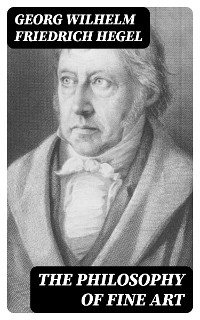
The Philosophy of Fine Art (eBook)
1368 Seiten
DigiCat (Verlag)
859-654740215-2 (EAN)
Georg Wilhelm Friedrich Hegel (1770–1831) is widely acknowledged as a pivotal figure in the history of philosophy, who profoundly influenced subsequent German Idealism and laid the groundwork for many intellectual developments of the 19th and 20th centuries. Born in Stuttgart, Hegel initially studied theology at Tübingen before shifting his focus towards philosophy. His dialectical method, which posits that development occurs through a process of thesis, antithesis, and synthesis, is central to his thought and has shaped a host of philosophical discourses. Hegel held various academic posts, most notably at the University of Berlin from 1818 until his death. One of Hegel's lesser-known but significant works is 'The Philosophy of Fine Art,' in which he delves into his comprehensive aesthetic theory. In this treatise, he argues that art provides a unique way of understanding and expressing the Geist, or Absolute Spirit, which is an essential element in his overarching philosophical system. Hegel's influence is far-reaching, having impacted philosophers, social theorists, and even the Marxist tradition, which adapted his dialectical approach to its materialist philosophy. Despite the complexity of his writings, Hegel's ideas on historical progress, consciousness, and freedom remain central to philosophical inquiry.
| Erscheint lt. Verlag | 13.11.2022 |
|---|---|
| Übersetzer | Francis Plumptre Beresford Osmaston |
| Verlagsort | Prague |
| Sprache | englisch |
| Themenwelt | Kunst / Musik / Theater |
| Geisteswissenschaften ► Philosophie ► Philosophie der Neuzeit | |
| Schlagworte | 12 Rules for Life • 19th-century Philosophy • 19th Century Philosophy • 19th century thought • absolute spirit • Aesthetic analysis • aesthetic philosophy • Aesthetics history • aesthetic theory • Aristotle • artistic evolution • art theory • Art theory analysis • As a Man Thinketh • Classical Aesthetics • Cultural evolution exploration • cultural expression • Dense literary style • Design as Art • Dostoyevsky • fine arts philosophy • German Idealism • God Is With You Every Day • Hegelian aesthetics • Hegel's art philosophy • historical aesthetics • Historical art development • Historical materialism • Human understanding insights • In Praise of Shadows • Meditations • Philosophical aesthetics • philosophy of art • role of art • Romantic critique • Tao Te Ching • The Obstacle Is The Way • truth in art |
| Informationen gemäß Produktsicherheitsverordnung (GPSR) | |
| Haben Sie eine Frage zum Produkt? |
 EPUB (Wasserzeichen)
DRM: Digitales Wasserzeichen
Dieses eBook enthält ein digitales Wasserzeichen und ist damit für Sie personalisiert. Bei einer missbräuchlichen Weitergabe des eBooks an Dritte ist eine Rückverfolgung an die Quelle möglich.
Dateiformat: EPUB (Electronic Publication)
EPUB ist ein offener Standard für eBooks und eignet sich besonders zur Darstellung von Belletristik und Sachbüchern. Der Fließtext wird dynamisch an die Display- und Schriftgröße angepasst. Auch für mobile Lesegeräte ist EPUB daher gut geeignet.
Systemvoraussetzungen:
PC/Mac: Mit einem PC oder Mac können Sie dieses eBook lesen. Sie benötigen dafür die kostenlose Software Adobe Digital Editions.
eReader: Dieses eBook kann mit (fast) allen eBook-Readern gelesen werden. Mit dem amazon-Kindle ist es aber nicht kompatibel.
Smartphone/Tablet: Egal ob Apple oder Android, dieses eBook können Sie lesen. Sie benötigen dafür eine kostenlose App.
Geräteliste und zusätzliche Hinweise
Buying eBooks from abroad
For tax law reasons we can sell eBooks just within Germany and Switzerland. Regrettably we cannot fulfill eBook-orders from other countries.
aus dem Bereich