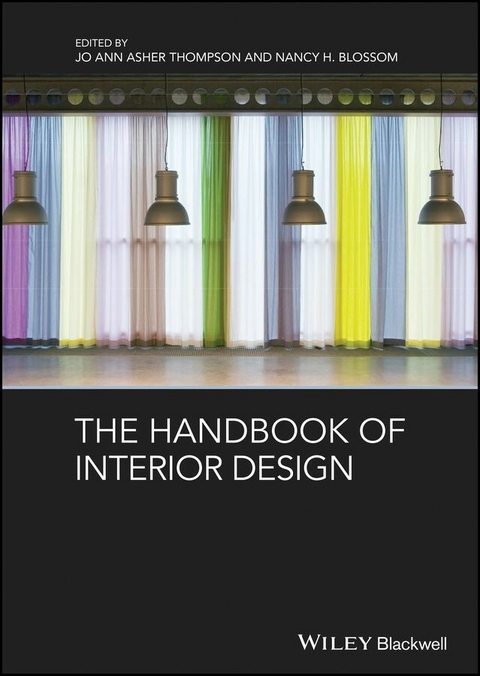
The Handbook of Interior Design (eBook)
John Wiley & Sons (Verlag)
978-1-118-53238-6 (ISBN)
The Handbook of Interior Design explores ways of thinkingthat inform the discipline of interior design. It challengesreaders to consider the connections within theory, research, andpractice and the critical underpinnings that have shaped interiordesign.
- Offers a theory of interior design by moving beyond adescriptive approach to the discipline to a 'why and how' study ofinteriors
- Provides a full overview of the most current Interior Designresearch and scholarly thought from around the world
- Explores examples of research designs and methodologicalapproaches that are applicable to interior design upper divisionand graduate education courses
- Brings together an international team of contributors,including well established scholars alongside emerging voices inthe field – reflecting mature and emergent ideas,research, and philosophies in the field
- Exemplifies where interior design sits in its maturation as adiscipline and profession through inclusion of diverse authors,topics, and ideas
Jo Ann Asher Thompson, Ph.D., is Professor Emeritus ofInterior Design at Washington State University. Thompson served asPresident and Chairman of the Board of the Interior DesignEducators Council (IDEC) and served five years as Editor-in-Chiefof the Journal of Interior Design. She is a recipient of theInternational Interior Design Association’s (IIDA) Educatorof the Year Award. Amongst other publications, Thompson is editorof The ASID Professional Manual (1992).
Nancy Blossom is Professor of Interior Design atWashington State University and served as Director of theInterdisciplinary Design Institute and as the Director of theDoctor of Design Program. Blossom is a Fellow of the InteriorDesign Educators Council and served as the Council’sPresident and Chairman of the Board. In 2010 Blossom joined otherleaders in the field of Interior Design on a panel of experts inreview of the Body of Knowledge (of Interior Design) projectsponsored by professional organizations of the U. S. and Canada.Blossom has served as reviewer of interior design programs inDubai, Saudi Arabia, Canada, and the United States.
JO ANN ASHER THOMPSON is Professor Emeritus of Interior Design at Washington State University. She served as president and chairman of the Board of the Interior Design Educators Council (IDEC) and for five years was editor-in-chief of the Journal of Interior Design. She is a recipient of the International Interior Design Association's (IIDA) Educator of the Year Award. Amongst other publications, Thompson is editor of the ASID Professional Manual (1992). NANCY H. BLOSSOM is Professor Emeritus of Interior Design at Washington State University and served as director of the Interdisciplinary Design Institute and director of the Doctor of Design Program. She is a Fellow of the Interior Design Educators Council and served as the Council's president and chairman of the board. In 2010 she joined other leaders in the field of interior design on a panel of experts in review of the Body of Knowledge (of Interior Design) project sponsored by professional organizations of the United States and Canada.
Notes on Contributors viii
Preface xv
Introduction: The Shaping of Interior Design 1
Section I Explorations of the History of Interior Design 9
1 An Overview of Phenomenology for the Design Disciplines 11
David Wang
2 Dorothy Draper and the American Housewife: A Study of Class Values and Success 29
John C. Turpin
3 The Political Interior 46
Mary Anne Beecher
4 Taylorizing the Modern Interior: Counter-Origins 58
Ronn M. Daniel
5 Bringing the Past In: Narrative Inquiry and the Preservation of Historic Interiors 70
Erin Cunningham
Section II Perspectives on the Practice of Interior Design 95
6 Aesthetic Coding in Interior Design 97
Mads Nygaard Folkmann
7 Toward a Creative Ecology of Workplace Design 112
Margaret Portillo and Jason Meneely
8 Designing Emotional Connection into the Workplace: A Story of Authentic Leadership 128
Sheila Danko
9 Exploring the Schism: Toward an Empathetic Language 148
Shauna Corry Hernandez
10 Ways of Knowing in Design: A Position on the Culture of Interior Design Practice 171
Janice Barnes
11 Sustainable Life-Span Design: A New Model 186
Amber Joplin
12 Frameworks for Decision-Making in Design for the Aging 212
Halime Demirkan
13 Designing More Successful Social Spaces: Lessons Learned from a Continuing Care Retirement Community Study 226
Nichole M. Campbell
14 Developing a Person-Centric Design Philosophy 246
Jill Pable
15 In Support of Contemporary Identity: The Modern Palestinian Home 260
May Sayrafi
16 Creativity in Interior Design: Cross-Cultural Practitioners' Reviews of Entry-Level Portfolios 273
Siriporn Kobnithikulwong
17 Human Responses to Water Elements in Interior Environments: A Culture and Gender Comparison 293
Gwo Fang Lin
18 Concerns with Daylight and Health Outcomes 310
Michael D. Kroelinger
19 Healthy Interiors for the Visually Impaired 327
Dak Kopec
20 Interior People Places: The Impact of the Built Environment on the Third Place Experience 347
Dana Vaux
21 Places in the Virtual and Physical Continuum: Examining the Impact of Virtual Behaviors on Place Attributes of Wireless Coffee Shops 366
Newton D'Souza and Yu Fong Lin
22 The Relationship between Historic Preservation and Sustainability in Interior Design 382
Lisa Tucker
23 Forging Empathetic Connections to Create Compatible Designs in Historic Buildings 393
Jessica Goldsmith
Section III Considerations of Education in Interior Design 415
24 The Phenomenological Contribution to Interior Design Education and Research: Place, Environmental Embodiment, and Architectural Sustenance 417
David Seamon
25 Testing a Culture-Based Design Pedagogy: A Case Study 432
Abimbola O. Asojo
26 Connecting the Scholarship of Teaching and Learning to the Discipline of Interior Design 446
Isil Oygur and Bryan D. Orthel
27 Engaging Voices within a Dynamic Problem-Based Learning Context 465
Tiiu Poldma
28 Aesthetic Theory and Interior Design Pedagogy 478
Ji Young Cho and Benyamin Schwarz
29 Interior Design Teaching and Learning in Elementary and Secondary Education (K-12) 497
Stephanie A. Clemons
30 Community-Building through Interior Design Education 516
Patrick Lucas
31 A Reflective Journey in Teaching Interior Design: The Virtual Studio 524
Kathleen Gibson
Index 538
"The Handbook of Interior Design captures some of
the best thinking available in the field. We are reminded of
the value of design in shaping the human experience and the power
we hold as designers to positively impact society."
Lisa Waxman, Florida State University
"In this important collection of work gathered and
edited by Thompson and Blossom, I am struck by three critical
themes relative to the profession of Interior Design: the
importance of research at both the academic and practice levels
which guides and shapes our creative outcomes; the richness,
diversity and complexity of this 'thing' we call
Interior Design; and the time-honored importance of people
connected to place. Each of these three things lives on its own as
subject matter, but together form the foundation of our
profession. For anyone interested in provoking their
knowledge of Interior Design in the first part of the 21st century,
this is the go-to resource."
Eileen Jones, Perkins + Will
Notes on Contributors
Abimbola O. Asojo, PhD, Associate Professor of Interior Design, University of Minnesota, studied in the US, the UK, and Nigeria. Her research includes cross-cultural design issues, African architecture, computing and design, lighting design, and global design issues. She has published in the Journal of Interior Design, Traditional Dwellings and Settlements Review, Designing for the 21st Century journal, and the Journal of Design Communication.
Janice Barnes, PhD, is the Global Discipline Leader, Principal, Planning+Strategies for the design firm Perkins+Will. With nearly twenty-five years of experience in design practice and research, the focus of Janice's work is on work practices. By bringing practical experience together with empirical research, Janice recognizes the critical aspects of business processes and links these to appropriate organizational responses.
Mary Anne Beecher, PhD, heads the Department of Design at the Ohio State University. She holds a doctoral degree in American studies (with an emphasis in material culture studies) from the University of Iowa, and interior design degrees from Iowa State University. Her research explores the evolution of interior space in the 20th century through the influence of design and culture. She has taught in the United States and Canada.
Nichole M. Campbell, PhD, is an Assistant Professor in Department of Interior Design at the University of Florida. She holds degrees from the University of Wisconsin-Madison, Illinois State University, and DePauw University. Her teaching foci are environment and behavior theory and interior design studio. Current research interests are on the design and construction of buildings that optimize health and wellness, with a particular emphasis on elderly inhabitants and supportive social interaction through the built environment.
Ji Young Cho, PhD, Leed-AP, is an Assistant Professor at the Interior Design Program in the College of Architecture and Environmental Design, Kent State University. She received her PhD in architectural studies from the University of Missouri, Columbia, and Bachelor's and Master's degrees in architecture from the Pusan National University in South Korea. Her research interests include pedagogy of design education, design cognition and process, and environment–behavior relations. As a designer for 10 years, she has completed more than 50 projects in South Korea. In 2008 one of her projects received first place in the Interior Design Educators Council Creative Scholarship category.
Stephanie A. Clemons, PhD, is Professor and Coordinator of the Interior Design Program at Colorado State University. She holds degrees from Colorado State University, Utah State University, and Michigan State University, and is certified by the National Council of Interior Design Qualifications (NCIDQ) as a professional interior designer. Her research interests are K-12 linkages with interior design, third places, and sense of self and place. She has served in several leadership roles including president of the Interior Design Educators Council and president of the American Society of Interior Designers.
Shauna Corry Hernandez, PhD, is an Associate Professor and Chair of the Interior Design Program at the University of Idaho. She received her PhD and MA from Washington State University and has taught at the University of Idaho and North Dakota State University where she served as Interior Design and Facility Management Program Coordinator. She has been with the University of Idaho since 2001, and enjoys teaching history of interiors and design studios. Her research focuses on universal design, social justice issues, and cultural responsibility in design. She has been recognized for her prowess in the classroom as the recipient of the Alumni Awards of Excellence for mentorship and the Hoffman Teaching Excellence Award.
Erin Cunningham, PhD, is an Assistant Professor in the Interior Architecture Program at the University of Oregon. She holds degrees from the University of Florida, the University of Manitoba, and the University of Victoria. Her research focuses on the history and preservation of 19th- and 20th-century interior spaces. Her research interests include social settlement houses, vernacular architecture, and public housing interiors. Erin's current work also explores the development of a social welfare focus in the interior design profession, and the application of narrative methodology to the study of historic spaces. In both her research and teaching, Erin explores interior space from a socio-historical perspective, concentrating on issues of race, gender, and class. She has presented on her research at conferences and the Vernacular Architecture Forum, and recently published “ ‘Renovating an Industry’: The Expanding Role of Interior Design in Times of Recession” in Interiors: Design, Architecture, Culture.
Ronn M. Daniel, M.Arch., is the Interior Design Program Coordinator at James Madison University in Harrisburg, Virginia, where he teaches design theory, design history, and interior design studios. His research explores the intersections between interior space, technological modernization, and social and ideological change in the 20th century.
Sheila Danko, Professor and Chair of the Department of Design and Environmental Analysis at Cornell University, has a multi-disciplinary design background with training in architecture, industrial, graphic, and interior design. Professor Danko has received the honor of being named a J. Thomas Clark Professor of Entrepreneurship for her research entitled Values-Led Entrepreneurship by Design.
Halime Demirkan holds a PhD from the Middle East Technical University in computer-aided architectural design and now serves and the Chairperson and Associate Dean of the Department of Interior Architecture and Environmental Design at Bilkent University, one of Turkey's leading research universities. She is an industrial engineer and experienced as an instructor at the Middle East Technical University and as a researcher at the Scientific and Technical Council of Turkey. Her current research and teaching include design education, universal design, and ergonomics.
Newton D'Souza is a Professor in the Department of Architectural Studies at the University of Missouri, Columbia where he teaches design studio, environment behavior, and design research. He holds a PhD from the University of Wisconsin-Milwaukee and has an academic and practice background as an architect and design researcher in the US, Singapore, and India. Over the past 10 years, intrigued by his own experience as an architect, he has conducted research in design process, learning environments, creativity research, and the use of new media in design education. His current work includes research in the potential of virtual reality for design education and the use of multiple intelligences among architectural designers.
Jessica Goldsmith holds a PhD in design, construction, and planning from the University of Florida. She is an Assistant Professor at Radford University in Valdosta, Georgia, and is certified by the National Council for Interior Design Certification (NCIDQ) as a professional interior designer. Her research focus is on student learning and historic preservation.
Mads Nygaard Folkmann is an Associate Professor in the field of design studies and design culture in the Department of Design and Communication at the University of Southern Denmark. His research interests are design culture, aesthetics, and symbolism in design. His work has been published in Danish and English in journals such as Design Issues and Design and Culture.
Kathleen Gibson is an Associate Professor of Interior Design at Cornell University. She is also the Director of Undergraduate Studies for the Department of Design and Environmental Analysis. Her research focuses on computer-aided design (CAD) where she investigates the effect of digital media on creativity, studio processes, and decision-making. Gibson practices interior design and has achieved national publication and award recognition for her work.
Amber Joplin, D. Des., completed her doctoral degree at the Interdisciplinary Design Institute at Washington State University. Prior to completing her degree she assisted in the WSU GIS and Simulation Lab and participated in research on pedestrian accessibility and public transportation modeling. Her dissertation research involves developing, and testing with GIS, a matrix for sustainable aging that includes individual, social, material support and natural systems.
Siriporn Kobnithikulwong, PhD, serves as Department Chair and Head of the Interior Design Master's Program for the Department of Interior Architecture at the Thammsat University, Thailand. Thammsat is the second-oldest institution of higher education and known as one of the most prestigious universities in Thailand. She holds a Bachelor of Architecture degree in interior architecture from Chulalongkorn University in Bangkok and a Master's of Interior Design from the University of Florida. She was the recipient of an international student academic award for her doctoral work at the University of Florida.
Dak Kopec, PhD, holds a doctorate in environmental psychology with a concentration in perception and design and two Master's degrees, one in architecture and another in community psychology. He is currently an Assistant Professor at Radford University, and has served twice as a visiting lecturer at...
| Erscheint lt. Verlag | 9.2.2015 |
|---|---|
| Sprache | englisch |
| Themenwelt | Kunst / Musik / Theater ► Design / Innenarchitektur / Mode |
| Technik ► Architektur | |
| Schlagworte | Architecture • Architektur • Art & Applied Arts • Art History & Criticism • Design-Geschichte u. -Theorie • Design History & Theory • design theory, design research, design practice, art history, art theory, criticism, architecture, design pedagogy, design history, phenomenology, design philosophy, sustainability, design education, aesthetic theory • Innenarchitektur • Interior design • Kunstgeschichte u. -kritik • Kunst u. Angewandte Kunst |
| ISBN-10 | 1-118-53238-4 / 1118532384 |
| ISBN-13 | 978-1-118-53238-6 / 9781118532386 |
| Informationen gemäß Produktsicherheitsverordnung (GPSR) | |
| Haben Sie eine Frage zum Produkt? |
 EPUB (Adobe DRM)
Kopierschutz: Adobe-DRM
Adobe-DRM ist ein Kopierschutz, der das eBook vor Mißbrauch schützen soll. Dabei wird das eBook bereits beim Download auf Ihre persönliche Adobe-ID autorisiert. Lesen können Sie das eBook dann nur auf den Geräten, welche ebenfalls auf Ihre Adobe-ID registriert sind.
Details zum Adobe-DRM
Dateiformat: EPUB (Electronic Publication)
EPUB ist ein offener Standard für eBooks und eignet sich besonders zur Darstellung von Belletristik und Sachbüchern. Der Fließtext wird dynamisch an die Display- und Schriftgröße angepasst. Auch für mobile Lesegeräte ist EPUB daher gut geeignet.
Systemvoraussetzungen:
PC/Mac: Mit einem PC oder Mac können Sie dieses eBook lesen. Sie benötigen eine
eReader: Dieses eBook kann mit (fast) allen eBook-Readern gelesen werden. Mit dem amazon-Kindle ist es aber nicht kompatibel.
Smartphone/Tablet: Egal ob Apple oder Android, dieses eBook können Sie lesen. Sie benötigen eine
Geräteliste und zusätzliche Hinweise
Buying eBooks from abroad
For tax law reasons we can sell eBooks just within Germany and Switzerland. Regrettably we cannot fulfill eBook-orders from other countries.
aus dem Bereich