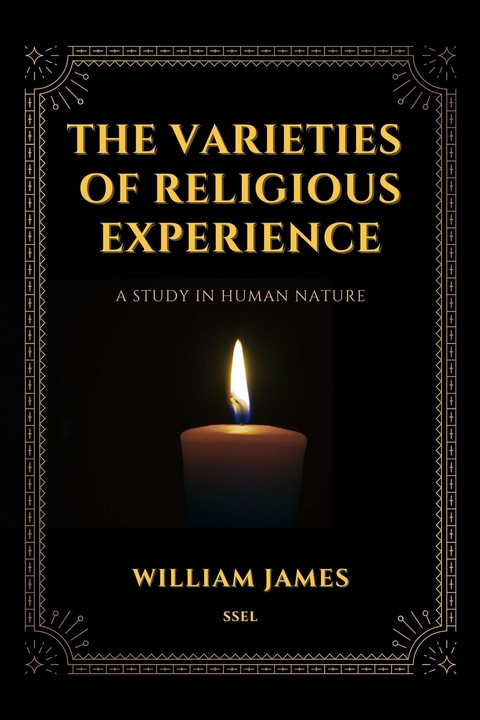
The Varieties of Religious Experience (eBook)
640 Seiten
Ssel (Verlag)
979-10-299-1277-1 (ISBN)
William James was an American philosopher, historian, and psychologist, and the first educator to offer a psychology course in the United States.
William James was an American philosopher, historian, and psychologist, and the first educator to offer a psychology course in the United States.
Lectures 4 & 5: The Religion Of Healthy-Mindedness
1 C. Hilty: Gluck, dritter Theil, 1900, p. 18.
2 The Soul; its Sorrows and its Aspirations, 3d edition, 1852, pp. 89, 91
3 Starbuck: Psychology of Religion, pp. 305, 306
4 "I know not to what physical laws philosophers will some day refer the feelings of melancholy. For myself, I find that they are the most voluptuous of all sensations," writes Saint Pierre, and accordingly he devotes a series of sections of his work on Nature to the Plaisirs de la Ruine, Plaisirs des Tombeaux, Ruines de la Nature, Plaisirs de la Solitude—each of them more optimistic than the last.
This finding of a luxury in woe is very common during adolescence. The truth-telling Marie Bashkirtseff expresses it well:—
"In his depression and dreadful uninterrupted suffering, I don't condemn life. On the contrary, I like it and find it good. Can you believe it? I find everything good and pleasant, even my tears, my grief. I enjoy weeping, I enjoy my despair. I enjoy being exasperated and sad. I feel as if these were so many diversions, and I love life in spite of them all. I want to live on. It would be cruel to have me die when I am so accommodating.
I cry, I grieve, and at the same time I am pleased—no, not exactly that—I know not how to express it. But everything in life pleases me. I find everything agreeable, and in the very midst of my prayers for happiness, I find myself happy at being miserable. It is not I who undergo all this—my body weeps and cries; but something inside of me which is above me is glad of it all." Journal de Marie Bashkirtseff, i. 67
5 R. M. Bucke: Cosmic consciousness, pp. 182-186, abridged.
6 Song of Myself, 32
7 Iliad, XXI., E. Myers's translation
8 "God is afraid of me!" remarked such a titanic-optimistic friend in my presence one morning when he was feeling particularly hearty and cannibalistic. The defiance of the phrase showed that a Christian education in humility still rankled in his breast.
9 "As I go on in this life, day by day, I become more of a bewildered child; I cannot get used to this world, to procreation, to heredity, to sight, to hearing, the commonest things are a burthen. The prim, obliterated, polite surface of life, and the broad, bawdy and orgiastic—or maenadic—foundations, form a spectacle to which no habit reconciles me. R. L. Stevenson: Letters, ii. 355.
10 "Cautionary Verses for Children": this title of a much used work, published early in the nineteenth century, shows how far the muse of evangelical protestantism in England, with her mind fixed on the idea of danger, had at last drifted away from the original gospel freedom. Mind-cure might be briefly called a reaction against all that religion of chronic anxiety which marked the earlier part of our century in the evangelical circles of England and America.
11 I refer to Mr. Horatio W. Dresser and Mr. Henry Wood, especially the former. Mr. Dresser's works are published by G. P. Putnam's Sons, New York and London; Mr. Wood's by Lee & Shepard Boston.
12 Lest my own testimony be suspected, I will quote another reporter, Dr. H. H. Goddard, of Clark University, whose thesis on "the Effects of Mind on Body as evidenced by Faith Cures" is published in the American Journal of Psychology for 1899 (vol. x.). This critic, after a wide study of the facts, concludes that the cures by mind-cure exist, but are in no respect different from those now officially recognized in medicine as cures by suggestion; and the end of his essay contains an interesting physiological speculation as to the way in which the suggestive ideas may work (p. 67 of the reprint). As regards the general phenomenon of mental cure itself, Dr. Goddard writes: "In spite of the severe criticism we have made of reports of cure, there still remains a vast amount of material, showing a powerful influence of the mind in disease. Many cases are of diseases that have been diagnosed and treated by the best physicians of the country, or which prominent hospitals have tried their hand at curing, but without success. People of culture and education have been treated by this method with satisfactory results. Diseases of long standing have been ameliorated, and even cured… . We have traced the mental element through primitive medicine and folk-medicine of to-day, patent medicine, and witchcraft. We are convinced that it is impossible to account for the existence of these practices, if they did not cure disease, and that if they cured disease, it must have been the mental element that was effective. The same argument applies to those modern schools of mental therapeutics— Divine Healing and Christian Science. It is hardly conceivable that the large body of intelligent people who comprise the body known distinctively as Mental Scientists should continue to exist if the whole thing were a delusion. It is not a thing of a day; it is not confined to a few; it is not local. It is true that many failures are recorded, but that only adds to the argument. There must be many and striking successes to counterbalance the failures, otherwise the failures would have ended the delusion… . Christian Science, Divine Healing, or Mental Science do not, and never can in the very nature of things, cure all diseases; nevertheless, the practical applications of the general principles of the broadest mental science will tend to prevent disease… . We do find sufficient evidence to convince us that the proper reform in mental attitude would relieve many a sufferer of ills that the ordinary physician cannot touch; would even delay the approach of death to many a victim beyond the power of absolute cure, and the faithful adherence to a truer philosophy of life will keep many a man well, and give the doctor time to devote to alleviating ills that are unpreventable" (pp. 33, 34 of reprint).
13 Horace Fletcher: Happiness as found in Forethought Minus Fearthought, Menticulture Series, ii. Chicago and New York, Stone. 1897, pp. 21-25, abridged
14 H. W. Dresser: Voices of Freedom, New York, 1899, p. 38
15 Henry Wood: Ideal Suggestion through Mental Photography. Boston, 1899, p. 54
16 Whether it differs so much from Christ's own notion is for the exegetists to decide. According to Harnack, Jesus felt about evil and disease much as our mind-curers do. "What is the answer which Jesus sends to John the Baptist?" asks Harnack, and says it is this: "'The blind see, and the lame walk, the lepers are cleansed, and the deaf hear, the dead rise up, and the gospel is preached to the poor.' That is the 'coming of the kingdom,' or rather in these saving works the kingdom is already there. By the overcoming and removal of misery, of need, of sickness, by these actual effects John is to see that the new time has arrived. The casting out of devils is only a part of this work of redemption, but Jesus points to that as the sense and seal of his mission. Thus to the wretched, sick, and poor did he address himself, but not as a moralist, and without a trace of sentimentalism. He never makes groups and departments of the ills, he never spends time in asking whether the sick one 'deserves' to be cured; and it never occurs to him to sympathize with the pain or the death. He nowhere says that sickness is a beneficent infliction, and that evil has a healthy use. No, he calls sickness sickness and health health. All evil, all wretchedness, is for him something dreadful; it is of the great kingdom of Satan; but he feels the power of the saviour within him. He knows that advance is possible only when weakness is overcome, when sickness is made well." Das Wesen des Christenthums, 1900, p. 39.
17 R. W. Trine: In Tune with the Infinite, 26th thousand, N.Y. 1899. I have strung scattered passages together.
18 The Cairds, for example. In Edward Caird's Glasgow Lectures of 1890-92 passages like this abound:—
"The declaration made in the beginning of the ministry of Jesus that 'the time is fulfilled, and the kingdom of heaven is at hand,' passes with scarce a break into the announcement that 'the kingdom of God is among you'; and the importance of this announcement is asserted to be such that it makes, so to speak, a difference IN KIND between the greatest saints and prophets who...
| Erscheint lt. Verlag | 7.8.2021 |
|---|---|
| Verlagsort | Vachendorf |
| Sprache | englisch |
| Themenwelt | Kinder- / Jugendbuch ► Sachbücher ► Religion / Philosophie / Psychologie |
| Schlagworte | divine • feelings • Mysticism • Prayer • Psychology of religion • Religious Philosophy |
| ISBN-13 | 979-10-299-1277-1 / 9791029912771 |
| Informationen gemäß Produktsicherheitsverordnung (GPSR) | |
| Haben Sie eine Frage zum Produkt? |
 EPUB (Wasserzeichen)
DRM: Digitales Wasserzeichen
Dieses eBook enthält ein digitales Wasserzeichen und ist damit für Sie personalisiert. Bei einer missbräuchlichen Weitergabe des eBooks an Dritte ist eine Rückverfolgung an die Quelle möglich.
Dateiformat: EPUB (Electronic Publication)
EPUB ist ein offener Standard für eBooks und eignet sich besonders zur Darstellung von Belletristik und Sachbüchern. Der Fließtext wird dynamisch an die Display- und Schriftgröße angepasst. Auch für mobile Lesegeräte ist EPUB daher gut geeignet.
Systemvoraussetzungen:
PC/Mac: Mit einem PC oder Mac können Sie dieses eBook lesen. Sie benötigen dafür die kostenlose Software Adobe Digital Editions.
eReader: Dieses eBook kann mit (fast) allen eBook-Readern gelesen werden. Mit dem amazon-Kindle ist es aber nicht kompatibel.
Smartphone/Tablet: Egal ob Apple oder Android, dieses eBook können Sie lesen. Sie benötigen dafür eine kostenlose App.
Geräteliste und zusätzliche Hinweise
Buying eBooks from abroad
For tax law reasons we can sell eBooks just within Germany and Switzerland. Regrettably we cannot fulfill eBook-orders from other countries.
aus dem Bereich