Zum Hauptinhalt springen
Nicht aus der Schweiz? Besuchen Sie lehmanns.de
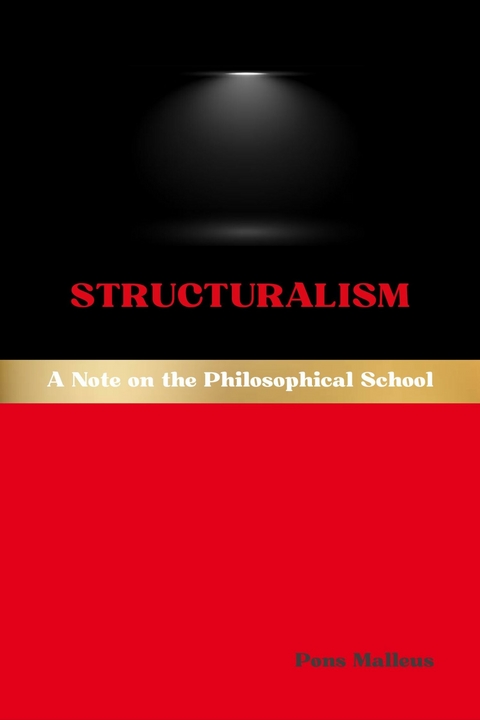
Structuralism -  Pons Malleus

Structuralism (eBook)

A Note on the Philosophical School

(Autor)

eBook Download: EPUB
2025 | 1. Auflage
106 Seiten
Publishdrive (Verlag)
978-0-00-110151-7 (ISBN)
Systemvoraussetzungen
5,99 inkl. MwSt
(CHF 5,85)
Der eBook-Verkauf erfolgt durch die Lehmanns Media GmbH (Berlin) zum Preis in Euro inkl. MwSt.
  • Download sofort lieferbar
  • Zahlungsarten anzeigen

This book is an exploration into one of the most influential, yet often misunderstood, movements in 20th-century philosophy and human sciences: structuralism. Born from the crossroads of linguistics, anthropology, psychoanalysis, and literary theory, structuralism is less a rigid doctrine than a mode of inquiry-a way of seeing the world that privileges systems, relationships, and structures over isolated elements. Its central premise is deceptively simple: the meanings we assign to things, ideas, and experiences do not arise from their intrinsic nature, but from their position within a larger system. Whether that system is language, myth, culture, or society, structuralism urges us to shift our focus from the individual unit to the network of relations that make that unit intelligible.


This shift has far-reaching consequences. It compels us to reconsider what it means to understand a text, a ritual, or even a self. It challenges the romantic ideal of the autonomous subject, calling into question the notion of individual creativity or originality as the ultimate source of meaning. It proposes that human thought itself is shaped-and perhaps constrained-by the deep structures that underlie culture and language. Structuralism, in this way, is both a method and a worldview. It is a lens through which we can interpret the complexity of human life, not by tracing origins or intentions, but by revealing the hidden architectures that organize experience.


The roots of structuralism are most often traced to the work of Swiss linguist Ferdinand de Saussure, who revolutionized the study of language by proposing that meaning arises not from a direct relationship between words and things, but from the differential relations between signs within a system. This insight would be adopted and expanded by thinkers such as Claude Lévi-Strauss in anthropology, Roland Barthes in literary theory, Jacques Lacan in psychoanalysis, and Michel Foucault in epistemology. Each of these figures, in their own domain, demonstrated how human phenomena-be they kinship systems, narratives, unconscious desires, or systems of knowledge-could be understood as structured wholes governed by underlying rules and oppositions.


Yet structuralism is not without its critics. From its very inception, it sparked debates about determinism, agency, and the possibility of change. The rise of post-structuralism in the late 20th century marked both a continuation and a critique of structuralist thought, emphasizing instability, multiplicity, and the limits of totalizing systems. Still, many of the questions raised by structuralism remain vital today. In an era of big data, algorithmic logic, and global networks, structuralist approaches offer valuable tools for interpreting complex systems and patterns that shape contemporary life.


This book does not aim to be an exhaustive history of structuralism, nor does it present a unified theory. Instead, it offers a guided tour through its central concepts, thinkers, and debates. Each chapter focuses on a key domain-language, culture, mind, literature, and power-showing how structuralist methods have reshaped our understanding of each. Along the way, the reader will encounter both foundational texts and critical reassessments, encouraging a balanced view of structuralism's legacy.


Ultimately, this book is intended for readers curious about how we make meaning and how that meaning is structured-by language, by culture, by unconscious processes, and by systems larger than ourselves. Structuralism asks us to see the familiar in unfamiliar ways, to find order where we assumed chaos, and to question the givenness of the world around us. In that spirit, this preface serves not as a conclusion, but as an invitation: to think structurally, to read deeply, and to see what lies beneath the surface.

Evolution of Structuralist Thought
Early Precursors:
The roots of structuralist thought can be traced back to several early precursors that laid the foundation for its emergence. One of the key philosophical and intellectual influences that predated structuralism is the work of Wilhelm Wundt, who is considered the father of experimental psychology and is renowned for his pioneering efforts in the establishment of psychology as a formal discipline. Wundt's emphasis on introspection and the study of consciousness helped shape the conceptual framework within which structuralism would later evolve.
Another influential precursor to structuralism is the work of Ferdinand de Saussure, whose groundbreaking contributions to linguistics provided a rich reservoir of ideas and methodologies for the structuralist movement. Saussure's distinction between langue (language structure) and parole (actual language use) formed the basis for structuralist analyses that sought to uncover fundamental linguistic structures underlying surface expressions. His ideas sparked a paradigm shift in linguistic theory and set the stage for the application of structuralist principles across diverse disciplines.
The philosophical underpinnings of structuralism can be linked to the rationalist tradition, which emphasized the importance of systemic organization and the search for universal principles governing phenomena. Rationalist thinkers such as René Descartes, Baruch Spinoza, and Gottfried Wilhelm Leibniz articulated views that prioritized the systematic analysis of knowledge and sought to discover underlying structures beneath the surface manifestations of reality. Their contributions laid the groundwork for the structuralist pursuit of uncovering hidden patterns and deep structures in various domains of inquiry.
The holistic perspective espoused by anthropological pioneers like Franz Boas and Émile Durkheim also played a pivotal role in shaping the intellectual landscape from which structuralism emerged. Boas's cultural relativism and Durkheim's focus on social structures offered valuable insights into the interconnectedness of elements within a system, setting the stage for the structuralist endeavor to map out the relational networks and underlying configurations in different domains of study.
The Influence of Linguistics:
In understanding the influence of linguistics on the foundations of structuralism, it is crucial to delve into the groundbreaking work of Ferdinand de Saussure. Saussure's pioneering ideas, articulated in his seminal work 'Course in General Linguistics', laid the groundwork for the structuralist approach. His distinction between langue (language system) and parole (actual language use) fostered the notion that the structure of language governs its functioning and meaning. This emphasis on systematic structures within language formed the nexus for broader application in fields such as anthropology, literary theory, and psychology. Additionally, Saussure's concept of the signifier and signified led to a reevaluation of how meaning is constructed within a system, planting the seeds for a structural understanding of meaning and representation. Moreover, the structuralist focus on binary oppositions, drawn from Saussure's analysis of language, became a pivotal tool in uncovering underlying relationships and hierarchies in various cultural phenomena. The application of linguistic principles to non-linguistic systems illustrated the profound impact of this field on shaping structuralist methodologies. Beyond Saussure, the extension of linguistic theories by Roman Jakobson and the Prague School further bolstered the influence of linguistics on structuralism. Jakobson's structuralist approach to phonology and morphology expanded the applicability of structuralist principles beyond semantics and syntax, reinforcing the concept of underlying structures governing diverse domains.
Emergence in the Early 20th Century:
The burgeoning insights into linguistics and anthropology, coupled with the burgeoning theoretical frameworks in mathematics and biology, set the stage for the birth of structuralism. In the wake of World War I, there was a palpable sense of disillusionment with traditional modes of thinking, leading many scholars and thinkers to seek alternative paradigms that could better account for the complexities of human existence. It is within this socio-intellectual milieu that structuralism gained traction, offering a promising methodology for comprehending the underlying structures and patterns that govern human behavior, language, and culture.
The early 20th century witnessed a confluence of ideas from diverse fields, coalescing to form the intellectual landscape upon which structuralism would flourish. Fueled by advancements in fields such as psychology, sociology, and philosophy, structuralism's foundational principles took root in the works of pioneering figures like Ferdinand de Saussure, Roman Jakobson, and Emile Durkheim. These luminaries laid the groundwork for the interdisciplinary nature of structuralist thought, with each contributing unique perspectives that enriched the evolving discourse. Moreover, the nascent stages of structuralism saw a deliberate engagement with the intersectionality of disciplines, as scholars increasingly recognized the interconnectedness of various domains and sought to identify overarching structures inherent to human expression and society.
The early 20th century bore witness to the rise of transnational intellectual exchanges, enabling the dissemination of structuralist ideas beyond their country of origin. This facilitated the cross-pollination of concepts and theories, engendering a cosmopolitan approach to structuralism that transcended geographical boundaries. As a result, structuralism underwent a process of acculturation and enrichment, drawing upon diverse cultural and intellectual traditions to construct a more holistic framework for understanding the fabric of human experience.
Structuralism and the Social Sciences:
Structuralism provided a framework for understanding complex social structures and systems, emphasizing the interconnectedness of elements within these systems. This approach was especially influential in disciplines such as anthropology, sociology, and psychology, where scholars sought to uncover underlying patterns and structures in human behavior and society.
In anthropology, structuralism offered a new lens through which to examine cultural practices and rituals. Pioneering anthropologist Claude Lévi-Strauss applied structuralist principles to study kinship systems, mythologies, and symbolic meanings in various societies, highlighting the underlying structures that governed these cultural phenomena. By identifying recurring patterns and universal structures, Lévi-Strauss aimed to reveal the fundamental principles governing human cultural expressions.
Similarly, in sociology, structuralism contributed to the analysis of social institutions, power relations, and social hierarchies. Scholars like Pierre Bourdieu utilized structuralist perspectives to explore the ways in which social structures shape and constrain individuals' behaviors and opportunities. By focusing on the underlying structures of society, sociologists attempted to uncover the mechanisms that perpetuate inequality, class divisions, and social stratification.
The influence of structuralism extended into the field of psychology, particularly in the work of Jean Piaget. Piaget's theory of cognitive development drew heavily from structuralist frameworks, emphasizing the role of mental structures in shaping human cognition and intelligence. Piaget proposed that children construct and adapt their cognitive structures as they interact with their environment, highlighting the formative impact of internal mental structures on the process of learning and intellectual growth.
Beyond these specific disciplines, the insights of structuralism have had a broader impact on interdisciplinary studies, fostering cross-disciplinary collaborations and integrative approaches to understanding complex social phenomena. The emphasis on uncovering underlying structures and patterns has led to fruitful exchanges between fields such as linguistics, anthropology, sociology, and psychology, enriching the discourse on human society and culture.
Seminal Figures:
Structuralism owes much of its development and refinement to the contributions of several seminal figures whose work has left an indelible mark on the landscape of structuralist thought. One of the foremost figures in structuralist thought is Ferdinand de Saussure, whose groundbreaking work in linguistics laid the foundations for structuralist analysis. Saussure's distinction between langue (the underlying structure of language) and parole (actual speech) revolutionized linguistic theory and provided a framework for understanding language as a system of signs with relational meanings. His focus on the inherent structure and synchronic analysis of language set the stage for structuralist approaches across diverse fields.
Another luminary in the realm of structuralism is Claude Lévi-Strauss, whose contributions to anthropology and cultural studies have had a profound impact. Lévi-Strauss' structuralist perspective emphasized the study of universal patterns and underlying structures in human societies, challenging conventional anthropological paradigms and offering a new lens through which to interpret cultural phenomena. His structuralist approach to kinship systems, myths, and rituals not only redefined anthropology but also influenced fields such as literary theory and semiotics.
In the domain of literature and literary theory, Roland Barthes...

Erscheint lt. Verlag 12.11.2025
Sprache englisch
Themenwelt Geisteswissenschaften
ISBN-10 0-00-110151-X / 000110151X
ISBN-13 978-0-00-110151-7 / 9780001101517
Informationen gemäß Produktsicherheitsverordnung (GPSR)
Haben Sie eine Frage zum Produkt?
EPUBEPUB (Adobe DRM)
Größe: 112 KB

Kopierschutz: Adobe-DRM
Adobe-DRM ist ein Kopierschutz, der das eBook vor Mißbrauch schützen soll. Dabei wird das eBook bereits beim Download auf Ihre persönliche Adobe-ID autorisiert. Lesen können Sie das eBook dann nur auf den Geräten, welche ebenfalls auf Ihre Adobe-ID registriert sind.
Details zum Adobe-DRM

Dateiformat: EPUB (Electronic Publication)
EPUB ist ein offener Standard für eBooks und eignet sich besonders zur Darstellung von Belle­tristik und Sach­büchern. Der Fließ­text wird dynamisch an die Display- und Schrift­größe ange­passt. Auch für mobile Lese­geräte ist EPUB daher gut geeignet.

Systemvoraussetzungen:
PC/Mac: Mit einem PC oder Mac können Sie dieses eBook lesen. Sie benötigen eine Adobe-ID und die Software Adobe Digital Editions (kostenlos). Von der Benutzung der OverDrive Media Console raten wir Ihnen ab. Erfahrungsgemäß treten hier gehäuft Probleme mit dem Adobe DRM auf.
eReader: Dieses eBook kann mit (fast) allen eBook-Readern gelesen werden. Mit dem amazon-Kindle ist es aber nicht kompatibel.
Smartphone/Tablet: Egal ob Apple oder Android, dieses eBook können Sie lesen. Sie benötigen eine Adobe-ID sowie eine kostenlose App.
Geräteliste und zusätzliche Hinweise

Buying eBooks from abroad
For tax law reasons we can sell eBooks just within Germany and Switzerland. Regrettably we cannot fulfill eBook-orders from other countries.

Mehr entdecken
aus dem Bereich
Strategien und Hilfen für die Alltagsbewältigung

von Roberto D' Amelio; Wolfgang Retz …

eBook Download (2024)
Kohlhammer Verlag
CHF 25,35